"60 Billion Won Invested in Discounting Agricultural, Livestock, and Marine Products in March-April"
"Fines for Violations of Adjustment Standards on Academy and Tuition Fees"
Choi Sang-mok, Deputy Prime Minister for Economic Affairs and Minister of Strategy and Finance, recently pressured the industry by stating that the recent decline in international grain prices has not been properly reflected in food prices, urging, "When prices fall, they should be properly lowered by the amount of the decline." He also announced that 60 billion won will be invested in discounts on agricultural, livestock, and fishery products in March and April.
On the 6th, during the 'Price-related Ministers' Meeting' held at the Government Seoul Office, Deputy Prime Minister Choi said, "Although international grain prices have fallen by about half compared to the peak in 2022, there are criticisms that this has not been properly reflected in food prices such as flour and cooking oil, causing high inflation."
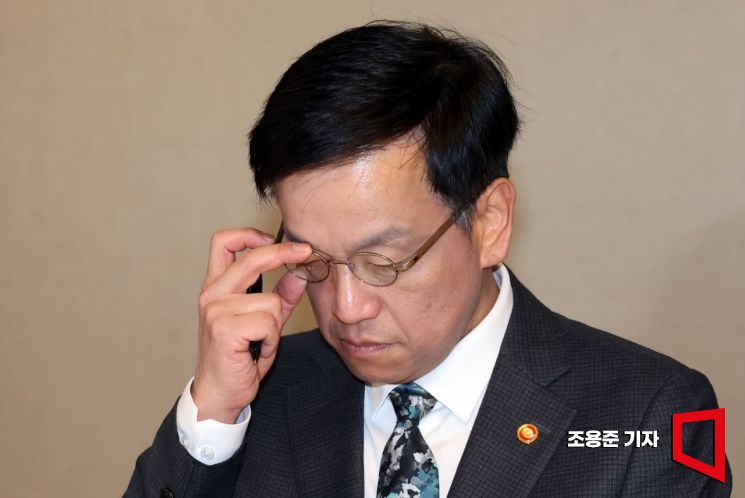 Choe Sang-mok, Deputy Prime Minister for Economic Affairs and Minister of Economy and Finance, is touching his glasses after delivering opening remarks at the Price-Related Ministers' Meeting held on the 6th at the Government Seoul Office in Jongno-gu, Seoul. Photo by Jo Yong-jun jun21@
Deputy Prime Minister Choi stated, "If prices were raised due to an increase in raw material costs, then when prices fall, they must be lowered promptly and properly by the amount of the decline for the public to accept it as reasonable business practice." He added, "In particular, since the government has decided to further extend the tariff reduction measures on major food raw materials, which were supported during the period of raw material price surges, even as raw material prices have fallen this year, we request the industry to actively participate in alleviating the burden on the public."
According to the February Consumer Price Trends report by Statistics Korea on the same day, consumer prices in February increased by 3.1%. This marks a rise back to the 3% range just one month after falling to the 2% range in January. Notably, the fresh food index, which includes fruits and vegetables, rose by 20%, with fresh fruits experiencing the largest increase in 35 years. Apples, in particular, rose by 71% compared to the same period last year.
Deputy Prime Minister Choi said, "We take the recent price situation seriously and will make every effort to stabilize inflation in the 2% range as soon as possible." He added, "We will invest a record-high 60 billion won in discount support for agricultural, livestock, and fishery products in March and April to reduce the perceived prices of major food items such as apples and pears by up to 40-50%."
Additionally, the Korea Agro-Fisheries & Food Trade Corporation (aT) will directly import major fruits such as oranges and bananas to supply them to the market at affordable prices. They will also apply additional tariff reductions on three types of imported fruits. Starting today, an emergency supply stabilization task force will be immediately activated to monitor daily trends by item.
Efforts will also be made to crack down on petroleum and service prices. Deputy Prime Minister Choi said, "For unstable items such as petroleum and services, each ministry will conduct on-site inspections to spread a price stabilization atmosphere." He added, "The pan-government petroleum market inspection team visits gas stations nationwide every week to check prices to prevent illegal or opportunistic price hikes in petroleum products. Regarding private academy fees, strict measures such as fines will be imposed if local governments' tuition adjustment standards are violated."
© The Asia Business Daily(www.asiae.co.kr). All rights reserved.
![Clutching a Stolen Dior Bag, Saying "I Hate Being Poor but Real"... The Grotesque Con of a "Human Knockoff" [Slate]](https://cwcontent.asiae.co.kr/asiaresize/183/2026021902243444107_1771435474.jpg)















