Mushroom Found Growing on the Side of a Wild Frog
A Type of Aejureum Mushroom... Seems Influenced by Surrounding Environment
A mushroom growing on a frog's body has been discovered, attracting attention. This is the first time that the phenomenon of a mushroom growing on the tissue of a living animal has been observed.
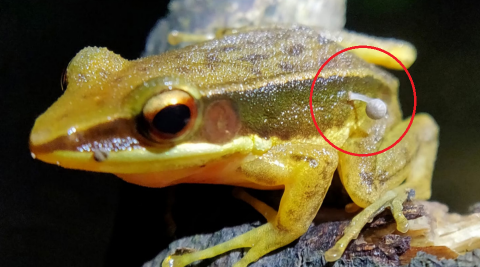
On the 29th of last month (local time), major foreign media reported that researchers from the World Wildlife Fund (WWIF) found a frog with a mushroom growing on its side in a pond in Karnataka, southwestern India. The frog in question is the 'Rao's Intermediate Golden-backed Frog,' discovered in June last year, characterized by its golden hue.
Photos released by the research team show a white, cotton swab-shaped mushroom growing on the side of the frog's body. When the frog was discovered, the researchers captured several instances of the frog turning its body or moving, but the mushroom did not fall off and remained attached to the frog's body.
The mushroom was identified as a species of 'Mycena,' a type of fungus. Mycena mushrooms are small saprophytic mushrooms that rarely exceed a few centimeters in width, with over 500 species known. Some are known to be toxic, but due to their small size, most have an unknown edibility status. It was previously known that Mycena fungi generally obtain nutrients from decaying wood, but this study revealed that they can also grow on the skin of living animals.
Alisa Wetterau Kagener, a researcher at Cornell University's College of Veterinary Medicine, said, "Fungi easily adapt to environmental changes, and when exposed to new potential hosts in various environments, they can grow in unexpected places." She added, "Healthy frogs are unlikely to be adversely affected and can tolerate light skin colonization (dense microbial community formation) by this fungus." However, she also expressed concern, saying, "If the fungus grows extensively on the skin or penetrates the body, signs of disease may appear."
Sonali Greg, a herpetologist at Harvard University's Museum of Comparative Zoology, remarked, "During the monsoon season when the researchers found the frog, mushrooms grow abundantly on the forest floor," and expressed amazement, saying, "The warm and humid environment, combined with the dew-covered skin of the frog, creates perfect conditions for mushroom growth."
Fortunately, it has been confirmed that this mushroom does not cause significant harm to the frog. There were no noticeable injuries on the frog's body. The research team plans to study the frog further to gain deeper insights into the phenomenon of mushrooms growing on animal tissue.
© The Asia Business Daily(www.asiae.co.kr). All rights reserved.

















