Sales Decline Concerns for Surgical Drugs Including IV Fluids and Anesthetics
"In-Hospital Drug Supply Reduced by 20% for Anticancer Injections"
Temporary Reflex Benefits Seen in Chronic Drug Prescriptions at Local Clinics
The fallout from the medical school quota increase crisis is spreading to the pharmaceutical industry. This is because the resignation of residents has caused a medical vacuum in training hospitals nationwide, leading to a decline in demand for pharmaceuticals.
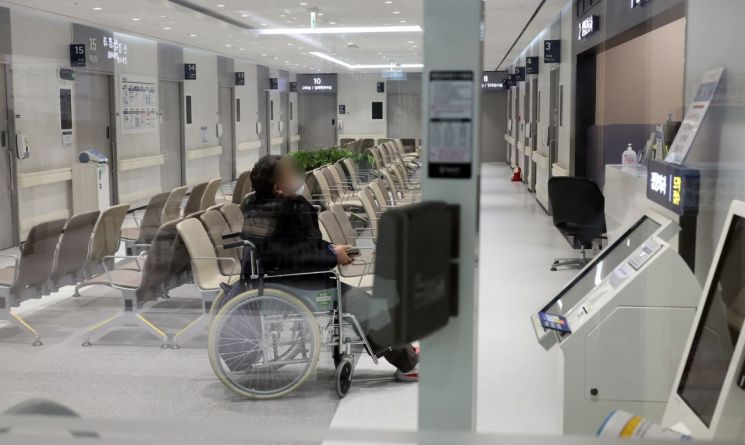 On the 15th, a patient waiting for medical treatment visited a university hospital in Seoul as medical associations opposed the government's plan to increase the number of medical students and announced simultaneous rallies across the country. Photo by Jo Yongjun jun21@
According to the Ministry of Health and Welfare on the 6th, nearly 9,000 residents have left from 100 major training hospitals nationwide. This number exceeds 90% of all residents in those hospitals. Surgeries and chemotherapy treatments have already dropped to less than half of the usual volume. As a result, sales of related pharmaceuticals and surgical devices have begun to plummet.
The hardest hit are pharmaceuticals related to surgery. Representative examples include intravenous fluids, anesthetics, hemostatic agents, and narcotic analgesics. Among 781 reports of damages caused by collective medical actions filed last month, surgery delays accounted for the largest number at 256 cases. Intravenous fluids have large volumes and incur high logistics costs for storage and transportation, so when surgeries are canceled and inventory accumulates, the burden on manufacturers is much greater than for other dosage forms like tablets. Manufacturers and sellers of anesthetics, hemostatic agents, and narcotic analgesics are often pharmaceutical companies with product portfolios concentrated in these items, raising concerns that the impact of sales declines due to the medical vacuum will be severe.

In-hospital prescription drugs have also begun to be affected. The industry currently anticipates a maximum sales decline of about 20% for prescription drugs, with in-hospital drugs expected to see a decrease of about one-third. A sales representative for a foreign pharmaceutical company's anticancer drugs said, "The supply of anticancer injectables, mainly supplied to top-tier hospitals in Seoul, has already started to decrease," adding, "Since these are high-priced items, prolonged situations will cause significant damage to sales."
The pharmaceutical distribution industry, which acts as a link between pharmaceutical companies and pharmacies/hospitals, is already showing direct effects. Hospitals are seeing fewer patients, and pharmacies are reducing orders due to inventory management issues, making them the first to be affected. A pharmaceutical wholesaler said, "Since the 2000 pharmaceutical separation strike, similar situations have occurred during every strike," and added, "Currently, there is about a 20% decrease in supply according to the figures." Another industry insider said, "Hospitals are discharging patients quickly even immediately after surgery," and "Supply is significantly decreasing, especially for in-hospital prescriptions."
Some predict that chronic disease product groups may experience short-term boosts. For example, if hospitals extend the prescription interval for hypertension medication from one month to two or three months to reduce outpatient visits, sales could temporarily increase. It is also analyzed that mild chronic disease patients who used to visit hospital-level institutions may shift to local clinics, increasing sales at primary medical institutions. A cardiovascular pharmaceutical sales representative said, "If the medical vacuum prolongs, chronic disease medications will be prescribed for longer periods," and "Oral chronic disease drugs may benefit indirectly." However, the industry believes that since this is merely shifting resources, long-term performance will not differ significantly.
Not only pharmaceuticals but also the surgical medical supplies industry has begun to feel the impact as orders decrease. The CEO of company S, which supplies consumable medical devices related to spinal and joint surgery to three of the 'Big 5' hospitals, said, "We can endure for a month or two, but if surgery suspensions exceed three months, we cannot sustain the company." A representative from a surgical treatment company said, "Surgeries are decreasing simultaneously across general hospitals nationwide, causing immediate damage," and added, "We plan to wait for recovery by increasing supply to small and medium hospitals that originally had no residents."
Jung Yoon-taek, director of the Pharmaceutical Industry Strategy Research Institute, expressed concern, saying, "The impact on related industries will vary depending on how long the resident resignation crisis continues," and "If the situation prolongs, delays in new drug development through clinical trials may occur, weakening the competitiveness of the domestic pharmaceutical industry itself."
© The Asia Business Daily(www.asiae.co.kr). All rights reserved.
![Clutching a Stolen Dior Bag, Saying "I Hate Being Poor but Real"... The Grotesque Con of a "Human Knockoff" [Slate]](https://cwcontent.asiae.co.kr/asiaresize/183/2026021902243444107_1771435474.jpg)

















