UNIST Professor Junwoo Jeong's Team Proposes Theory of Asymmetric Motion in Symmetric Objects
Supports Micro Robot Design... Published in Nature Communications
A new form of motion principle enabling objects in the microscopic world to move has been discovered for the first time. This research result can be applied in various fields, such as creating tiny robots.
UNIST (President Yong-Hoon Lee) announced on the 5th that Professor Junwoo Jeong's team from the Department of Physics discovered that objects can move in one direction simply by periodically changing their size within a material called liquid crystal. They also presented a theoretical model explaining the cause of this phenomenon.
Symmetrical spherical air bubbles expand or contract uniformly in all directions, so their centers cannot move. However, air bubbles inside liquid crystals exhibited different movements.
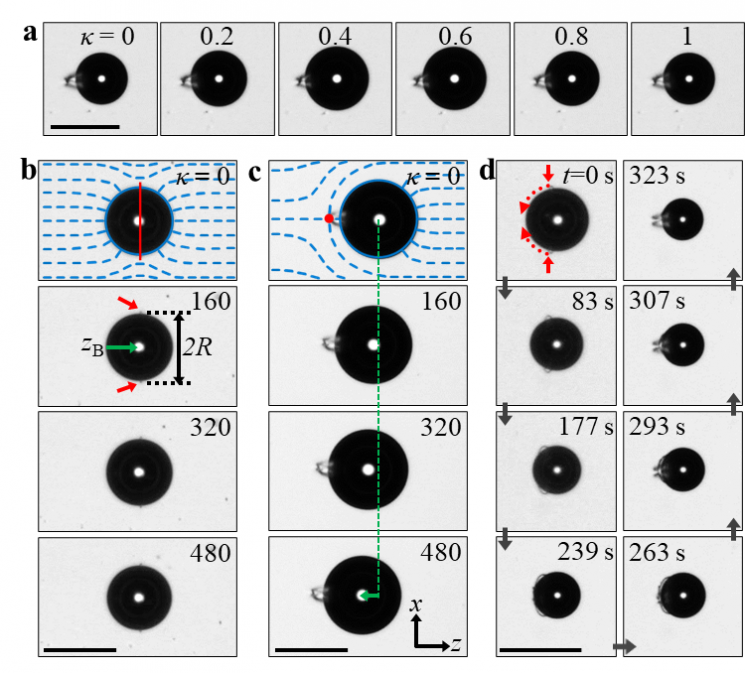
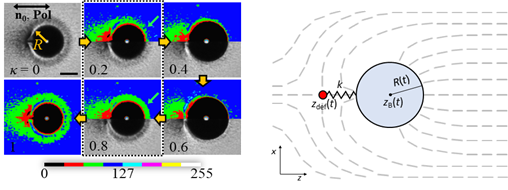
According to the research, liquid crystals, widely used in various displays, flow like liquids but have an ordered structure like solids. The research team placed air bubbles about the thickness of a hair’s diameter into the liquid crystal and controlled the pressure.
They periodically changed the size of the air bubbles, similar to inflating and deflating a balloon. When the size of the air bubbles changed, they moved in one direction as if defying the laws of physics. This contrasts with water, where size changes do not allow movement in one direction.
The research team provided a physical explanation for this phenomenon. Liquid crystals distort their structure next to the air bubbles, creating a special structure called a topological defect. Since the defect forms only on one side of the air bubble, the bubble can experience a greater force in one direction despite its symmetrical shape.
The size-changing bubble pushes or pulls the liquid crystal, disturbing its structure. This causes different magnitudes of force to be transmitted to the bubble when it expands and contracts. As the bubble repeatedly grows and shrinks, it moves in one direction.
 (From left) First author Researcher Kim Seong-jo, Professor Jeong Jun-woo, Research Professor Eom Yu-jin.
First author Researcher Sungjo Kim explained, “This is the first observation that a symmetrical object can move in one direction simply by repeating symmetrical movements.”
Researcher Kim added, “The same principle could be applied to various complex fluids beyond liquid crystals.”
Professor Junwoo Jeong said, “This interesting result shows that breaking spatiotemporal symmetry plays a significant role in motion at the microscopic scale,” and added, “It will also be useful for research on creating tiny robots.”
This research was published online on February 9 in the internationally renowned journal Nature Communications.
The research was supported by the Ministry of Science and ICT, the National Research Foundation of Korea, the Institute for Basic Science, and the Slovenian Research Agency.
© The Asia Business Daily(www.asiae.co.kr). All rights reserved.
![Clutching a Stolen Dior Bag, Saying "I Hate Being Poor but Real"... The Grotesque Con of a "Human Knockoff" [Slate]](https://cwcontent.asiae.co.kr/asiaresize/183/2026021902243444107_1771435474.jpg)

















