As conflicts between the government and the medical community over the expansion of medical school quotas continue, the business and medical sectors in Gyeongnam held a joint press conference to voice their concerns.
At the press conference held on the 4th at the Gyeongnam Provincial Government Press Center, attendees included Choi Jae-ho, Chairman of the Changwon Chamber of Commerce and Industry, Kim Min-gwan, President-elect of the Gyeongsangnam-do Medical Association, Hwang Soo-hyun, Director of Changwon Gyeongsang National University Hospital, and Park Sung-jin, Chairman of the Gyeongnam Dental Association.
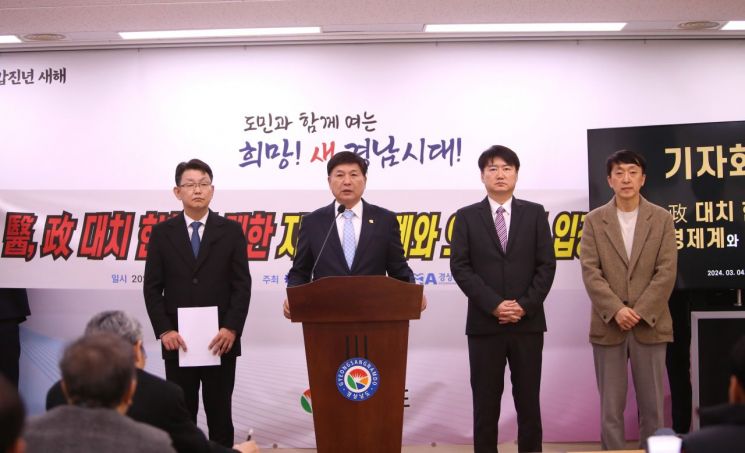 Choi Jae-ho, Chairman of the Changwon Chamber of Commerce and Industry (second from left), Kim Min-gwan, President-elect of the Gyeongsangnam-do Medical Association (third from left), Hwang Soo-hyun, Director of Changwon Gyeongsang National University Hospital (far left), and Park Sung-jin, President of the Gyeongnam Dental Association (far right), are making a statement regarding the conflict between the government and the medical community over the expansion of medical school quotas.
 [Photo by Lee Se-ryeong]
First, Choi Jae-ho, Chairman of the Changwon Chamber of Commerce and Industry, who took the stage, pointed out, “This is the time for the government and the medical community to join forces to resolve regional medical imbalances, not to emphasize their own arguments and cause division.”
He stated, “Due to the intense confrontation between the government and the medical community, a medical vacuum has emerged, causing essential medical systems such as pediatrics, obstetrics and gynecology, and emergency surgery to begin collapsing in the region. Residents are suffering from the pain of having to invest double the time and cost due to open-run and medical tourism.”
He continued, “On behalf of 2,200 member companies of the Changwon Chamber of Commerce and Industry, I strongly appeal that the current claims of the government and the medical community cannot take precedence over the life rights and safety of local residents.”
“Please alleviate the anxiety caused by the current medical vacuum through prompt dialogue and understanding,” he requested. “Strengthen the regional medical system by expanding the deployment of specialists, enhancing medical facilities by region, and implementing education and incentive policies for medical personnel.”
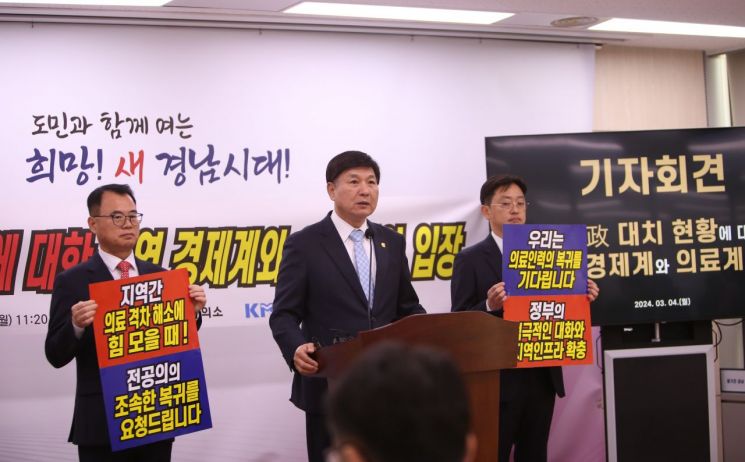 Choi Jae-ho, Chairman of the Changwon Chamber of Commerce and Industry, is expressing the local economic sector's position on the conflict between the government and the medical community over the expansion of medical school quotas.
 [Photo by Lee Se-ryeong]
Chairman Choi urged, “Various measures such as the introduction of a regional doctor system and changes in medical fees should be carefully discussed. Policies should not be implemented by applying the same standards to the metropolitan area and regions, but rather tailored to the region, such as providing benefits to county-level areas.”
He added, “I support the central and local governments and the medical community engaging in magnanimous dialogue and making decisions to restore the medical system to normal and find ways to eliminate medical disparities between regions.”
Kim Min-gwan, President-elect of the Gyeongsangnam-do Medical Association, said, “The collective actions such as the submission of resignation letters by residents are not a fight to protect doctors’ interests.” He asked, “Please take a moment to listen to why doctors, who value patients’ lives and health above all, are acting this way.”
Kim explained, “The government diagnosed the cause of the nurse’s death from cerebral hemorrhage at Seoul Asan Hospital last year as a shortage of doctors. However, doctors diagnose it not simply as a shortage of doctors but as a shortage of essential medical doctors, and they argue that unreasonable systems or policies must be improved first so that essential medical doctors can work with conviction.”
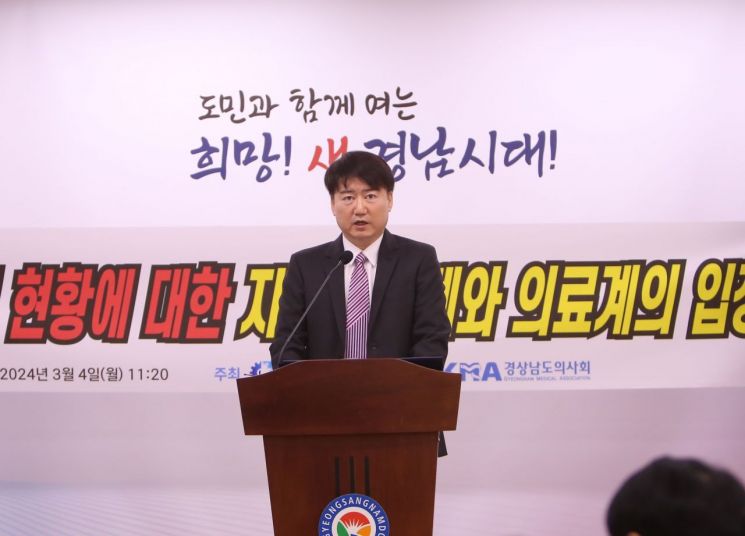 Kim Min-gwan, the president-elect of the Gyeongnam Medical Association, is speaking about the government's policy to increase the number of medical school admissions.
 [Photo by Lee Se-ryeong]
He also said, “No matter how many doctors are increased, if the doctors produced do not choose essential medical fields, it is useless. A sudden large-scale increase leads to poor medical school education and resident training, making it difficult to produce competent doctors responsible for essential medical care.”
“A rapid increase in the number of doctors will lead to a surge in total national medical expenses, causing the health insurance finances to collapse and resulting in health insurance premium hikes,” he criticized. “The Korean medical system, which currently provides the world’s best medical benefits at the fastest speed and lowest cost, will be shaken to its core.”
He proposed, “Even if the number of doctors is increased immediately, I suggest first increasing only a few dozen and monitoring whether those increased doctors dedicate themselves to essential medical care and remain in the region.” He added, “Even if a regional doctor system is introduced immediately, there is no guarantee that doctors will work evenly in all areas of the province such as Geochang and Hapcheon, so it is difficult to consider it a definite solution.”
Kim stated, “Among the 140,000 doctors in Korea, about 8,000 residents’ resignations have brought the medical system to the brink of paralysis. We need to identify where the system, which barely functions thanks to residents who work over 80 hours a week at minimum wage sacrificing their youth, has gone wrong and change the fundamental causes.”
He also expressed, “I sincerely apologize for causing anxiety and inconvenience to the residents of Gyeongnam due to the current situation.” He pledged, “We will maintain a close cooperative system and communication with local governments to resolve the current situation quickly and do our best to protect the health of the residents without disruption.”
© The Asia Business Daily(www.asiae.co.kr). All rights reserved.
![Clutching a Stolen Dior Bag, Saying "I Hate Being Poor but Real"... The Grotesque Con of a "Human Knockoff" [Slate]](https://cwcontent.asiae.co.kr/asiaresize/183/2026021902243444107_1771435474.jpg)













