Plenary Session Reshaped 8 to 5: Moderate-Conservative vs Progressive
Former Judge: "Issue Lies in Recommendation and Appointment, Not Supreme Court Justice's Inclination"
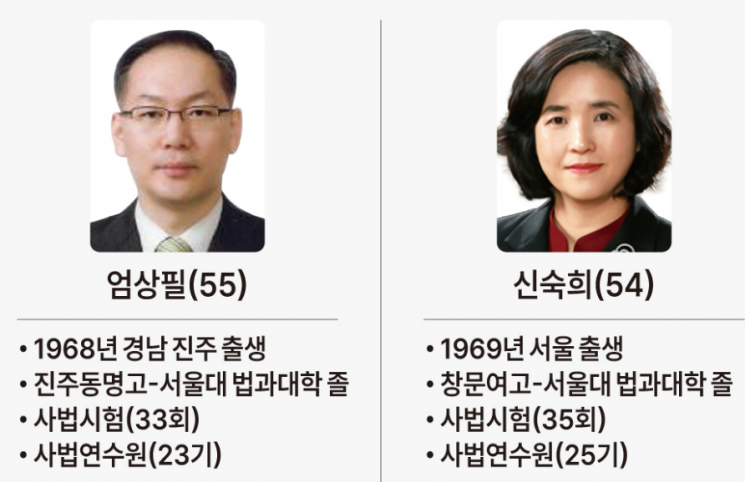 Profiles of Eom Sang-pil and Shin Sook-hee, Supreme Court Justices inaugurated on the 4th. Graphic by Kim Min-ji, Yonhap News.
The appointment of Supreme Court Justices Eom Sang-pil (55, Judicial Research and Training Institute class 23) and Shin Sook-hee (54, class 25), both regarded as having a 'moderate' stance, on the 4th has drawn legal circles' attention to how the shift in the Supreme Court's landscape will concretely affect rulings.
Justices Eom and Shin were appointed as successors to former Justices Ahn Cheol-sang and Min Yoo-sook, who retired after completing their terms in January. Former Justices Ahn and Min were classified as 'moderate' and 'progressive,' respectively.
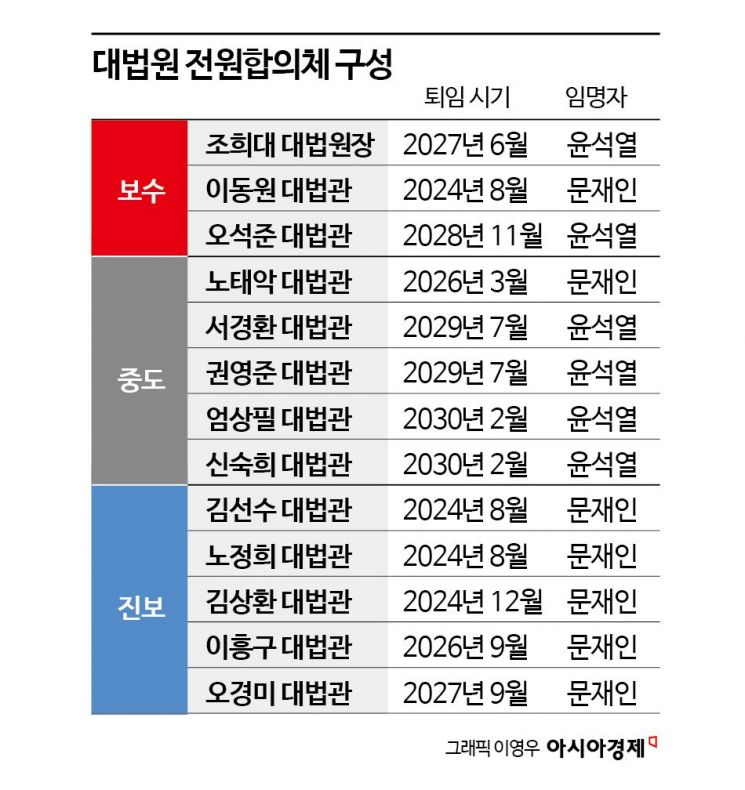
Among the 14 justices, Justice Chun Dae-yeop, who serves as the Chief of the Court Administration Office, does not participate in the full bench. Justice Kim Sang-hwan, who had been the Chief of the Court Administration Office since May 2021, stepped down from the position in January and rejoined the full bench.
Of the 13 justices forming the full bench, Chief Justice Cho Hee-dae and Justices Lee Dong-won and Oh Seok-jun are classified as 'conservative,' Justices Noh Tae-ak, Seo Kyung-hwan, and Kwon Young-joon as 'moderate,' and Justices Kim Sun-soo, Noh Jung-hee, Kim Sang-hwan, Lee Heung-gu, and Oh Kyung-mi as 'progressive.'
With the inauguration of Justices Eom and Shin, the ratio of moderate/conservative to progressive justices in the full bench has been reorganized to 8 to 5, strengthening the moderate/conservative stance from the previous 7 (moderate/conservative) to 6 (progressive).
Legal circles widely anticipate a clear shift in the Supreme Court's direction, similar to the era under Chief Justice Kim Myung-soo, when progressive rulings in labor and industrial sectors were prevalent due to the numerical majority of progressive justices. Furthermore, with the terms of progressive Justices Kim Sun-soo and Kim Sang-hwan expiring in August and December respectively, and their successors being appointed, it is expected that the Supreme Court's moderate/conservative stance will deepen.
The Court Organization Act stipulates that the Supreme Court's principle is to deliberate and rule in a full bench. Although exceptions allowing rulings in smaller panels are broadly permitted, important cases that may change existing Supreme Court views or involve constitutional review of orders and regulations are often referred to the full bench, making the justices' stances inevitably significant.
Article 7, Paragraph 1 of the Court Organization Act (Exercise of Jurisdiction) states, "The Supreme Court's jurisdiction shall be exercised by a panel consisting of at least two-thirds of all justices, with the Chief Justice presiding. However, if a panel of three or more justices first deliberates on a case and reaches a unanimous opinion, the panel may adjudicate the case except in the following instances."
Items 1 through 4 enumerate cases that must be adjudicated by the full bench, including ▲when an order or regulation is deemed unconstitutional ▲when an order or regulation is deemed unlawful ▲when it is necessary to change previous Supreme Court interpretations or applications of the constitution, laws, orders, or regulations ▲when it is deemed inappropriate for the panel to adjudicate.
Currently, the Supreme Court has several labor and industrial cases under close watch, such as lawsuits filed by the Metalworkers' Union demanding recognition of collective bargaining rights for subcontractor unions against the primary contractor Hyundai Heavy Industries, and cases related to ordinary wages.
Meanwhile, there is considerable skepticism inside and outside the judiciary about categorizing justices as conservative or progressive based on a few specific rulings.
A former chief judge turned attorney said, "Defining a justice's stance with one or two frames among many factors can cause misunderstandings from different perspectives. For example, Justice Shin is completely 'progressive' on women's issues, but from my long observation, she holds a neutral position on labor issues."
He added, "Neutrality in the court means its role is to stabilize and maintain the system. While outsiders might label it as 'moderate/conservative,' I am not sure what it means to classify Justice Shin as 'moderate' or 'conservative.'"
He pointed out that justices hold different positions across various fields, so labeling them as either progressive or conservative and quantifying the overall stance of the Supreme Court is problematic.
The attorney also questioned the assessment that many progressive labor rulings were issued under former Chief Justice Kim Myung-soo's administration.
He said, "For instance, a ruling that grants the employer one more benefit than currently existing could be called a 'conservative ruling,' but if the result benefits workers by five, is that ruling conservative or progressive? It would be more accurate to call it a labor-friendly ruling contrasting with a corporate-friendly stance rather than a progressive ruling."
Furthermore, he emphasized that the issue is not the justices' stances but that candidates who do not meet the required qualifications are recommended and appointed as justices in the first place.
The attorney stated, "The problem is whether the Supreme Court is perfectly composed of judges with at least the minimum basic competence to perform the role of a justice. Since the president's appointment of justices requires the consent of the National Assembly and the recommendation of the Chief Justice, the three institutions should maintain checks and balances in appointing justices."
He explained, "Assuming there are 200 judges or attorneys who meet the age and experience requirements to be included in the pool of justice candidates, only about 20 of them can actually perform the role of a justice. If justices are appointed from that category of 20 qualified individuals, it is not a big problem even if there are somewhat more progressive or conservative justices in specific fields like labor or taxation."
He continued, "However, the problem arises when, depending on who becomes president or Chief Justice, someone ranked 180th is recommended and appointed as a justice because they seem to think alike or will favor their side. The court needs systemic improvements to properly establish itself."
© The Asia Business Daily(www.asiae.co.kr). All rights reserved.
![Clutching a Stolen Dior Bag, Saying "I Hate Being Poor but Real"... The Grotesque Con of a "Human Knockoff" [Slate]](https://cwcontent.asiae.co.kr/asiaresize/183/2026021902243444107_1771435474.jpg)
















