'4-Day Workweek Network' Launched, Political Debate
Is Expanding Rest Without Wage Cuts Possible?
High Support but Calls for Caution Considering Business Realities

Kim Young-ah (43), an 11-year employee working at the online data company 'Hunet,' has been working only four days a week since last year. This is because the company proactively introduced a four-day workweek, allowing all employees to have Fridays off every week.
Hunet piloted the four-day workweek in June last year and officially implemented the system starting in July. Although there were concerns that productivity might decline due to fewer working days, the company successfully established the system by reducing unnecessary meetings and increasing work concentration. The introduction of the four-day workweek has significantly changed Kim's daily life. She uses Fridays to catch up on overdue bank errands and medical appointments and spends time with her child, who entered middle school this year.
Kim said, "Since the four-day workweek was introduced without using annual leave or cutting wages, the employee response has been generally positive. I strongly feel that for the four-day workweek to be maintained, the company must do well, and I must work hard. It seems that employees are working with more responsibility than before."
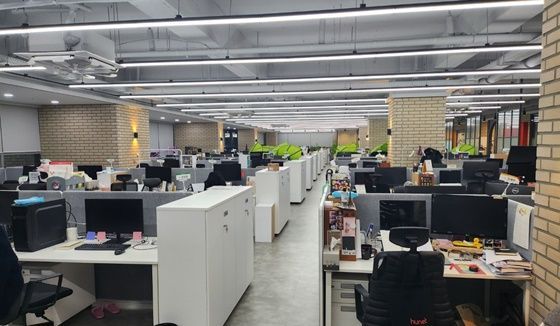 On Friday morning, the office of the online data company 'Hunet' located in Guro-gu, Seoul, was completely empty.
 [Photo by Hunet]
'Four-Day Workweek Network' Launched... Civic Groups and Political Circles Begin Discussions
Voices calling for discussions on the introduction of a four-day workweek are emerging mainly from civil society and political circles ahead of the general election. On the 29th of last month, the 'Four-Day Workweek Network' for realizing the four-day workweek held its launch ceremony in front of the National Assembly in Yeouido, Seoul. Attendees proposed making the legalization of the four-day workweek, the establishment and implementation of a government roadmap for reducing working hours, and the installation and operation of a National Working Hours Committee as pledges for the 22nd National Assembly election. The Four-Day Workweek Network includes labor groups such as the Federation of Korean Trade Unions, civic organizations like the Union Center, and research organizations such as the Working Citizens Research Institute.
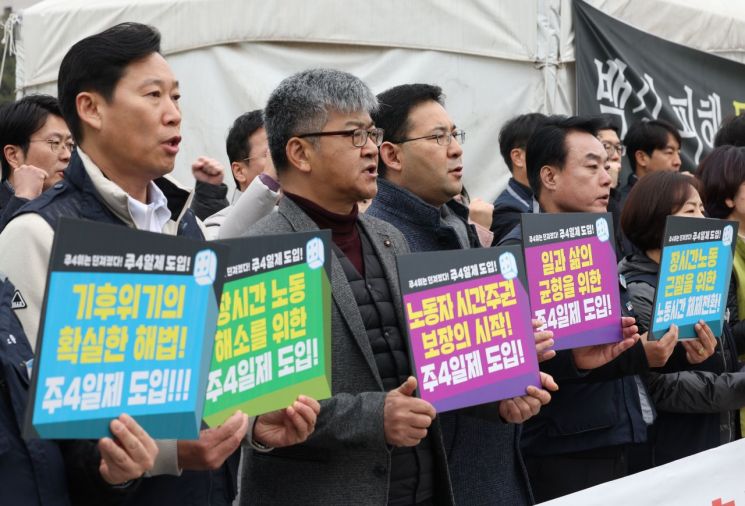 On the morning of the 29th of last month, participants shouted slogans at the "Joint Press Conference for the Launch of the 4-Day Workweek Network" held in front of the National Assembly in Seoul. [Image source=Yonhap News]
In particular, the formation of a policy advisory group composed of academic experts in labor law and social policy has signaled the start of serious discussions. The advisory group includes Kwon Hye-won, a public interest member of the Economic, Social and Labor Council under the President and a professor in the Department of Business Administration at Dongduk Women's University, and Lee Jeong-hee, a senior researcher at the Korea Labor Institute, a government-funded research institute. Although there have been consistent opinions sympathetic to the purpose of the four-day workweek, the formation of such a large-scale organization for discussion is the first in 20 years since the implementation of the five-day workweek in 2004.
A representative of the Four-Day Workweek Network said, "The significance of launching this organization lies not in immediately implementing the four-day workweek but in intensifying discussions. Using this as a stepping stone, we will legalize the introduction of the four-day workweek to escape the overwork society and realize a society where work and life can be harmonized."
Discussions in the political sphere are also becoming active. On the 28th of last month, Lee Jae-myung, leader of the Democratic Party of Korea, held a 'Working Professionals Policy Meeting' and announced plans to introduce a 'four-and-a-half-day workweek' as a stepping stone to the four-day workweek, aiming to reduce working hours to below the OECD average by 2030. He also added that minimum rest times would be introduced to set daily working hour limits and that the prohibition of the comprehensive wage system would be codified in the Labor Standards Act.
The Key is 'No Wage Cuts' Rest... "Long-Term Experiment Needed"
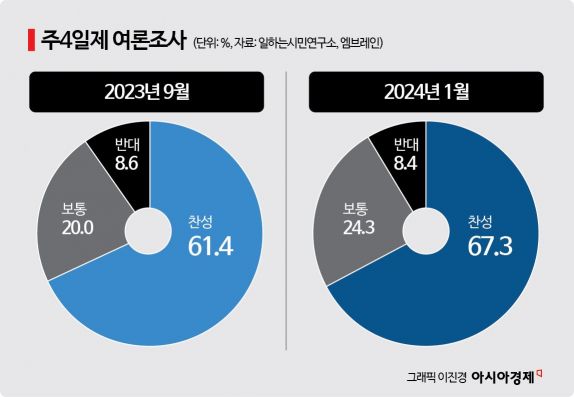
Public opinion on the four-day workweek is generally positive, but challenges are expected before it can be fully legalized. Some companies find it difficult to adopt the four-day workweek depending on their characteristics, and if it leads to wage cuts, it could deepen the polarization of working conditions between companies.
The four-day workweek is a system where, in addition to weekends, one more day from Monday to Friday is given off. The idea is that if workers rest one more day, their work efficiency will improve, leading to an overall increase in corporate productivity. Currently, some advanced countries such as the United States, Europe, and Japan are piloting and operating this system.
The problem is that there could be 'blind spots' where it is practically difficult to introduce the four-day workweek, such as in traditional manufacturing industries. Some production workers still maintain competitiveness through long working hours and low wages, so taking even one more day off could cause greater damage to companies in these sectors than in others. There is also an opinion that the improvement in individual workers' efficiency and productivity due to rest may not be relatively significant.
In fact, companies piloting the four-day workweek in Korea are limited to a few, including Samsung, SK Hynix, Woowa Brothers (Baedal Minjok), and Kakao. Samsung and SK Hynix give employees one Friday off per month, while Woowa Brothers and POSCO give Fridays off every other week.
Another issue is that the introduction of the four-day workweek could lead to wage cuts. In companies that cannot afford it, wage cuts may be inevitable as a means to reduce labor costs, which could lead to a decline in workers' quality of life and widen wage gaps between companies. There is also a possibility of side effects such as companies reducing employment.
Experts suggest that the four-day workweek should be experimented with and evaluated from a long-term perspective rather than as a 'general election gimmick.' Park Joo-young, a professor in the Department of Venture and Small Business at Soongsil University, said, "IT companies or startups with high added value can significantly increase individual workers' productivity through rest, but it is difficult to expect such results in traditional manufacturing industries. Rather than advocating the four-day workweek as a 'flashy' election promise, we need to start experimenting with its effects across various company sizes and industries now."
© The Asia Business Daily(www.asiae.co.kr). All rights reserved.
![Clutching a Stolen Dior Bag, Saying "I Hate Being Poor but Real"... The Grotesque Con of a "Human Knockoff" [Slate]](https://cwcontent.asiae.co.kr/asiaresize/183/2026021902243444107_1771435474.jpg)


















