Major Activist Funds Propose 'Board Improvement' Through Shareholder Proposals
Corporate Value-Up Programs and National Pension Also Demand Board Reform
As the regular shareholder meeting season approaches this year, shareholder proposals from activist funds and the stewardship code (action guidelines) direction of pension funds are emphasizing 'board independence.' This is interpreted as a growing societal will for reform of the so-called 'rubber-stamp boards,' which have long been cited as the main cause of the Korea discount (undervaluation of the Korean stock market).

According to the financial investment industry on the 6th, major activist funds such as Truston Asset Management, Cha Partners Asset Management, and Align Partners Asset Management have presented board reform as the main agenda item through shareholder proposals ahead of this year’s regular shareholder meetings. Instead of simultaneous shareholder proposals and campaigns, the strategy focuses on strengthening board independence to bring about more visible and fundamental changes.
Cha Partners recommended Kim Kyung-ho, chairman of the KB Financial Group board, as an outside director candidate to become an audit committee member through a shareholder proposal to Kumho Petrochemical. Cha Partners is an activist fund delegated shareholder proposal rights by Park Cheol-wan, former executive director and nephew of Park Chan-gu, chairman of Kumho Petrochemical, who is the largest individual shareholder (9.1% stake) of Kumho Petrochemical. Cha Partners explained that Kim is recommended because he has professional experience as an outside director, including serving as chairman of the audit committee at Citibank Korea and Shinhan Investment Corp., and possesses accounting expertise. Cha Partners pointed out that currently, among the 10 seats on the Kumho Petrochemical board, there is not a single director who can represent the rights of common shareholders.
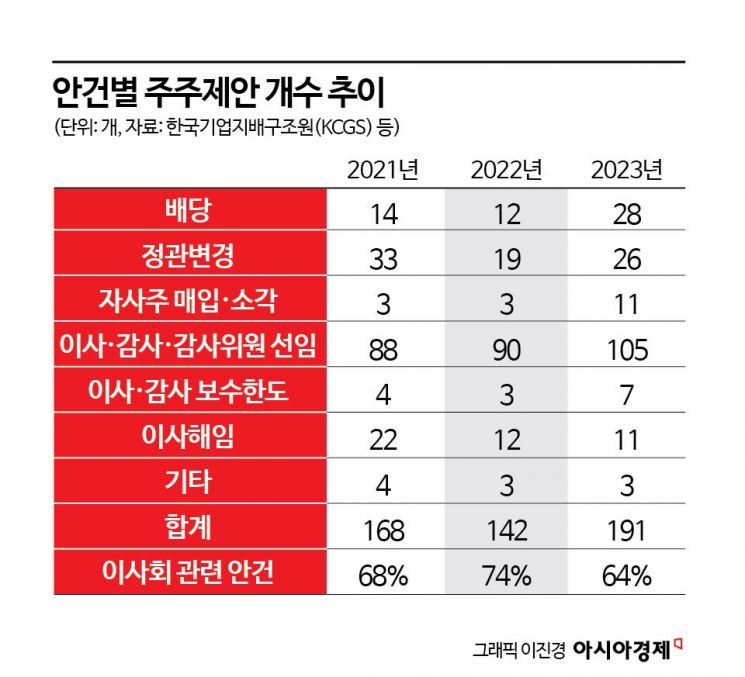
Truston Asset Management also demanded the appointment of an outside director to the audit committee at Taekwang Industrial. Unlike last year, when they proposed improvements to share buyback and dividend policies, this year they are focusing solely on the director appointment agenda, concentrating on 'board reform.' Rather than going to a vote battle, Truston plans to build consensus with the controlling shareholders and board members on the candidates they propose through the Taekwang Industrial board meeting held before the shareholder meeting. Lee Sang-hyun, CEO of Flashlight Capital Partners (FCP), directly ran as an outside director candidate for KT&G. Align Partners also proposed five director candidates and a board expansion agenda to JB Financial Group. These will be finalized through voting at the shareholder meeting.
The movement by these activist funds to strengthen board independence is gaining momentum in conjunction with corporate value-up programs and the stewardship code activities of pension funds. Recently, Kim Tae-hyun, chairman of the National Pension Service, criticized the independence of the POSCO Holdings board. He raised concerns after the board showed no significant changes and tried to continue their terms despite insufficient explanations or clarifications regarding the outside directors’ overseas trips.
Chairman Kim stated, "There are doubts about whether past outside director activities were truly independent, especially amid controversies over a lavish board during my tenure," and criticized, "It is questionable how the board and related committees’ re-nomination of outside director candidates without sufficient explanation or clarification contributes to enhancing shareholder value."
Board reform that can represent not only controlling shareholders but all shareholders is considered a long-standing task for value enhancement in the domestic stock market. The government recently defined the board as the 'highest decision-making body for practical corporate management' in its 'Corporate Value-Up Support Plan for the Leap of the Korean Stock Market' and announced that guidelines will specify the board’s responsible role.
An asset management industry official said, "Simply having various outside directors enter the board to secure board independence will help reflect shareholders’ voices and increase corporate value."
© The Asia Business Daily(www.asiae.co.kr). All rights reserved.
![Clutching a Stolen Dior Bag, Saying "I Hate Being Poor but Real"... The Grotesque Con of a "Human Knockoff" [Slate]](https://cwcontent.asiae.co.kr/asiaresize/183/2026021902243444107_1771435474.jpg)
















