The National Assembly's Special Committee on Political Reform passed a redistricting plan on the 29th that reduces one proportional representation seat and maintains 10 seats in the Jeonbuk electoral district.
On the afternoon of the same day, the ruling and opposition parties held a full meeting of the Special Committee on Political Reform and approved the redistricting plan containing these details. Of the 16 members present, 14 voted in favor and 2 opposed, resulting in final approval.
The ruling and opposition parties agreed to reduce the number of proportional representation seats from the existing 47 to 46, while maintaining 10 seats in the Jeonbuk electoral district. Previously, the redistricting committee's proposal included reducing Jeonbuk's seats from 10 to 9. Thus, for the 22nd general election, the number of district seats was adjusted to 254 and proportional seats to 46.
The number of National Assembly members by city and province is as follows: △Seoul 48 seats △Busan 18 seats △Daegu 12 seats △Incheon 14 seats △Gwangju 8 seats △Daejeon 7 seats △Ulsan 6 seats △Sejong 2 seats △Gyeonggi 60 seats △Gangwon 8 seats △Chungbuk 8 seats △Chungnam 11 seats △Jeonbuk 10 seats △Jeonnam 10 seats △Gyeongbuk 13 seats △Gyeongnam 16 seats △Jeju 3 seats.
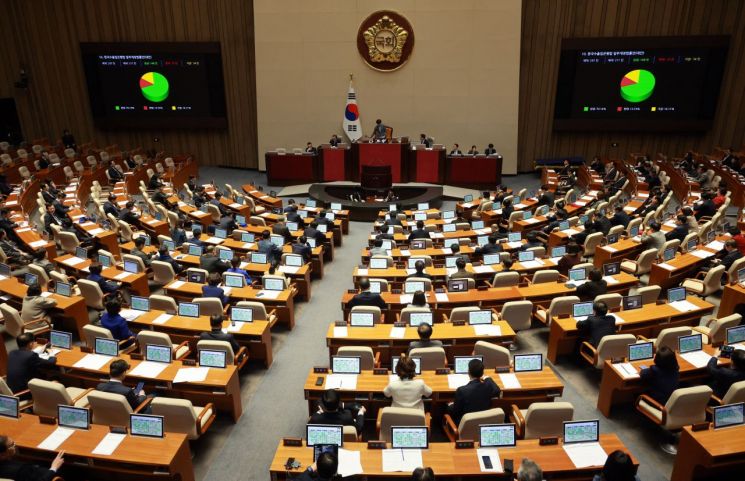 Amendment to the Export-Import Bank Act Passed in the Plenary Session
(Seoul=Yonhap News) Reporter Han Jong-chan = The amendment to the Export-Import Bank Act, which mainly raises the statutory capital limit of the Korea Export-Import Bank, was passed in the National Assembly plenary session on the 29th. 2024.2.29
saba@yna.co.kr
(End)
<Copyright(c) Yonhap News Agency, Unauthorized reproduction and redistribution, AI training and use prohibited>
Accordingly, the electoral districts of Seoul Jongno, Jung-gu Seongdong-gu Gap and Eul, the current Gangwon districts, and Jeonnam Suncheon Gwangyang Goseong Gurye Gap and Eul will remain unchanged. Part of Gunsan in Jeonbuk was included in the Gimje Buan electoral district, and part of Yangju in Gyeonggi was included in the Dongducheon-si Yeoncheon-gun electoral district.
The ruling and opposition parties designated 'special zones' in five areas?Seoul, Gyeonggi, Gangwon, Jeonnam, and Jeonbuk?to maintain the existing districts. This was to prevent the creation of ultra-large districts such as the 'Gyeonggi Pocheon Yeoncheon Gapyeong' district, which is four times the size of Seoul, and the 'Sokcho Cheorwon Hwacheon Yanggu Inje Goseong' district, which is eight times the size of Seoul.
The revised redistricting plan passed by the Special Committee on Political Reform will be sent to the National Election Commission's redistricting committee. Once the Election Commission's approval is completed, it will return to the Special Committee and then be processed in the plenary session. As of 5 p.m. that day, the National Assembly temporarily adjourned the plenary session while waiting for the revised plan sent to the Election Commission to be returned.
© The Asia Business Daily(www.asiae.co.kr). All rights reserved.
![Clutching a Stolen Dior Bag, Saying "I Hate Being Poor but Real"... The Grotesque Con of a "Human Knockoff" [Slate]](https://cwcontent.asiae.co.kr/asiaresize/183/2026021902243444107_1771435474.jpg)















