Candlelight Rally Scheduled at Shinjuku Station
Various Topics Expected Including Comfort Women, Zainichi Koreans, and the Kanto Earthquake
On the occasion of the March 1st Movement Day, film screenings and lectures condemning Japan's colonial rule and reflecting on Korea's painful history are scheduled to be held across Japan.
On the 1st, a March 1st candlelight rally will take place near Shinjuku Station. A "relay talk" discussing issues such as the 100th anniversary of the Kanto Earthquake massacre, forced labor, and the Japanese military comfort women issue is also planned. The organizers invited speakers from Korea on the 25th of last month to hold an indoor meeting and give lectures on colonial rule.
Various historical films dealing with the comfort women issue and discrimination will also be screened. First, in Nagoya, a screening of the film Jujeonjang will be held to commemorate the 105th anniversary of the independence movement. Jujeonjang is a documentary film by Japanese-American Miki Dezaki, in which the director interviews people related to the comfort women issue across Korea, the United States, and Japan. The film has been praised for revealing the true nature of right-wing groups led by the Abe administration and has faced turmoil such as lawsuits by Japanese right-wingers to stop screenings and sudden cancellations.
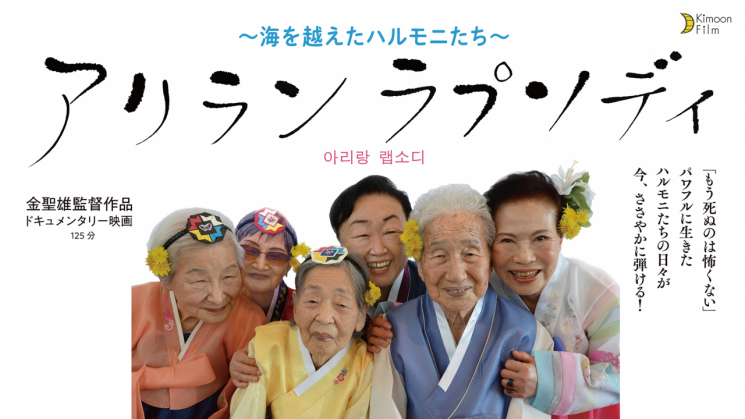 Poster of the movie "Arirang Rhapsody: Grandmothers Across the Sea," which focuses on the first-generation Korean residents in Japan. (Photo by Arirang Rhapsody official website)
Arirang Rhapsody: Grandmothers Across the Sea, a documentary depicting the history of Korean residents in Japan, which was released in Japan on the 17th of last month, will be shown in theaters until March 1st before concluding. Directed by second-generation Korean-Japanese director Kim Seong-ung, the film portrays first-generation Korean grandmothers living in a Korean-Japanese community in Kanagawa Prefecture.
At Doshisha University in Kyoto, a screening of the film Discrimination, which addresses the educational rights of Korean residents in Japan excluded from free education for Korean schools, will be held. Doshisha University is where poet Yun Dong-ju studied, and on the 10th, it held a memorial event honoring his legacy. A GV (guest visit) with director Kim Ji-woon is also scheduled.
In Tokyo, a first-come, first-served public lecture related to the Kanto Earthquake and the suppression of the Korean independence movement will be held. Professor Shin Chang-woo from Hosei University’s Department of Sociology will give the lecture. The Japanese government continues to deny the massacre of Koreans during the Kanto Earthquake, claiming no records have been found.
© The Asia Business Daily(www.asiae.co.kr). All rights reserved.
![Clutching a Stolen Dior Bag, Saying "I Hate Being Poor but Real"... The Grotesque Con of a "Human Knockoff" [Slate]](https://cwcontent.asiae.co.kr/asiaresize/183/2026021902243444107_1771435474.jpg)
















