Labor Shortage Due to Low Birthrate and Aging... Employment Consulted with Parents
Job Change and Hiring Cancellation Completely Blocked with Child and Parent Consent
Recently, in the Japanese job market, a practice called 'Oyakaku (親確)'?obtaining parental consent from successful new graduate hires?is spreading. This reflects a facet of Japanese society grappling with labor shortages due to low birth rates and an aging population. The strategy aims to completely prevent the loss of new talent by blocking opposition not only from the job seekers themselves but also from their parents during the recruitment process.
On the 28th, NHK reported, citing the employment information site Mynavi, that 52.4% of parents of new graduate hires were contacted by companies last month, a significant increase from 17.7% six years ago. In Japan, job hunting before graduation and deciding on a place of employment after graduation is called a job offer (naitei).
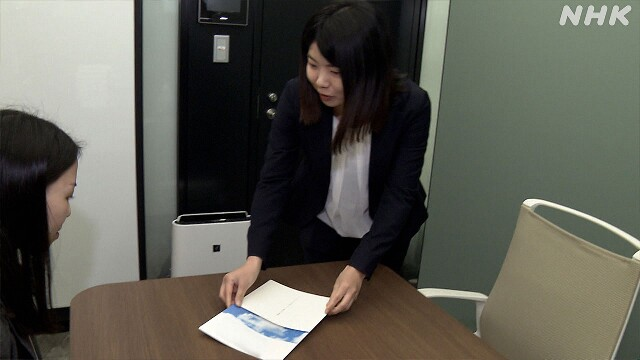 A representative from a recruitment consulting company is introducing a sample booklet for the parents of prospective employees. (Photo by NHK)
Oyakaku is implemented in various ways. It starts with sending pamphlets containing company information to the parents of the prospective hires, and many companies even require parents to sign an employment pledge agreeing to their child's employment. These pledges often include a guardian's signature section and a clause stating that the hire cannot refuse employment without a valid reason after submission.
Some HR teams directly call the parents, while others create dedicated pages for parents on recruitment websites. There are even companies that invite parents to join meals with the prospective hires.
According to Procommit, a company that develops corporate recruitment systems, Oyakaku was created to completely prevent the withdrawal of prospective hires. This is because the number of students canceling their acceptance due to parental opposition has been increasing.
Procommit explained that they receive inquiries from parents such as "Is there a risk of the company going bankrupt?" and calls from successful candidates saying, "My parents told me to check." This indicates that the relationship between children and parents has changed significantly compared to before. In fact, Mynavi's survey on consultation partners at the time of job decision this year showed that 'father or mother' accounted for the largest share at 61.9%.
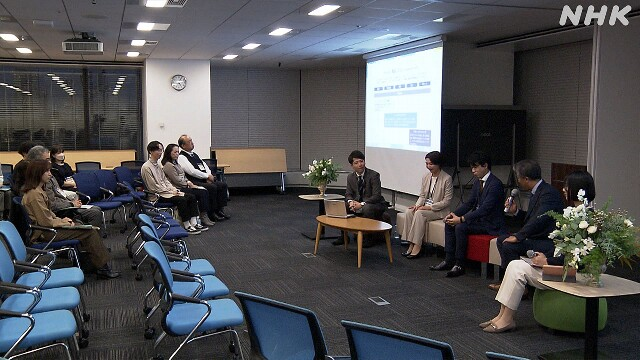 An IT company in Osaka is holding an orientation by inviting the parents of prospective employees. (Photo by NHK)
Additionally, an orientation for parents called 'Oyaori' has emerged. Since December last year, an IT company in Osaka has been holding briefing sessions where prospective hires and their parents tour the workplace together to deepen their understanding of the company. These events are held on weekday evenings to show actual employees at work and include social gatherings with senior employees.
According to corporate insiders, Oyakaku and Oyaori help imprint a positive image on parents that the company is trustworthy for their children, which can also help prevent turnover after joining. This is because the desired workplaces of parents and children have started to diverge even in Japan. Among people in their 20s, there is a growing preference for venture companies with growth potential and flexible work styles over large corporations, while parents still emphasize stable companies like large corporations, causing a gap. Mynavi's survey showed that over 60% of parents approved of employment in public service or large corporations, but only 11% approved of employment in venture companies.
The reason companies have to pay attention even to the parents of successful candidates is due to Japan's chronic problems of low birth rates and aging. Many companies are competing to recruit new graduates, leading to cases where a single candidate is accepted by multiple companies and cancels their job offer to accept the one with better conditions.
Yosuke Hasegawa, a researcher at Mynavi, analyzed, "With the declining university student population due to low birth rates and aging, the recruitment market has shifted to favor the sellers. Additionally, the closer relationship between parents and children is also a cause of this phenomenon." He added, "Since parental approval actually leads to increased motivation for the prospective hires to join, the number of companies implementing Oyaori will continue to increase."
© The Asia Business Daily(www.asiae.co.kr). All rights reserved.
![Clutching a Stolen Dior Bag, Saying "I Hate Being Poor but Real"... The Grotesque Con of a "Human Knockoff" [Slate]](https://cwcontent.asiae.co.kr/asiaresize/183/2026021902243444107_1771435474.jpg)
















