The Constitutional Court has ruled that the current Medical Service Act provision prohibiting fetal sex determination before 32 weeks of pregnancy is unconstitutional.
On the 28th, the Constitutional Court made an unconstitutional ruling on Article 20, Paragraph 2 of the Medical Service Act, which stipulates the 'prohibition of fetal sex determination,' with a 6 to 3 vote among the justices. The court stated, "Restricting the disclosure of the fetus's sex is not an appropriate means to achieve the legislative purpose of protecting fetal life," and added, "It excessively restricts the parents' right not to be obstructed from accessing information about the fetus's sex, violating the principle of minimal infringement and thus contravening the Constitution."
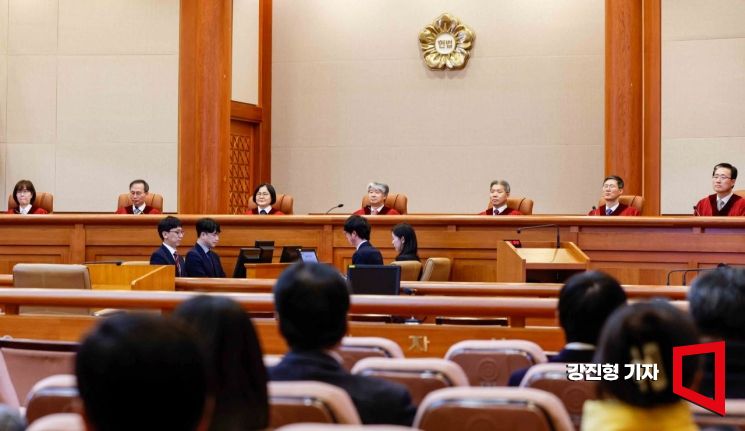 Lee Jong-seok, Chief Justice of the Constitutional Court, is presiding over a trial at the Grand Bench of the Constitutional Court in Jongno-gu, Seoul, on the 28th. On this day, the Constitutional Court ruled the contract renewal request right and the rent ceiling system of the Housing Lease Protection Act constitutional. Photo by Kang Jin-hyung aymsdream@
The current Medical Service Act prohibits medical personnel from informing pregnant women or their families of the fetus's sex before 32 weeks of pregnancy. This measure was intended to prevent sex-selective abortions based on son preference and to address gender imbalance while protecting fetal life.
The petitioners who filed the constitutional complaint argued, "Due to changes in public awareness in Korea, son preference has disappeared, so there is no longer a need to prohibit fetal sex disclosure," and claimed, "It excessively infringes on parents' rights not to be obstructed from accessing information about the fetus's sex."
The relevant provision of the Medical Service Act was amended in 2009 following the Constitutional Court's decision of constitutional inconsistency in 2008. Before the amendment, sex disclosure was prohibited throughout the entire pregnancy period, but reflecting the court's decision, disclosure of the fetus's sex has been allowed after 32 weeks of pregnancy.
However, three justices?Lee Jong-seok, Lee Eun-ae, and Kim Hyung-doo?dissented. The Constitutional Court stated, "As stated in the dissenting opinion, a simple unconstitutional ruling would result in the abrupt abolition of measures to protect fetal life without alternatives, which is not appropriate," and added, "It is appropriate to issue a decision of constitutional inconsistency on the challenged provision and require the legislature to improve the law by advancing the restriction period for fetal sex disclosure, considering various factors such as the amendment of the criminal law on abortion and the enforcement decree of the Maternal and Child Health Act, thereby minimizing the infringement of the basic rights of the fetus's parents while ensuring no legal vacuum regarding measures to protect fetal life."
Furthermore, the court added, "It is appropriate to make a provisional decision of constitutional inconsistency on the challenged provision until its unconstitutionality is removed through new legislation."
© The Asia Business Daily(www.asiae.co.kr). All rights reserved.
![Clutching a Stolen Dior Bag, Saying "I Hate Being Poor but Real"... The Grotesque Con of a "Human Knockoff" [Slate]](https://cwcontent.asiae.co.kr/asiaresize/183/2026021902243444107_1771435474.jpg)















