"Reinforcement of Report Reception Desks and Counseling Staff"
Emergency room visits are becoming difficult due to medical gaps caused by the collective departure of residents. As a result, requests from paramedics to the 119 Emergency Medical Situation Management Center to "find a hospital" have surged.
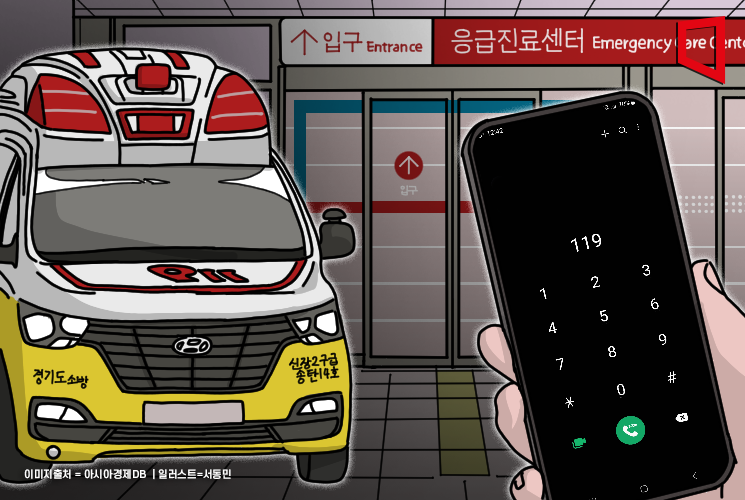
On the 28th, the National Fire Agency announced that the average daily number of hospital selections by the Emergency Medical Situation Management Center from the 16th to the 26th of this month was 66 cases. This is a 73.7% increase compared to the average daily 38 cases in February last year. The Emergency Medical Situation Management Center is also responsible for selecting hospitals when requested by paramedics, assessing the severity of patients, and directing 'severe and emergency patients' to regional emergency medical centers or large hospitals, and 'mild and non-emergency patients' to local emergency medical institutions or nearby clinics and hospitals.
Usually, paramedics find hospitals directly, but after the collective departure of residents, the shortage of emergency room medical staff has led to an increase in hospitals refusing patient admission, resulting in a surge in requests to the center for hospital selection. In fact, due to emergency room overload, 42 and 23 cases of delayed transport by paramedics were reported in Busan and Daejeon respectively from the 20th to the morning of the 26th.
In Daejeon, an octogenarian cardiac arrest patient experienced what is called an 'emergency room roundabout' and was later pronounced dead. Around noon on the 23rd, this 80-year-old cardiac arrest patient, who was experiencing consciousness impairment, was loaded into an ambulance but only arrived at a university hospital in Daejeon after 53 minutes of confirming available emergency rooms by phone. However, he was ultimately pronounced dead. The National Fire Agency has established a plan to strengthen hospital selection by the Emergency Medical Situation Management Center to minimize delays in emergency patient transport in response to this situation. They have also reinforced the call reception and consultation staff.
Meanwhile, considering the confusion in the medical field, following the government's request to refrain from calling 119 in non-emergency situations, emergency patient transports have slightly decreased. From the 16th to the 26th of this month, the average daily number of 119 paramedic dispatches and emergency patient transports were 8,294 cases and 4,713 people, respectively. This is a decrease of 3% and 3.7% compared to the averages of 8,552 cases and 4,894 people in February last year. However, during the same period, public emergency medical consultations and hospital/clinic guidance by the Emergency Medical Situation Management Center increased by 6.4%, and emergency treatment guidance increased by 2.3%. Medical guidance by doctors to paramedics decreased by 16.6%. A National Fire Agency official analyzed that there seems to be a tendency to refrain from reporting considering the difficulty of hospital treatment. They also estimated that the decrease in medical guidance cases was due to the reduction in patient transports, and that consultations and guidance increased due to concerns about difficulty in visiting familiar or nearby hospitals.
© The Asia Business Daily(www.asiae.co.kr). All rights reserved.

















