Shift from Medical Law to Civil Law in Government Confrontation
Medical License Revocation in 'Euiyakbuneop' Also Reacquired by KMA President
Government: "Unauthorized Absence Without Resignation Approval"
Residents who submitted resignation letters in protest against the increase of 2,000 medical students are unresponsive despite the government's strong crackdown. This is because the residents believe that no matter what the government says, it cannot ultimately disadvantage them.
Since the 19th, when residents announced their intention to submit resignation letters, the government has issued administrative orders such as work commencement orders and treatment maintenance orders, escalating its stance by declaring, "If there is no return, we will without exception impose license suspension, license revocation, and judicial measures." The Prosecutor General and the Commissioner General of the National Police Agency also directly warned of strong criminal penalties, including consideration of arrest and investigation. However, the residents have yet to show any signs of returning to work.
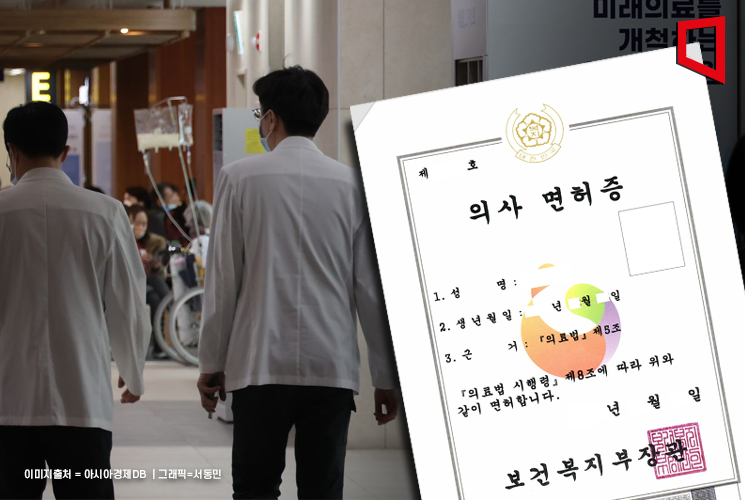
This is because residents are carrying the 'bomb' that doctors are an irreplaceable profession. A doctor who participated as a resident in the 2014 strike against telemedicine explained, "The thought is, if the bomb explodes and I die, you won't be able to cure patients either, so can you really touch me?"
The government announced, "Residents who do not return by the 29th will be mechanically subjected to license suspension of three months or more and judicial action." Regarding this, a training hospital official said, "If the government actually suspends the licenses of 10,000 residents for three months, normal medical services at all general hospitals nationwide will stop for three months," adding, "Residents who know this consider license suspension an impossible threat to carry out." Another hospital official said, "If the government imposes license suspension, there is no way to fill the resulting medical gap, and residents believe that more severe penalties such as license revocation will not be imposed at all," adding, "They think that since they were physically exhausted anyway, they can take a break for about three months to a year this time and then come back and work again."
Kim Jae-jung, former president of the Korean Medical Association who led collective closures and suspensions during the 2000 medical separation turmoil, was sentenced to one year in prison with a two-year probation by the Supreme Court on charges including obstruction of business, and his medical license was revoked in 2006. However, he reacquired his license in 2009. Apart from this case, there have been almost no instances of doctors being punished for collective actions.
During the 2020 doctors' strike opposing medical school expansion, the government filed complaints against 10 residents and fellows who violated work commencement orders but later withdrew them. At that time, medical students collectively refused to take the practical exam of the national medical licensing examination, but the government later amended the Medical Service Act Enforcement Decree to provide additional opportunities for the exam, thereby rescuing the medical students. The reason for this special treatment was that if medical school graduates failed to obtain doctor qualifications, the supply of interns to training hospitals nationwide that year would become impossible, shaking the national medical system.
Regarding the current resident departures, some argue, "Instead of resignation letters, they should return their medical licenses." However, medical licenses cannot be returned. The Medical Service Act does not have provisions for returning medical licenses. Unless a doctor is sentenced to imprisonment or probation and has their license revoked involuntarily, it is impossible for a doctor to voluntarily return their license and revert to being a 'non-doctor.' The reason for not allowing voluntary return of medical licenses is that the number of doctors appropriate to the population size must be maintained. Even if a license is revoked, after serving the sentence, if the doctor completes a 40-hour education program designated by the Minister of Health and Welfare, the license can be reissued. The legal guarantee that 'my doctor status is eternal' is a major reason why residents remain unmoved by the government's strong measures.
Unlike the previous three doctors' strikes in 2000 (medical separation), 2014 (telemedicine), and 2020 (public medical school), this time residents have shifted the confrontation line with the government from the 'Medical Service Act' to the 'Civil Act.' Unlike previous 'strikes' where they took leave and refused treatment, this time residents submitted resignation letters and 'resigned.' The Korean Medical Association and the Korean Intern Resident Association are professional organizations, not labor unions, so they do not have the legal right to strike. Accordingly, the government currently considers the residents' departure from their workplaces as an illegal strike.
Residents counter this by arguing, "We each submitted resignation letters and resigned, so this is not a strike." Park Dan, president of the Korean Intern Resident Association, resigned on the 20th, early in the crisis, after saying, "Do not engage in collective action." As a result, from the residents' perspective, the picture drawn is not of a collective resignation but of 'individual actions' without the intervention of the Korean Intern Resident Association. Under the Medical Service Act, doctors can have their licenses revoked if sentenced to imprisonment or more, but residents believe that since they personally submitted resignation letters and quit their jobs, they will not be sentenced to imprisonment or more.
The government's work commencement orders and treatment maintenance orders are based on Article 59, Paragraph 1 of the Medical Service Act, which states, "The Minister of Health and Welfare may provide guidance and orders to medical personnel if a serious threat to public health occurs," and Paragraph 2, which states, "The Minister of Health and Welfare may issue work commencement orders to medical personnel or medical institution operators who unjustifiably suspend treatment or collectively close or suspend their medical institutions, causing significant disruption to patient care." Violation of work commencement orders can result in suspension of qualifications for up to one year or imprisonment for up to three years under the Medical Service Act. In contrast, treatment maintenance orders are 'symbolic measures' without penalty provisions.
Residents argue, "Since we submitted resignation letters and quit the hospital, we are no longer 'medical personnel,' nor are we 'medical institution operators' who open and operate hospitals and then suspend or close them, so we are not subject to work commencement orders." They also argue, "Since we submitted resignation letters on the 20th, according to Article 660 of the Civil Act, which states that 'a notice of termination of an employment contract takes effect after one month,' even if the government refuses to accept the resignation letters, we will automatically retire on the 19th of next month," engaging in a 'time battle.'
However, the government interprets this as, "Since the hospital has not accepted the resignation letters, the existing employment contracts are valid for at least one month, so the residents are currently absent without leave." The government's basis under the Civil Act for issuing work commencement and treatment maintenance orders to residents lies here. A senior official at a tertiary hospital said that none of the 47 tertiary hospitals, including the Big 5, are likely to accept residents' resignation letters. He explained, "If hospitals accept residents' resignation letters, the Ministry of Health and Welfare will give failing grades on 'educational function' in the evaluation of tertiary hospitals, demoting them to general hospitals," adding, "This would reduce the fee add-on rate and decrease hospital revenue."
The Ministry of Health and Welfare is expected to take steps to prosecute residents who do not return starting from the first workday after the 29th, which is the 4th of next month. After tallying those who have not returned, the police will be notified, and the police are expected to send summonses to them and begin investigations. If residents refuse to appear without justifiable reasons, the police plan to request arrest warrants in consultation with the prosecution.
Prior to this, on the 27th, the government filed complaints with the police against five individuals, including Kim Taek-woo, chairman of the Korean Medical Association's emergency committee; Joo Soo-ho, media publicity committee chairman of the emergency committee; Park Myung-ha, organization strengthening committee chairman of the emergency committee; Lim Hyun-taek, president of the Korean Pediatric Society; and Noh Hwan-gyu, former president of the Korean Medical Association, as well as an unidentified person who posted inciting statements online, on charges of obstruction of business and violation of work commencement orders. This appears to be an attempt to pressure the 'surroundings' before directly prosecuting the residents. The police assigned this case to the Public Crime Investigation Unit of the Seoul Metropolitan Police Agency.
© The Asia Business Daily(www.asiae.co.kr). All rights reserved.
![Clutching a Stolen Dior Bag, Saying "I Hate Being Poor but Real"... The Grotesque Con of a "Human Knockoff" [Slate]](https://cwcontent.asiae.co.kr/asiaresize/183/2026021902243444107_1771435474.jpg)















