 [Image source=Yonhap News]
Is it still a good time to jump on the Japanese stock market, which has been hitting record highs day after day? Is it too late?
On the 27th (local time), Bloomberg reported that global asset management firms such as BlackRock and Amundi forecast in their investment memos that the Japanese stock market will continue its upward trend for the time being.
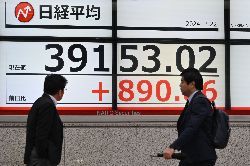
The Nikkei 225 index, which surpassed the peak of the bubble economy 34 years ago on the 22nd, is on track to set a new high for the third consecutive trading day by breaking the previous day's intraday index. In particular, the Nikkei index, which has surged about 17% this year, is showing higher performance than major stock markets such as the US, and is being evaluated as becoming a benchmark for global stock markets. However, many investors are weighing the timing of buying due to the steep rise.
Global asset management firms conclude that now is still the right time to invest in the Japanese stock market. There are two main reasons for this.
First, it is analyzed that a virtuous cycle is created where the growth momentum of Japanese companies leads to investment. BlackRock predicted that improvements in profitability and governance reforms of Japanese companies could attract domestic and foreign investors to the Japanese stock market. In its memo, BlackRock wrote, “The Japanese stock market can continue to set record highs.” JP Morgan's Japan branch predicted that the Nikkei index has room to rise 7% more to 42,000. This is because companies are increasing growth investments and improving capital efficiency, continuously attracting the interest of institutional and individual investors. It was also forecasted that Japanese investors, who have been ignoring their domestic stock market, will join the upward trend.
Second, the shift in monetary policies by the US and Japanese central banks is expected to lead to yen appreciation, adding returns from exchange gains.
French asset management firm Amundi expects the yen-dollar exchange rate to fall to 135 yen this year (yen appreciation). The yen-dollar exchange rate rose 6% this year (yen depreciation) as expectations grew that the pivot timing of the Bank of Japan (BOJ) and the US Federal Reserve (Fed) would be delayed. Eric Miziot, Global Equity Strategy Head at Amundi, said, “I think the yen is currently undervalued by about 40%,” adding, “The yen will appreciate against the dollar this year, increasing the returns on Japanese stocks held.”
Amundi emphasized that the catalyst for yen appreciation will be the Fed’s rate cuts rather than the BOJ ending its negative interest rate policy. They expect the BOJ to implement its first rate hike in April, followed by the Fed cutting rates around May to June.
Major asset management firms such as Morgan Stanley and Robeco also bet on yen appreciation against the Japanese yen. However, BNP Paribas pointed out that hedging against exchange rate fluctuations remains a valid strategy.
© The Asia Business Daily(www.asiae.co.kr). All rights reserved.
![Clutching a Stolen Dior Bag, Saying "I Hate Being Poor but Real"... The Grotesque Con of a "Human Knockoff" [Slate]](https://cwcontent.asiae.co.kr/asiaresize/183/2026021902243444107_1771435474.jpg)














