Finding Deposited Funds Through Meticulous Management
Collecting Overdue Taxes via Seizure and Collection
Local Governments Compete to Implement Comprehensive Revenue Collection Measures
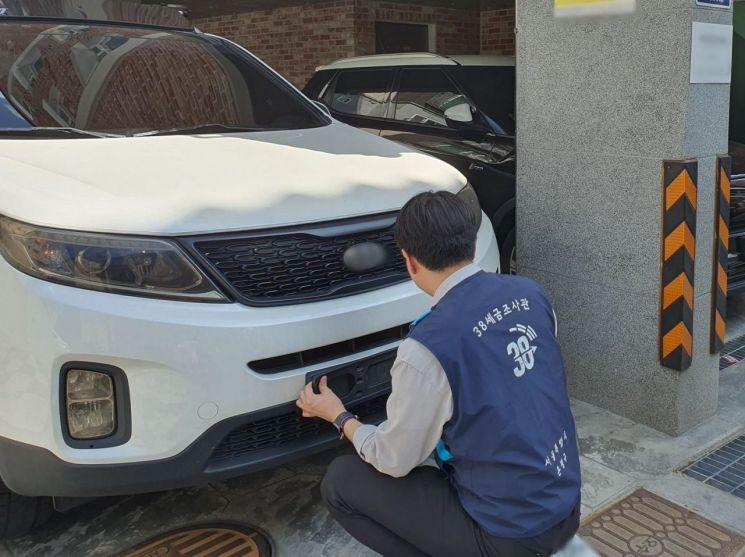 Eunpyeong-gu plans to actively carry out collection activities targeting delinquent taxpayers outside the district this year. An Eunpyeong-gu employee is seen impounding the license plate of a delinquent taxpayer's vehicle. (Photo by Eunpyeong-gu Office)
Mid-sized construction company A went bankrupt and eventually closed down after struggling during the International Monetary Fund (IMF) foreign exchange crisis. The company had thousands of unpaid local tax cases nationwide, amounting to 8 billion KRW. Most of these were unpaid comprehensive land taxes from Seoul City and district offices.
If a delinquent taxpayer is unable to pay taxes or has gone missing, tax collection becomes virtually impossible. In such cases, tax authorities classify and manage these amounts as ‘불납결손’ (uncollectible losses, referring to amounts written off due to inability to collect revenue) or ‘정리보류’ (collection suspension for delinquent taxes).
Company A had real estate assets such as land that could not be disposed of at the time. The sale proceeds of these assets, which had been tied up for nearly 30 years, were recently deposited in court, catching the attention of the Eunpyeong District Office in Seoul. After seizing and collecting the deposited funds, Eunpyeong District recovered 950 million KRW of long-standing unpaid taxes earlier this month. This was 28 years after the first tax notice was issued.
Wang Gyuma, head of the Eunpyeong District Tax Revenue General Team, said, “When there are many creditors, the party who claims the court deposit first is the rightful owner,” adding, “Thanks to consistently managing suspended taxes through the system and responding quickly, we were able to protect the valuable tax revenue of our residents.”
The Eunpyeong District Tax Administration Division reviews whether delinquent taxpayers have new assets quarterly through the comprehensive tax system used by local governments. In the case of repayment deposits, they check the court electronic deposit website after seizing creditors’ claims and can recover the funds through collection. Since payments are made on a first-come, first-served basis for seizures, Eunpyeong District was able to collect the funds through prompt action.
Collecting nearly 1 billion KRW in unpaid taxes after 28 years is significant for two reasons. First, the collected amount far exceeds Eunpyeong District’s annual local tax delinquency collection target. It is the highest single-case collection achievement in the district’s history.
Secondly, it represents a much-needed financial resource for local governments tightening their belts amid this year’s government austerity measures. The central government has drastically reduced local allocation taxes given to local governments this year, causing a ‘financial cold wave’ for basic local governments. As a result, local governments facing budget shortages are putting more effort into collecting delinquent taxes this year.
Jongno District has established a comprehensive tax revenue collection plan this month and formed three task forces led by the deputy district mayor to carry out sector-specific tax collection activities. They have intensified collection efforts against high-amount habitual delinquents and even strengthened reporting on collection performance by district office departments.
Dongjak District set a goal to collect 3.5 billion KRW in delinquent taxes this year, a 160% increase from last year, and established a new Non-Tax Revenue Delinquency Team within the collection department last month. This team centralizes the management of non-tax revenue delinquencies previously handled by various departments.
Eunpyeong District also plans to actively pursue delinquent tax collection this year. In particular, they will focus on a comprehensive crackdown on high-amount delinquents residing outside the district. They plan to manage large delinquent amounts through strong measures such as home searches of delinquent taxpayers, seizure of license plates on delinquent vehicles, and forced towing.
Team leader Wang said, “Due to COVID-19, face-to-face contact was difficult, making it hard to manage delinquent taxpayers outside the district over the past few years,” adding, “From April, we plan to organize teams by local regions for six months to actively carry out collection activities.”
Kim Mikyung, mayor of Eunpyeong District, stated, “We will continue to thoroughly investigate delinquent taxpayers’ assets, never neglecting long-standing delinquencies, and pursue collection to the end,” and added, “We will do our best to ensure that honest taxpayers do not suffer.”
© The Asia Business Daily(www.asiae.co.kr). All rights reserved.
![Clutching a Stolen Dior Bag, Saying "I Hate Being Poor but Real"... The Grotesque Con of a "Human Knockoff" [Slate]](https://cwcontent.asiae.co.kr/asiaresize/183/2026021902243444107_1771435474.jpg)















