Affordable Housing and Shared Spaces Cheaper Than Market Price
Near Subway Stations, Main Roads, and Hospitals Planned
Incentives Offered to Encourage Private Sector Participation
20,000 Units Expected to Begin Occupancy as Early as 2026
Shared housing that residents living alone in Seoul can use at 30-50% lower cost than nearby one-room units is expected to be supplied as early as 2026. To ensure the stable supply of such housing for single-person households, the Seoul Metropolitan Government will offer private developers benefits such as zoning upgrades, floor area ratio (FAR) relaxations, and tax incentives.
On the 26th, Seoul announced the commencement of the supply process for the shared housing project called ‘Ansim Teukjip’ designed for single-person households. The city stated, "Considering the increasing number of single-person households, we recognized the need for a new housing type beyond family units and have been preparing shared housing accordingly. The advantage is that residents can live stably for a long time without owning a home, and by sharing kitchens, laundry rooms, and other facilities, they can enjoy more spacious and comfortable living spaces."
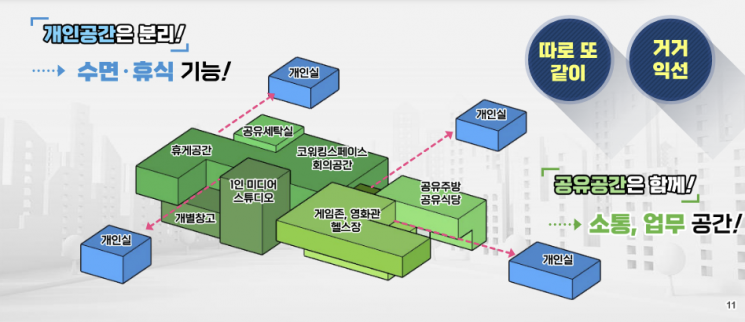
Private Spaces Separated, Shared Spaces Together
Shared housing is broadly divided into private living spaces and shared spaces for community activities. The private living spaces are designed to be at least 12㎡, which is 20% larger than the legal minimum area for rental dormitories (9.5㎡ or more). With a ceiling height of over 2.4m and a width of more than 1.5m, the design provides a sense of openness. To reduce noise between floors and walls, measures such as impact sound insulation on floors and boundary wall structures between units are applied.
The shared spaces consist of four types: ▲basic living spaces such as kitchens, dining rooms, laundry rooms, and exercise facilities ▲living support facilities such as parcel storage rooms and resident support centers ▲community spaces such as small libraries and meeting rooms ▲specialized spaces such as game zones, pet shower rooms, and performance halls. The minimum area per person is set at 6㎡, which is 50% higher than the legal standard of 4㎡. For example, if 150 private units are operated, 900㎡ of shared space will be installed.
Rent for private living spaces and basic shared spaces (basic living spaces, living support facilities, community spaces) will be set at 50-70% of the market rate for nearby one-room units. Fees for specialized spaces will be charged based on usage according to residents’ choices and returned as profits to the operators. According to the city, this approach simultaneously reduces residents’ housing costs and ensures business viability. Additionally, to ensure safe management of rental deposits, registration of rental businesses as ‘housing rental management businesses’ will be mandatory.
The city explained, “Unlike poor-quality housing such as goshiwons that lack housing protection, or one-room units, officetels, and urban lifestyle housing with insufficient community facilities and high rent burdens, this project secures affordable and transparent rents along with specialized spaces for leisure and work.”
The city plans to start site selection and establish operational standards, complete administrative procedures in the second half of this year, and then proceed with full-scale project implementation. It expects to complete project plan approvals for 2,500 units this year and begin construction on about 1,000 units by the end of the year. Considering the construction period, the first residents of Ansim Teukjip are expected to move in within 2-3 years. Currently, the city is reviewing potential sites in Dongdaemun-gu and Jung-gu districts.
The target residents are diverse single-person households including university students, office workers, and seniors. Accordingly, sites will be selected near convenient transportation hubs (within 350m of subway stations), main roads (within 50m), and medical facilities (within 350m of hospitals). Residents aged 19-39 can live up to 6 years, while middle-aged and older residents aged 40 and above can stay for up to 10 years.
Enhancing Business Viability to Encourage Private Participation, Public Contribution Plans Also Established
The city will actively encourage private developers’ participation by providing incentives to supply shared housing quickly and stably. First, zoning upgrades and application of the maximum legal floor area ratio will be allowed. For example, the current ‘Category 2 General Residential Area’ with a 200% FAR can be upgraded to a ‘Quasi-Residential Area’ allowing up to 500% FAR. However, a net burden rate of 15% for the FAR increase must be contributed to the public sector (public rental housing). Also, if the FAR increases from 400% to the maximum 500%, half of the increase (100%) must be contributed publicly.
Additionally, integrated reviews will ensure faster project approval, improving business viability. To provide swift project support to developers and stable private rental housing supply to residents, the sites will be designated as ‘Supply Promotion Districts.’
Tax benefits will also be provided. The city has requested the Ministry of the Interior and Safety to amend the ‘Local Tax Special Cases Act’ to allow reductions in capital gains tax, exclusion from comprehensive real estate tax aggregation, and reductions in acquisition and property taxes.
Han Byung-yong, Director of Housing Policy at Seoul City, said, "By 2030, it is expected that 2 out of every 5 households in Seoul will be single-person households, so it is time to prepare housing support measures for them. We will quickly supply shared housing with the ‘three essentials’ of good location, space, and rent to support stable housing for single-person households."
© The Asia Business Daily(www.asiae.co.kr). All rights reserved.
![Clutching a Stolen Dior Bag, Saying "I Hate Being Poor but Real"... The Grotesque Con of a "Human Knockoff" [Slate]](https://cwcontent.asiae.co.kr/asiaresize/183/2026021902243444107_1771435474.jpg)
















