Financial Services Commission "Expect Quantitative and Qualitative Improvement in Household Debt"
Incorporation of Additional Interest Rate: 25% in H1 → 50% in H2 → 100% Next Year
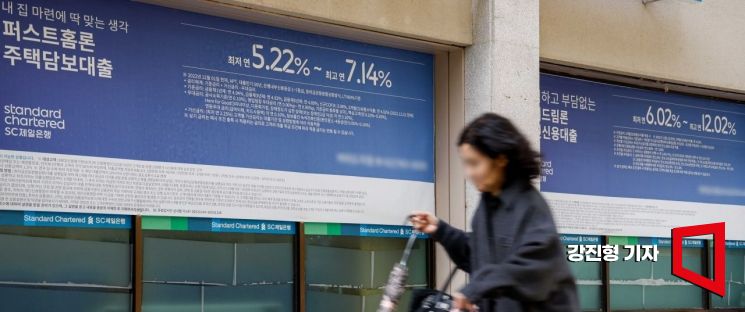 On the 23rd, as domestic market interest rates and bank loan interest rates rapidly rise, a banner displaying loan interest rates is hung on the exterior wall of a commercial bank in Seoul. Photo by Jinhyung Kang aymsdream@
Starting from the 26th, the 'Stress DSR,' which precisely reflects future interest rate fluctuation risks in the Debt Service Ratio (DSR), will be implemented for all bank mortgage loans. The Stress DSR system imposes an additional interest rate (stress rate) when calculating the DSR, considering the possibility that borrowers using variable interest rate loans may face increased principal and interest repayment burdens due to rising interest rates during the loan period.
According to the Financial Services Commission on the 25th, the stress rate applied from the 26th to June 30th is 0.38%. The stress rate is determined by comparing the highest monthly weighted average interest rate of household loans over the past five years (as announced by the Bank of Korea) with the current interest rate, and to compensate for tendencies of overestimation or underestimation during interest rate fluctuations, a lower limit of 1.5% and an upper limit of 3.0% are set.
To minimize the impact of the system's implementation, only 25% of the stress rate calculated by the above formula will be applied in the first half of this year, and 50% in the second half. From 2025, 100% will be applied. Accordingly, the stress rate applied in the first half of this year is operated at 0.38%, which is 25% of the lower limit rate of 1.5% (rounded to the third decimal place).
Due to the application of the stress rate (0.38%), the mortgage loan limits per borrower in the first half of this year are expected to decrease by approximately 2-4%, depending on the loan type: variable, mixed, or periodic. Assuming a borrower with an income of 50 million KRW (based on a 30-year maturity and principal and interest installment repayment), the mortgage loan limit decreases from the existing 330 million KRW to: ? 315 million KRW for variable interest rate loans, ? 320 million KRW for mixed loans (assuming a fixed interest rate loan product for the first five years after the initial loan), and ? 325 million KRW for periodic loans (assuming interest rate changes every five years).
The Financial Services Commission plans to expand the scope of application from the second half of this year, as the Stress DSR will be implemented gradually to minimize shocks caused by the system introduction. From the second half of this year, the application will extend to bank credit loans and second-tier financial institution mortgage loans. Monitoring the stabilization of the Stress DSR, the plan is to sequentially expand it from next year to all household loans subject to DSR across all financial sectors.
The financial authorities, banking sector, and Credit Information Service have held several working meetings to ensure that the Stress DSR operates smoothly in the loan field. After implementation, the Financial Supervisory Service and the Korea Federation of Banks will monitor the system's stabilization to prevent consumer inconvenience at frontline branches.
Lee Soo-young, Director of Financial Policy at the Financial Services Commission, stated, "With the implementation of the Stress DSR reflecting future interest rate fluctuation risks, the DSR system, which has been a key part of repayment ability assessment, will advance to the next level. This will allow a more thorough evaluation of borrowers' repayment capacity from a mid- to long-term perspective, considering future interest rate risks, and consumers will clearly recognize the risks of interest rate fluctuations associated with long-term loans, contributing to the qualitative improvement of household debt."
He added, "Since this is the early stage of the system's implementation, only a portion of the stress rate is reflected, and the application starts with bank mortgage loans and will gradually expand. We plan to carefully manage the process to minimize consumer shocks caused by the Stress DSR implementation."
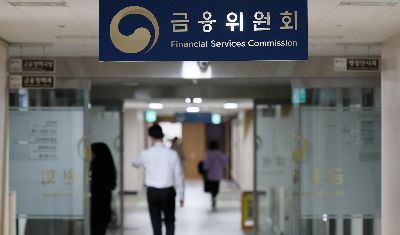 On the 9th, officials were busy moving through the corridor of the Financial Services Commission at the Government Seoul Office in Jongno-gu, Seoul, where financial authorities decided to include mortgage loans (Judaemae) in the 'debt refinancing' infrastructure set to launch in May by the end of the year. Financial authorities explained that the purpose is to reduce the interest burden on mortgage loans by establishing a debt refinancing platform that allows users to compare financial sector loan interest rates at a glance and switch loans easily. Photo by Dongju Yoon doso7@
© The Asia Business Daily(www.asiae.co.kr). All rights reserved.
![Clutching a Stolen Dior Bag, Saying "I Hate Being Poor but Real"... The Grotesque Con of a "Human Knockoff" [Slate]](https://cwcontent.asiae.co.kr/asiaresize/183/2026021902243444107_1771435474.jpg)
















