High Price... Declining Popularity Among LCCs
Government Considers Allowing Sales to Overseas Logistics Firms
Expectations for Eased Safety Operation Certification Requirements
Not only low-cost carriers (LCCs) but also foreign logistics companies are expected to participate in the sale of Korean Air's Asiana Airlines cargo division. As LCCs have shown less enthusiasm for acquisition than initially anticipated, the scope of participation is expanding to include logistics firms. Since the European Union (EU) has stipulated the sale of the cargo division as a condition for the merger of Korean Air and Asiana Airlines, it is highly likely that logistics companies will emerge as acquisition candidates.
According to industry sources on the 26th, the Ministry of Land, Infrastructure and Transport (MOLIT) is reportedly considering allowing foreign logistics companies to participate in the acquisition of Asiana Airlines' cargo business. An industry official said, "LCCs are showing lukewarm responses to acquiring Asiana Airlines' cargo division," adding, "It is understood that MOLIT is internally reviewing this matter."
Under the current Aviation Business Act, foreign corporations or organizations can operate air transportation businesses with the approval of the Minister of Land, Infrastructure and Transport, even if they are not domestic LCCs.
Some expect that the government might ease the conditions for obtaining the Air Operator Certificate (AOC), which is required to operate air transportation businesses. When granting an AOC, the government evaluates safety-related items as well as the purchase of aircraft and other facilities, workforce size, and business plan schedules. It is possible that the government could relax certain evaluation criteria, such as operational history requirements or spare parts inventory, tailored to specific operators. There is also a view that the 'Other' category in the evaluation criteria could be used to award higher scores in qualitative assessments. However, a MOLIT official stated, "The AOC is a system to prove safe operation," and "Since safety standards are international, there is no room for relaxation."
Nevertheless, there is growing anticipation in the industry that the pool of candidates will expand to include logistics companies. An industry insider hinted, "Several foreign logistics companies have already shown interest in acquiring Asiana Airlines' cargo business after hearing the news." Another source said, "If the cargo business goes to a specialized logistics company, it could benefit careers, so some employees in the Asiana Airlines-related division are trying to hold on."
This atmosphere stems from the expectation that selling Asiana Airlines' cargo division will not be easy. The current estimated sale price of the cargo division is between 500 billion and 700 billion KRW. However, since the buyer must also assume 1 trillion KRW in debt, the actual acquisition cost will exceed 1.5 trillion KRW. Additionally, costs for replacing aircraft must be invested after acquisition. According to the Ministry of Land, Infrastructure and Transport's Aircraft Technology Information System, as of this year, 10 out of 11 cargo aircraft owned by Asiana Airlines are over 20 years old. Considering that aircraft are typically used for up to 30 years, most are due for replacement.
Jeju Air, initially considered the most likely candidate, reportedly shows little interest. An industry official said, "Kim I-bae, CEO of Jeju Air, who has been in charge of finance and planning since the Asiana Airlines era, is not very keen." Jeju Air's financial situation is not very strong. As of the third quarter of last year, Jeju Air's cash assets were about 350 billion KRW, and its debt ratio reached 473%. Unless its parent company, the Aekyung Group, steps in for acquisition, it will be difficult for Jeju Air to proceed independently.
Air Premia, another candidate, is in a similar situation. Although it has formed an internal task force (TF) and is preparing a bid proposal, it is uncertain whether it will actively participate. Since it only turned a profit for the first time in the third quarter of last year since its launch, it is expected to struggle without collaboration with other financial investors (FIs). Eastar Jet, which has expressed acquisition intentions, is also likely to face limitations in raising funds.
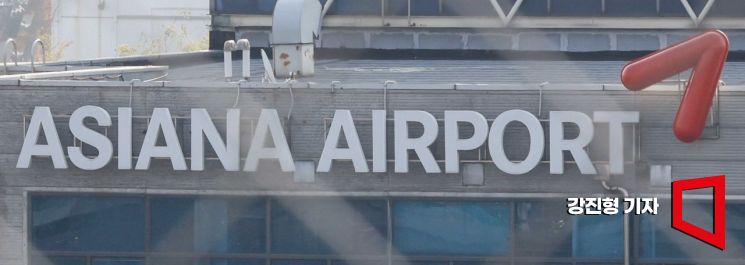 A board meeting is scheduled to discuss the sale of Asiana Airlines' cargo business in relation to the merger between Korean Air and Asiana Airlines. The photo shows the Asiana Airlines office set up at Gimpo Airport in Gangseo-gu, Seoul on the 2nd. Photo by Jinhyung Kang aymsdream@
© The Asia Business Daily(www.asiae.co.kr). All rights reserved.

















