KOSPI Hits New 52-Week Intraday High
US and Japan Stock Markets Reach All-Time Highs
NVIDIA and Shareholder Return Expectations Drive Market Rally
Valuation Concerns Remain but Trend Likely Unbroken
As the US and Japanese stock markets continue their high-flying streak by hitting all-time highs, the KOSPI has also followed suit, showing a rare simultaneous rise. Nvidia's strong earnings and corporate value-up programs acted as driving forces behind the stock price increases. While the upward trend continues, concerns such as valuation burdens are cited as risk factors. Additionally, there are forecasts that factors supporting the stock market's rise so far may weaken, potentially negatively impacting the market.
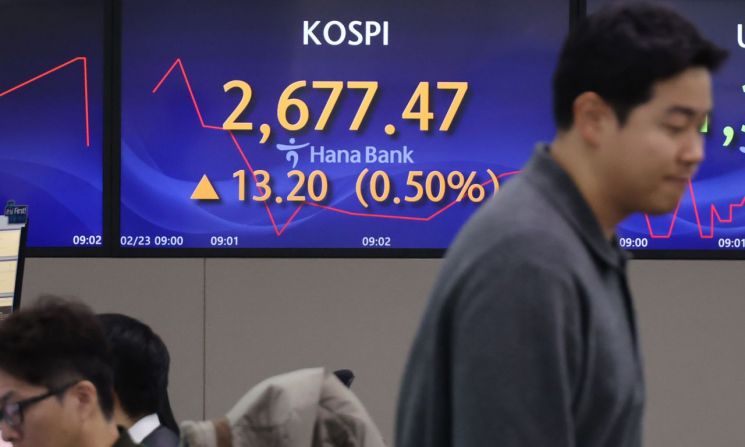
As of 10:20 AM on the 23rd, the KOSPI rose 18.15 points (0.68%) from the previous day to 2682.42, climbing back above the 2680 level. During the session, it rose as high as 2694.80, surpassing the 52-week high of 2683.39 recorded on the 19th. The KOSDAQ rose 0.30% to 872.71.
Following significant gains in the US and Japanese stock markets the previous day, the domestic market appears to be moving in tandem. On the 22nd (local time) at the New York Stock Exchange (NYSE), the Dow Jones Industrial Average closed at 39,069.11, up 456.87 points (1.18%) from the previous session. The S&P 500 closed at 5,087.03, up 105.23 points (2.11%). Both indices set new all-time highs. The Nasdaq closed at 16,041.62, up 460.75 points (2.96%). The Japanese stock market broke its all-time high set 34 years ago during the "bubble economy." The Nikkei 225 closed at 39,098.68, up 836.52 points (2.19%). During the session, it reached 39,156.97, surpassing the previous record high of 38,957 set on December 29, 1989, during the bubble economy.
The government's corporate value-up program also drove the domestic stock market's upward momentum. Buying interest flowed into low price-to-book ratio (PBR) stocks, instantly reversing the sluggish market trend seen earlier this year. In particular, foreign investors' buying concentrated on these stocks led the KOSPI's rise. Changmin Cho, a researcher at Yuanta Securities, said, "Foreign investors' love for low PBR stocks seems endless," adding, "Although the intensity varies depending on stock price trends, the net buying trend itself remains unchanged."
Japanese Stock Market Hits Highest Level in 34 Years... Dow and S&P 500 Also Reach Record Highs
Nvidia's strong earnings and expectations for corporate value-up programs are cited as factors behind the US and Japanese stock market rises. Nvidia's stock surged 16% from the previous trading day, driven by earnings that exceeded expectations and optimistic forecasts. Consequently, its market capitalization soared by $277 billion (approximately 368 trillion KRW) in a single day, easily surpassing the previous all-time high of $197 billion set by Meta in daily trading. Nvidia previously announced fourth-quarter sales of $22.1 billion and earnings per share of $5.15. Sales increased 265% compared to the same period a year earlier, and gross profit surged 769% to $12.29 billion.
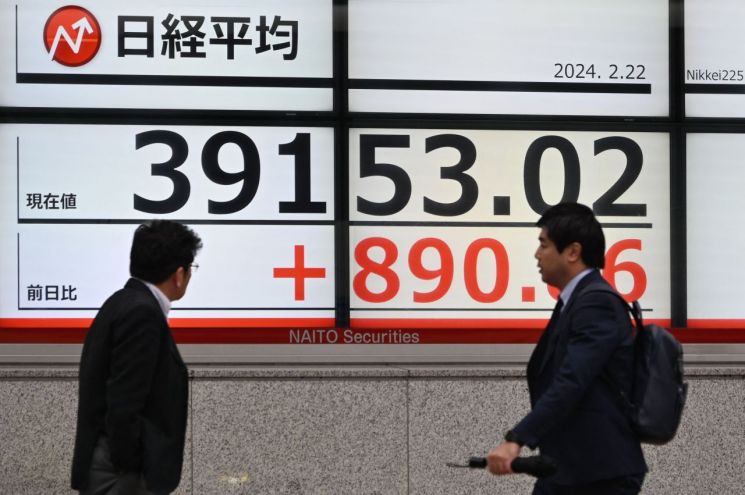
The cause of the Japanese stock market boom, which broke the record set during the bubble economy at the end of 1989 after 34 years, is attributed to the solid earnings of Japanese companies. Nihon Keizai Shimbun predicted that the first-quarter net profit of 1,020 listed Japanese companies would reach a record high of about 43.5 trillion yen (approximately 385 trillion KRW). The record-weak yen also fueled overseas capital inflows, acting as a driving force for the rise. According to data from the Tokyo Stock Exchange, foreign investors' investment in the Tokyo Stock Exchange Prime (first section) market approached 2 trillion yen (about 17 trillion KRW) in January this year. Related stocks such as Tokyo Electron and SoftBank rose due to the Nvidia effect, and Toyota Motor recorded an all-time high thanks to improved export performance driven by the weak yen and product price increases.
Concerns Must Also Be Examined Amid Rosy Outlook
The domestic stock market, which rose on expectations for the corporate value-up program, is expected to be influenced by the detailed plan to be announced next week. Kyungmin Lee, a researcher at Daishin Securities, said, "Since the market has already surged on expectations, unless the value-up program delivers a surprising result that greatly exceeds investors' expectations, low PBR stocks are expected to undergo a process of overheating and selling pressure digestion for the time being." Joonki Cho, a researcher at SK Securities, said, "The recent trend in the Japanese stock market is very strong, and since the domestic corporate value-up program to be announced next week benchmarks Japan a lot, if it presents a satisfactory roadmap that faithfully follows Japan's good precedent, it can be viewed positively."
The Japanese market envisions a rosy future where the Nikkei index surpasses 40,000. Daiwa Securities raised its 2024 forecast for the Nikkei index by 3,400 yen from the previous estimate to 43,000. Bank of America (BoA) also raised its year-end Nikkei index forecast from 38,500 to 41,000. On the other hand, there are cautious views that if Chinese capital, which has supported the market, flows out again, it could act as a negative factor. The yen-dollar exchange rate, which has surpassed the psychological resistance level of 150 yen, is also a source of concern.
The US market has high expectations that the tech stock rally will continue. On the 22nd (local time), Meta, Facebook's parent company, rose 3.87%. Amazon also increased by 3.55%. Microsoft (MS) and Netflix rose 2.35% and 2.64%, respectively. Solita Marcelli of UBS Global Asset Management forecasted, "The short-term momentum of AI-related stocks will continue." She added, "We maintain a preference for semiconductors and software," and "We see opportunities among beneficiaries such as AI computing, big tech companies, and their partners."
However, concerns about an excessive rally have also been raised. Philip Kolma of MRB Partners diagnosed, "There is a bubble in the Magnificent 7, the large US stocks," adding, "Considering the cyclical nature of semiconductor stocks, the rally led by Nvidia carries inherent risks."
Meanwhile, despite concerns about valuations as the stock markets in Korea, the US, and Japan have all recently continued their upward trends, there are also forecasts that the market trend will not be broken. Researcher Joonki Cho said, "Recently, both domestic and overseas markets have risen significantly, leading to comments that valuations are expensive and that we have reached historically high levels, which is burdensome. However, as Nvidia has shown, new growth engines are being created, and in Korea's case, policies are encouraging corporate value enhancement, which is a different event and trend from the past." He added, "If interest rates rise faster or tensions arise, it could shake this trend, but unless such situations involve major changes like a sharp rise in unemployment or banking system problems, it is unlikely to significantly break the trend."
© The Asia Business Daily(www.asiae.co.kr). All rights reserved.
![Clutching a Stolen Dior Bag, Saying "I Hate Being Poor but Real"... The Grotesque Con of a "Human Knockoff" [Slate]](https://cwcontent.asiae.co.kr/asiaresize/183/2026021902243444107_1771435474.jpg)

















