"Inflation Should Not Be Lowered Too Much Just Because It Has Dropped"
Core PCE Inflation Rate Expected to Fall to 2.8% in January
Philip Jefferson, Vice Chair of the U.S. Federal Reserve (Fed), cautioned against excessive interest rate cuts and stated that it would be appropriate to begin cuts "later this year." This reaffirmed the Fed's cautious stance on rate cuts following the release of the January Federal Open Market Committee (FOMC) minutes the previous day. The personal consumption expenditures (PCE) price index inflation rate for January, to be released on the 29th, is expected to slow down.
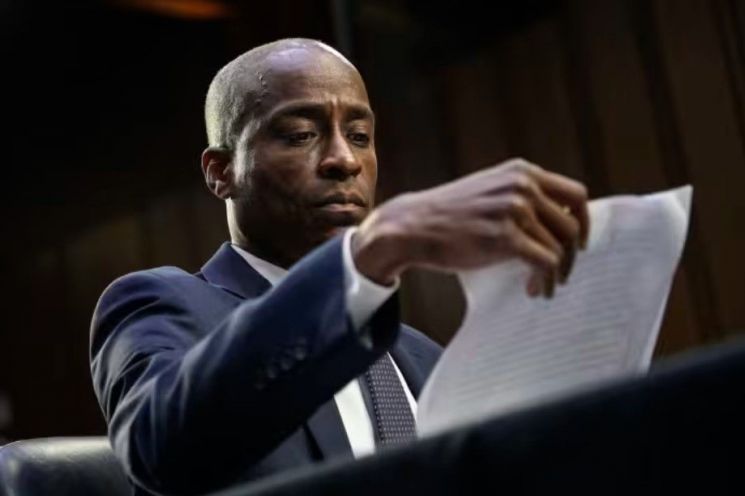
On the 22nd (local time), Vice Chair Jefferson said in a speech at the Peterson Institute for International Economics (PIIE) in Washington D.C., "If the economy broadly develops as expected, it seems appropriate to begin policy easing later this year."
He explained, "We must always be cautious of the risk of easing too much in response to improvements in inflation," adding, "Excessive easing could halt or reverse the process of restoring price stability." He also emphasized that the Fed's biggest concern is the situation where rates are cut and then raised again. This aligns with the views of Fed officials who have repeatedly expressed caution regarding recent rate cuts.
Inflation is expected to gradually ease. Vice Chair Jefferson disclosed the estimated January PCE price index figures to be released by the Department of Commerce on the 29th. According to him, the January PCE price index is expected to rise 2.4% year-over-year, slowing down compared to December last year (2.6%). The core PCE price index, which excludes volatile food and energy prices, is expected to rise 2.8%, down from 2.9% the previous month. If Jefferson's forecast is accurate, the PCE price index, the inflation indicator most closely watched by the Fed, is expected to continue its slowing trend.
However, regarding the January Consumer Price Index (CPI) increase, he assessed that the inflation normalization process "will not be smooth." The January CPI rose 3.1% compared to a year earlier, exceeding the forecast of 2.9%.
While mentioning the possibility of a soft landing for the U.S. economy, he pointed out that unexpected shocks could occur. These include a slowdown in inflation improvement due to strong consumer spending, price instability of crude oil and other raw materials caused by the Middle East conflict, and the risk of weakening employment due to slower growth. He particularly warned about the possibility of a labor market slowdown.
Vice Chair Jefferson emphasized, "The labor market can change dramatically," adding, "We must be cautious. We need to assess shocks that could damage the economy and adjust policies accordingly."
When asked whether a decline in growth is a prerequisite for rate cuts, he explained, "When deciding monetary policy stance, we look at the overall economic data," and "It is not necessary to confirm a decline in growth before cutting rates." He added, "On the real side, we will look at the labor market, growth, and productivity, and on the price side, we will look at inflation."
© The Asia Business Daily(www.asiae.co.kr). All rights reserved.
![Clutching a Stolen Dior Bag, Saying "I Hate Being Poor but Real"... The Grotesque Con of a "Human Knockoff" [Slate]](https://cwcontent.asiae.co.kr/asiaresize/183/2026021902243444107_1771435474.jpg)















