Democratic Party Support at 31%, Gap Widens with People Power Party
Regime Check Theory Still Prevails Over Regime Stability Theory
In party support, the People Power Party (PPP) was found to be significantly ahead of the Democratic Party of Korea (DPK) beyond the margin of error (±3.1 percentage points). However, when asked which party would become the ruling party, respondents favored the DPK, revealing a contrasting perception. Analysis suggests that proportional representation parties and nomination conflicts are pulling down the DPK's support rate.
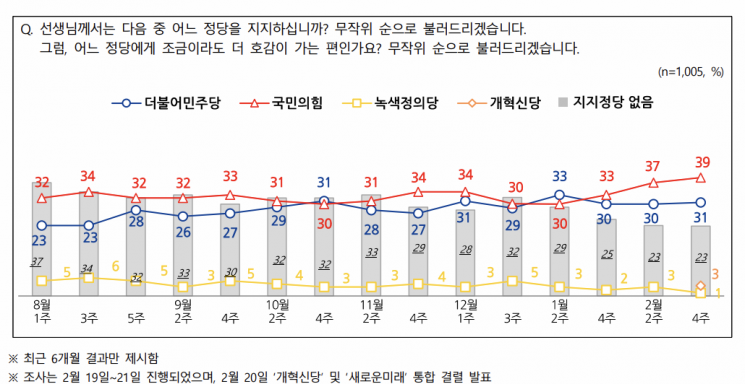
According to the National Barometer Survey (NBS), jointly conducted by four polling organizations?Embrain Public, K-Stat Research, Korea Research, and Hankook Research?the PPP received 39% support in party preference, significantly ahead of the DPK's 31%. The Reform New Party received 3%, and the Green Justice Party 1%. The PPP's support rate rose by 2 percentage points compared to the survey two weeks ago (second week of February), while the DPK's support increased by 1 percentage point, widening the gap between the two parties.
However, when asked which party's candidate they would choose for a district seat, 35% chose the PPP, 33% the DPK, 3% the Reform New Party, and 1% the Green Justice Party.
In proportional representation voting, 33% said they would vote for the proportional party created by the PPP, while 25% said they would vote for the proportional coalition party involving the DPK. The Reform New Party received 6%, the Green Justice Party 2%, and 29% of respondents were undecided.
When asked which party would become the ruling party, the DPK received 41%, ahead of the PPP's 39%. Regarding the nature of the 22nd general election, 44% supported the government and ruling party, while 48% favored checking the government and ruling party, with the opposition viewpoint prevailing. The opposition view rose by 4 percentage points compared to two weeks ago, while the support view fell by 3 percentage points.
Regarding President Yoon Suk-yeol's administration, positive evaluations rose by 1 percentage point from last week to 38%, while negative evaluations dropped by 1 percentage point to 55%. Trust in the administration increased by 5 percentage points compared to the survey one month ago (fourth week of January), reaching 40%. Those who did not trust the administration decreased by 7 percentage points.
Kim Bong-shin, director at Metavoice, stated, "It appears that conflicts related to proportional parties and nominations are affecting party support." He pointed out, "In the case of proportional parties, the DPK shows an 8 percentage point gap, which differs from the gap in district voting." Additionally, Kim said, "While the PPP seems to have orderly nominations, the DPK shows signs of discord and worsening conditions."
This survey was conducted over three days from the 19th to the 21st, targeting 1,005 men and women aged 18 and over, using telephone interviews with virtual mobile phone numbers. For an overview and detailed results related to the survey, please refer to the National Barometer Survey website or the Central Election Poll Deliberation Commission website.
© The Asia Business Daily(www.asiae.co.kr). All rights reserved.

















