Statistics Korea Publishes 'Quality of Life of the People 2023' Report
Indicators of travel and cultural activities, which had worsened due to COVID-19, showed improvement during the endemic (endemic phase) period last year. However, net assets decreased due to the real estate market downturn, and life expectancy declined for the first time since related statistics began in 1970. Male obesity rates also failed to return to pre-COVID-19 levels, highlighting a health risk factor. The number of deaths from industrial accidents and fires also increased.
Statistics Korea published the 'Quality of Life in Korea 2023' report on the 22nd, containing these findings.
The quality of life indicators are part of efforts to complement the limitations of economic indicators centered on Gross Domestic Product (GDP_), consisting of 71 indicators across 11 areas related to health, leisure, safety, and other aspects of quality of life.
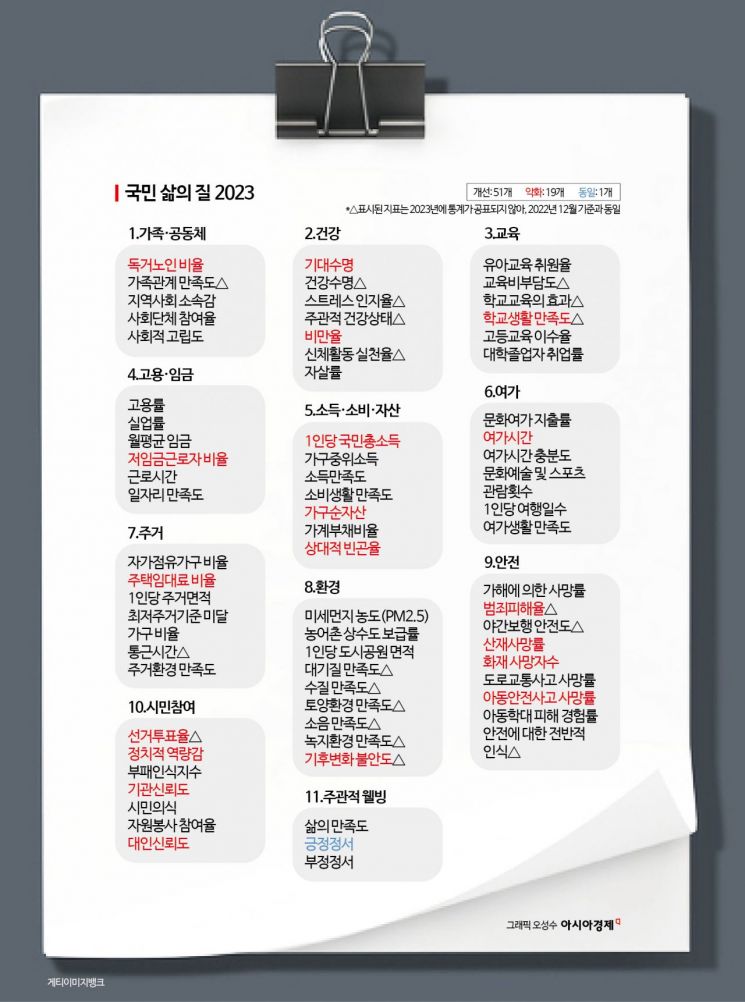
◆ Indicators that had improved after COVID-19 have worsened again = Since the reporting periods (1 to 3 years) and publication times (2019 to 2023) vary by indicator, 52 of the total 71 indicators were updated in this report. The remaining 19 indicators are the same as those in the previous year's report.
Among the 52 updated indicators, 36 (69.2%) improved compared to the previous period, 15 (28.8%) worsened, and 1 remained unchanged. Compared to the '2022 Quality of Life Report,' where 14 out of 62 updated indicators (22.6%) had worsened, the proportion of worsening indicators has increased.
However, Statistics Korea stated that interpreting this as a deterioration in quality of life is not appropriate. Choi Ba-ul, head of the Economic and Social Statistics Research Division at the Statistics Development Institute, explained, "Since the update cycles of the data vary, the number of improved indicators in a particular year may be slightly lower."
A notable feature in this data is that some indicators that had recovered in the 2022 report, right after COVID-19, showed a pattern of worsening again.
The number of cultural, arts, and sports event attendances (4.5 times → 7.0 times), volunteer participation rate (8.4% → 10.6%), travel days (6.58 days → 8.29 days), and social group participation rate (47.7% → 50.9%) slightly improved after worsening during COVID-19 but still have not reached pre-pandemic levels.
The obesity rate increased slightly from 37.1% to 37.2%, and interpersonal trust declined from 59.3% to 54.6%. In particular, the female obesity rate decreased to 25.7% in 2022, similar to the pre-COVID-19 level of 25.0%, but the male obesity rate remained at 47.7%, failing to return to the previous level of 41.8%.
Life expectancy, which had been steadily rising since the indicator was first compiled in 1970, decreased for the first time due to increased deaths from COVID-19, recording 82.7 years in 2022. This is a 0.9-year drop compared to the previous year. The decline in life expectancy due to COVID-19 is a global trend. The United States also saw a decrease from 78.8 years to 77.0 years, and the United Kingdom from 81.4 years to 80.4 years.
On the other hand, indicators such as employment rate (62.1% → 62.6%), unemployment rate (2.9% → 2.7%), employment rate of university graduates (67.7% → 69.6%), and fine dust concentration (18.7㎍/㎥ → 17.9㎍/㎥) improved compared to the COVID-19 period. Additionally, the rate of child abuse victimization (501.9 cases → 384.7 cases) and household debt ratio (209.8% → 203.7%) worsened sharply in 2021 but improved in 2022 compared to the previous year.
◆ Net assets decreased, and deaths from industrial accidents and fires increased = By area, based on the updated indicators, three or more worsening indicators were found in the fields of ▲income, consumption, and assets ▲safety ▲and civic participation.
In the income, consumption, and assets sector, ▲gross national income per capita ▲household net assets ▲and relative poverty rate worsened.
Gross National Income (GNI) per capita was 36.42 million KRW in 2022, down about 170,000 KRW (0.5%) from 36.59 million KRW the previous year. GNI represents the total income earned by nationals and is an indicator that comprehensively shows the economic foundation of well-being, as it has an absolute impact on the consumption and welfare of a nation's people.
Household net assets, which exclude liabilities from household assets (real value), decreased by 33.16 million KRW from 423.34 million KRW in 2022 to 390.18 million KRW. Both real net asset value and nominal value declined during the same period, from 456.02 million KRW to 435.40 million KRW. The decline in housing prices was the main factor affecting the decrease in net assets.
The 'relative poverty rate,' which refers to the proportion of households earning less than 50% of the median income, was 14.9% in 2022. The relative poverty rate had been steadily decreasing since it recorded 18.6% in 2011 but slightly increased from 14.8% in 2021.
In the safety sector, ▲industrial accident death rate ▲number of fire-related deaths ▲and child safety accident death rate worsened. The child safety accident death rate had been steadily decreasing since 2000 but increased by 0.1 per 100,000 people to 2.3 in 2022 compared to the previous year. The industrial accident death rate, which indicates deaths per 10,000 workers, rose to 1.10 in 2022 from 1.07 in 2021. The number of deaths due to industrial accidents also increased by 143, from 2,080 in 2021 to 2,223 in 2022. Fire-related deaths rose by 65 to 341 in 2022 compared to 2021, and the number of fire incidents increased from 36,267 in 2021 to 40,113 in 2022.
In the civic participation sector, ▲political efficacy ▲institutional trust ▲and interpersonal trust worsened. In particular, both institutional trust and interpersonal trust slightly declined in 2022 after rising in 2021.
Interpersonal trust dropped 4.7 percentage points from the previous year to 54.6% in 2022. The youth group (ages 19?29) recorded the lowest interpersonal trust at 50.7%. This indicates that the decline in interpersonal trust caused by COVID-19 has still not recovered. Institutional trust had been around 39?41% from 2014 to 2019, surged to 48.3% in 2020 and 55.4% in 2021, but slightly fell to 52.8% in 2022.
Political helplessness also increased. 'Political efficacy' refers to the proportion of the population who perceive themselves as having political efficacy. Political efficacy, which had risen to 26.7% in 2013, dropped to 15.2% in 2022, marking the lowest level since 2013.
© The Asia Business Daily(www.asiae.co.kr). All rights reserved.
![Clutching a Stolen Dior Bag, Saying "I Hate Being Poor but Real"... The Grotesque Con of a "Human Knockoff" [Slate]](https://cwcontent.asiae.co.kr/asiaresize/183/2026021902243444107_1771435474.jpg)











