Researcher Jongwook Lee of Samsung Securities Announces
High-Performance AI Chips Embedded in Phones and PCs Released
"Collaboration Needed... Must Enhance Consumer Satisfaction"
The on-device AI market, which enhances efficiency and security by embedding artificial intelligence (AI) technology into hardware, is expected to officially open.
It is analyzed that from this year until 2026, about one-third of smartphones and two-thirds of PCs will be shipped equipped with on-device AI technology.
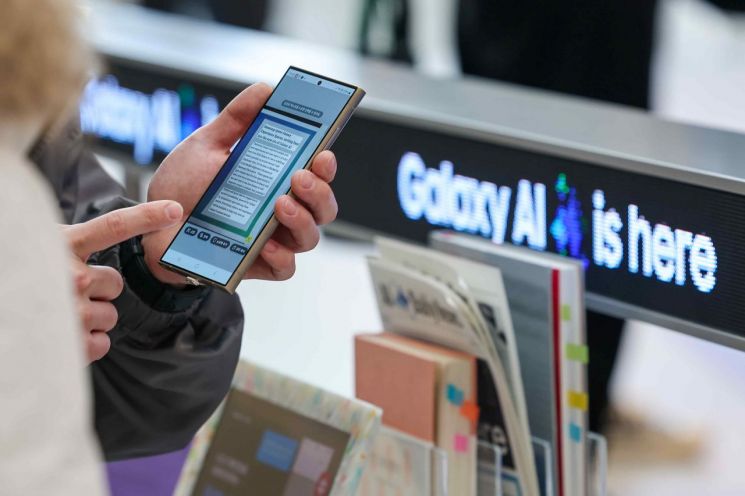 Citizens are experiencing AI features at the Galaxy Studio, a Galaxy S24 experience space set up in Times Square, Yeongdeungpo-gu, Seoul.
 [Image source=Yonhap News]
Jongwook Lee, a research fellow at Samsung Securities, recently stated this at a press briefing on the trends of the on-device AI industry and technology, held at the Korea Press Center in Jung-gu, Seoul, led by the Ministry of Science and ICT.
In Korea, on-device AI, which allows various AI functions to be used without an internet connection, was recently introduced through Samsung Electronics' Galaxy S24 series.
Starting with OpenAI's GPT, the development of generative AI technology is accelerating, with AI model sizes growing tenfold each year. This has created a situation where existing hardware struggles to support new AI software technologies.
Additionally, as software companies operate advanced AI technologies, cloud costs increase while privacy protection issues inevitably come to the forefront.
Accordingly, the trend is shifting to embedding neural processing units (NPUs) in devices such as smartphones and PCs to enable fast and efficient AI model training and inference, explained the research fellow.
Through on-device AI, users can utilize AI functions such as chatbot features, text summarization, grammar correction, and image generation even while offline.
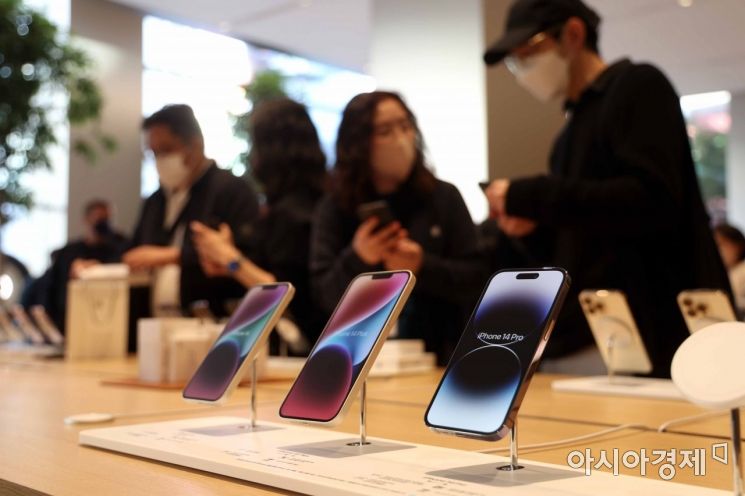 Citizens are examining products at the Apple Store in Myeongdong, Jung-gu, Seoul. Photo by Moon Honam munonam@
The research fellow said, "OpenAI is considering what device design optimized for AI looks like together with Jonathan Ive, a former Apple designer," adding, "Apple's progress in the AI field has been somewhat slow, but an AI roadmap is expected to be released in the first week of June."
He predicted, "Traditional manufacturers will also embed AI semiconductors in their products," and added, "Korea, which has various industries such as shipbuilding, construction, and distribution, could create a favorable market landscape if proactive AI collaboration between different industries takes place."
However, an increase in device prices seems inevitable. Just as Apple surprised people by launching the iPhone X with enhanced camera features at a record-high price of $999 in 2017, it is difficult to avoid price increases for devices equipped with high-performance AI chips.
The research fellow said, "Price increases are expected to start with flagship models and then spread downward," forecasting the strong presence of Apple, which holds about 75% of the global premium smartphone market.
He added, "If consumers are satisfied and continue to use the devices despite the price increase, it means there is utility," and said, "It is true that AI technology is costly, but it is much more important whether companies satisfy consumers."
© The Asia Business Daily(www.asiae.co.kr). All rights reserved.
![Clutching a Stolen Dior Bag, Saying "I Hate Being Poor but Real"... The Grotesque Con of a "Human Knockoff" [Slate]](https://cwcontent.asiae.co.kr/asiaresize/183/2026021902243444107_1771435474.jpg)

















