Government Provides Incentives for Cheongyang Chili Peppers and Cucumbers
Diesel and CNG Fuel Price-Linked Subsidies Extended Until April
The government has decided to take additional price stabilization measures, such as allocating an additional 20,000 tons of imported fruit and providing subsidies for Cheongyang chili peppers, cucumbers, and green onions in response to the sharp rise in fruit and vegetable prices. The fuel price-linked subsidies for diesel and compressed natural gas (CNG) will also be extended until April. Large retailers will be allowed to directly import the allocated tariff quota for fruits, and the remaining 527 tons of oranges will be fully imported within this month to lower fruit prices.
On the 22nd, Choi Sang-mok, Deputy Prime Minister and Minister of Economy and Finance, held a meeting on price stabilization issues at the Government Complex Sejong with key vice ministers from major ministries, including Song Mi-ryeong, Minister of Agriculture, Food and Rural Affairs, to review price trends and supply-demand conditions for major items such as agricultural, livestock, and fishery products, petroleum products, and services.
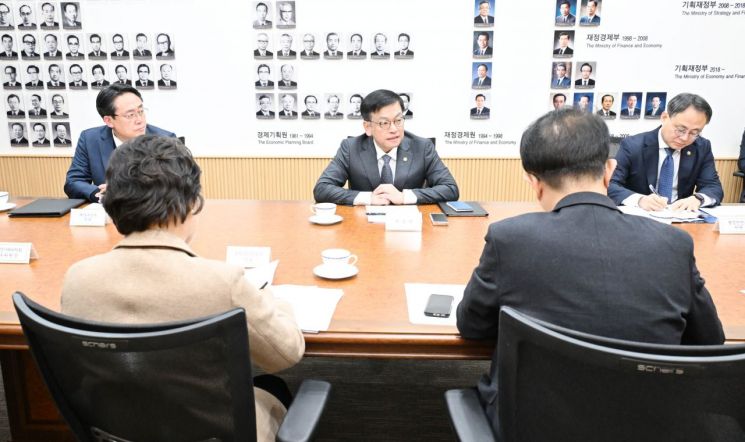
The attendees evaluated that although consumer prices in January fell by 2.8% compared to the previous month, indicating a continued trend of price stabilization, there remain concerns such as the persistent strength of fruit prices and the recent rise in gasoline prices. They agreed to further strengthen efforts to stabilize prices.
To stabilize fruit supply and demand, the government decided to import the remaining 527 tons of the 8,500-ton tariff quota for oranges within this month after reducing tariffs.
Additionally, reflecting the actual demand of retailers, an additional 20,000 tons of tariff-reduced fruit will be allocated to importers by the end of next month, and related systems, including allowing direct imports by retailers, will be immediately improved. 'Direct import by retailers' opens the way for large retailers to directly import allocated tariff quota volumes, which had previously been limited to importers, food manufacturing and processing companies, and food material suppliers.
The government will conduct weekly surveys of major retailers and consumer outlets to swiftly introduce allocated tariff quota volumes, continuously monitor fruit import performance, and actively consider additional tariff quotas if necessary.
From the 26th, for two weeks, a shipment incentive of 1,300 KRW per kilogram will be newly provided for Cheongyang chili peppers, cucumbers, and zucchini, and a supply price support of 500 KRW per kilogram for green onions will continue.
Regarding petroleum products, to minimize the impact of recent international oil price increases, the government will extend the fuel tax reduction measures and the fuel price-linked subsidies for diesel and CNG, which were scheduled to end in February, until April to help reduce fuel cost burdens. A government-wide petroleum market inspection team will also be intensively operated for one month starting today.
Efforts will also be made to stabilize service prices. Public utility charges will be frozen in principle during the first half of the year, and if there are reasons for increases, efforts will be made to absorb them internally through cost reduction and self-help measures. In particular, cooperation with local governments will be strengthened to ensure no additional increases in public transportation fares, which have a significant impact on prices, during the first half of the year.
For major service sectors such as aviation, delivery, and dining out, relevant ministries will closely monitor price trends and any unfair or opportunistic price hikes, and the Fair Trade Commission will continuously check for collusion, monopolistic practices, or competition-restricting behaviors using market positions.
The Ministry of Economy and Finance stated, "The government plans to continue focusing inter-ministerial efforts to ensure that inflation stabilizes in the 2% range early so that the public can feel the effects of price stabilization."
© The Asia Business Daily(www.asiae.co.kr). All rights reserved.
![Clutching a Stolen Dior Bag, Saying "I Hate Being Poor but Real"... The Grotesque Con of a "Human Knockoff" [Slate]](https://cwcontent.asiae.co.kr/asiaresize/183/2026021902243444107_1771435474.jpg)















