Two New Bus Stops Added at Myeongdong Entrance
Stops at Myeongdong and Namdaemun Tax Office Dispersed
Dispersed at Gangnam Station, Sinnonhyeon Station, and Sadang Station
Alleviating Congestion on Routes in the Same Direction
The Seoul Metropolitan Government is undertaking a major overhaul of key bus stops that cause pedestrian congestion and traffic jams due to the concentration of intercity buses. The targeted locations include Myeongdong Entrance, where the previous bus crisis occurred, as well as Namdaemun Tax Office, Gangnam Station, Sinnonhyeon Station, and Sadang Station.
On the 22nd, Seoul announced that it will implement urgent measures focused on establishing new bus stops and dispersing existing ones to improve congestion at intercity bus stops that have experienced heavy pedestrian traffic and safety concerns.
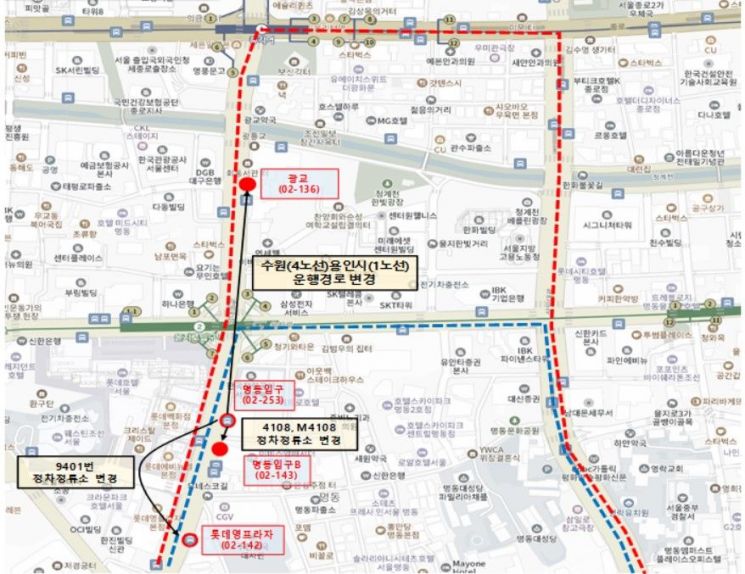
The congestion improvement measures are based on ▲deployment of guidance personnel ▲establishment and adjustment of bus stops ▲route adjustments. First, Seoul plans to deploy guidance personnel near bus stops to prevent crowds from gathering and to maintain order on site. Starting with the Myeongdong Entrance bus stop on the 8th of last month, most of the on-site guidance personnel deployment has been completed, and Seoul will continue to operate them in cooperation with the Association of Model Drivers until the situation stabilizes.
In particular, for major bus stops where intercity buses are concentrated and cause pedestrian congestion and traffic jams, Seoul will implement new bus stops, relocate existing ones, and adjust routes according to the status of each area. The main sections include Myeongdong Entrance, Namdaemun Tax Office, Gangnam Station, Sinnonhyeon Station, and Sadang Station.
Considering the high concentration during evening rush hours at the Myeongdong Entrance bus stop, eight intercity bus routes will be dispersed to the newly established nearby Gwanggyo bus stop and Myeongdong Entrance B bus stop. The new bus stops will begin operation on the 24th. For the Namdaemun Tax Office (formerly Baek Hospital) bus stop, in coordination with Gyeonggi Province, 10 routes will be relocated to the newly established Myeongdong Cathedral bus stop (tentative name) to reduce congestion.
Gangnam Station, Sinnonhyeon Station, and Sadang Station, which have experienced high congestion due to bus concentration, will also be managed promptly through bus stop adjustments within the first half of the year and route adjustments by the end of the year in cooperation with Gyeonggi Province. For Gangnam Station, to alleviate route concentration at the central bus stop, bus routes heading in the same direction will be dispersed and relocated to three nearby curbside bus stops.
Sinnonhyeon Station has also experienced heavy traffic concentration. To ensure pedestrian safety during evening rush hours, guidance personnel have been deployed at the currently congested bus stops. During the first half of the year, discussions are underway to relocate five bus routes to nearby bus stops. At Sadang Station, guidance personnel have been deployed at the highly congested bus stop in front of Exit 9, and one bus route will be relocated to the bus stop in front of Exit 4 during the first half of the year to alleviate congestion.
Additionally, fundamental measures to fundamentally improve intercity bus congestion are being discussed. Since route adjustments require consultation with the Metropolitan Transportation Commission, the license holder for intercity buses, and Gyeonggi Province, various efforts will be made through a working-level consultative body among related agencies to resolve route concentration issues by changing operation routes. For Myeongdong Entrance, five routes will be adjusted to turn back in nearby areas through route changes, and two routes will be arranged to pass through the Myeongdong Entrance bus stop without stopping, thereby dispersing overly concentrated routes.
Before implementing these measures, Seoul conducted on-site surveys at highly congested bus stops and carried out simulations reflecting bus stop dispersal and route adjustment plans. According to simulations conducted by the Seoul Institute on the dispersal and route adjustment measures for the Myeongdong Entrance bus stop prepared by Seoul, the average bus waiting queue length decreased from 312m to 93m, and the speed of general vehicle traffic increased from 17.9 km/h to 21.7 km/h, indicating meaningful results in congestion relief. Additionally, to verify the effects of dispersing boarding and alighting at the Namdaemun Tax Office bus stop, Seoul commissioned the University of Seoul to conduct simulation analysis. Currently, 83% of the routes passing through the Myeongdong Cathedral intersection are Gyeonggi buses, and the central lane experiences overcrowding. The analysis predicts that dispersing to adjacent curbside bus stops will reduce travel time on Samil-daero by about 5%.
Yoon Jong-jang, Director of Urban Transportation at Seoul City, stated, "Despite the road capacity limits, many routes such as intercity buses are concentrated at some bus stops, causing not only inconvenience for passengers boarding but also safety concerns such as jaywalking." He added, "From a long-term perspective for the convenience of metropolitan public transportation, dispersing bus stops and adjusting routes are essential. We will continue to cooperate with related agencies such as the Metropolitan Transportation Commission and Gyeonggi Province to do our best to prepare measures to improve congestion."
© The Asia Business Daily(www.asiae.co.kr). All rights reserved.
![Clutching a Stolen Dior Bag, Saying "I Hate Being Poor but Real"... The Grotesque Con of a "Human Knockoff" [Slate]](https://cwcontent.asiae.co.kr/asiaresize/183/2026021902243444107_1771435474.jpg)











