Equivalent to 330% of Global GDP
Last year, the global debt scale surpassed $313 trillion, marking an 'all-time high.' Amid the continuing increase in debt, concerns have arisen that the repayment burden on governments and corporations has intensified in the high-interest-rate environment.
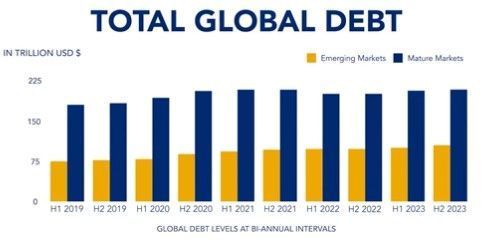
According to the 'Global Debt Report' released on the 21st (local time) by the International Institute of Finance (IIF), the global debt scale as of the end of 2023 was recorded at $313 trillion, an increase of $15 trillion compared to the previous year. This is an all-time high, equivalent to 330% of the global Gross Domestic Product (GDP). Over the past decade, global debt has expanded by more than $100 trillion.
By country, advanced economies such as the United States, France, and Germany accounted for 55% of the total debt. Besides advanced countries, debt is rapidly increasing in countries like India, Argentina, China, Malaysia, and South Africa, which is cited as a future concern. By sector, government debt was identified at $89.9 trillion. This figure is about $71 trillion higher compared to immediately after the pandemic. This is analyzed as a consequence of most countries implementing expansionary fiscal policies to stimulate the economy following the pandemic shock.
In particular, this debt scale draws more attention given that the monetary policy stance of major central banks has rapidly shifted from low interest rates to high interest rates in recent years. It indicates that the repayment burden on governments and corporations has significantly increased due to the cumulative effects of interest rate hikes. The IIF also pointed out that governments with high debt levels have seen "a substantial surge in average interest expenditures relative to income." The average government debt interest expenditure in Western European and North American countries is estimated to expand from 3.2% of revenue last year to 4.1% next year.
Accordingly, analyses suggest that the longer the high-interest-rate stance continues, the greater the pain caused by debt will inevitably become. The IIF conveyed the atmosphere, stating, "The economy still lags behind potential growth rates, and interest costs are rising," and "Funding conditions are becoming increasingly difficult for countries with relatively high external borrowing dependence."
Currently, financial markets expect that major countries such as the United States and Europe will begin cutting interest rates within the year. However, central bank officials, including those from the Federal Reserve (Fed), have expressed caution against the market's early rate-cut expectations due to concerns that inflation might rebound.
The IIF also expressed concerns in the report that rising inflationary pressures could lead to increased borrowing costs. It identified risks such as geo-economic fragmentation, geopolitical conflicts, and protectionism, diagnosing that global volatility and debt vulnerabilities are increasing.
© The Asia Business Daily(www.asiae.co.kr). All rights reserved.
![Clutching a Stolen Dior Bag, Saying "I Hate Being Poor but Real"... The Grotesque Con of a "Human Knockoff" [Slate]](https://cwcontent.asiae.co.kr/asiaresize/183/2026021902243444107_1771435474.jpg)
















