"Fewer Opportunities for Early-Career Researchers to Start New Projects"
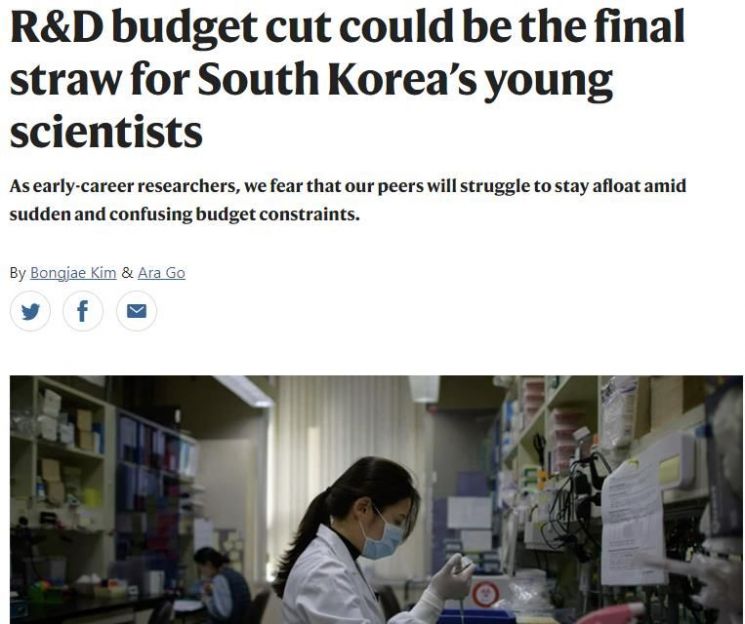
The world-renowned scientific journal Nature published an article on the 20th local time featuring Korean researchers' concerns that cuts to South Korea's research and development (R&D) budget will make life even more difficult for researchers.
The article titled "R&D Budget Cuts Could Be a Critical Blow to Young Scientists in Korea," published in Nature that day, was written by Professors Kim Bongjae of the Department of Physics at Kyungpook National University and Go Ara of the Department of Physics at Chonnam National University.
In their article, the two professors pointed out that "the 14.7% budget cut at the end of last December will generally make researchers' lives more difficult," adding that "early-career scientists are likely to be most affected as they are already facing funding shortages and job insecurity."
They noted that although the budget cuts were triggered by government fiscal issues, the government is overlooking the important role of R&D investment not only in producing immediate research results but also in nurturing future generations of experts. In particular, universities are facing a dual challenge of a sharp decline in student numbers and the shift from basic research to industrial research, raising concerns that the space for basic science researchers will further diminish.
The two professors also stated that some basic research project funds have been cut, reducing opportunities for young researchers to start new projects, and that they have already made difficult decisions such as suspending recruitment of student researchers or canceling equipment orders. Although the government cited reallocating funds to young researchers as one reason for the R&D budget cuts, the unpredictability of policies is causing increased confusion.
The professors pointed out, "While support for young scientists in new projects has increased, ongoing projects have been cut by 10%," calling this move contradictory and harmful to the stability and continuity of research efforts. They cited Japan’s example, where issues with researcher salaries have led to excessive burdens on professors in education, industry-academia cooperation, and community engagement, resulting in decreased research capabilities, emphasizing that this is the situation Korea is facing.
They concluded, "The solution is to support young researchers," and suggested, "Before decline begins, we must show young researchers that there is hope for the future."
© The Asia Business Daily(www.asiae.co.kr). All rights reserved.
![Clutching a Stolen Dior Bag, Saying "I Hate Being Poor but Real"... The Grotesque Con of a "Human Knockoff" [Slate]](https://cwcontent.asiae.co.kr/asiaresize/183/2026021902243444107_1771435474.jpg)















