PDP's Negotiation Group Speech Reveals 5 Major Political Reforms
Urges Re-negotiation of Ruling and Opposition's Current Issue Laws
Proposes 5 Directions for Livelihood Reforms Including Labor Reform
Yoon Jae-ok, the floor leader of the People Power Party, stated on the 21st that if they win the general election, they will delegate authority over election systems and lawmakers' salaries to external bodies to reform the National Assembly. Regarding current issues such as renegotiating the Serious Accident Punishment Act for workplaces with fewer than 50 employees, he urged continued negotiations between the ruling and opposition parties even during the election period.
In his speech to the negotiation groups that day, Floor Leader Yoon promised, "The People Power Party will push for five major political reforms in the 22nd National Assembly to fundamentally change parliamentary politics." He added, "The opposition claims that the semi-proportional representation system is more democratic and innovative compared to the parallel proportional representation system, but in reality, it only serves as an incubator for political contamination." He announced, "We will form a fair and transparent independent external committee and delegate election system reforms, including the abolition of the semi-proportional representation system."
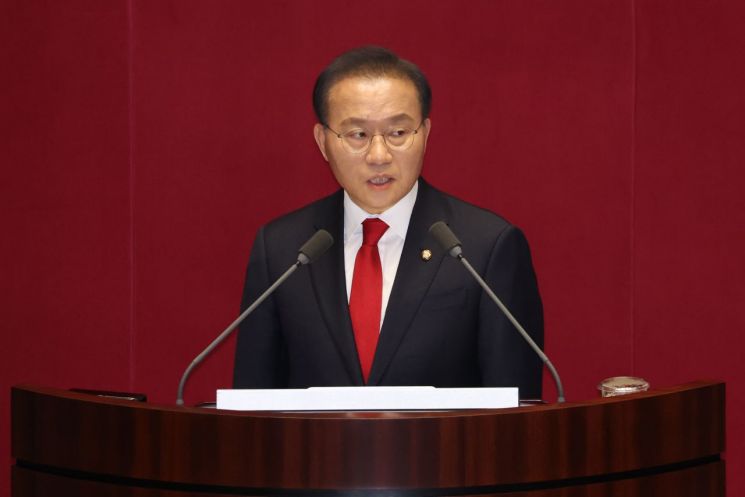
Regarding the issue of electoral district delineation, where the ruling and opposition parties fail to reach consensus even after the delineation process, he said, "We will transfer authority to the Central Election Commission." On lawmakers' salaries, he stated, "We will establish a separate independent body to entrust the decision to the people," adding, "By forming an independent body composed of external personnel to decide on the increase or decrease and payment methods of lawmakers' salaries, we can restore trust in the National Assembly." Previously, Han Dong-hoon, the emergency committee chairman of the People Power Party, proposed, as a personal opinion, reducing lawmakers' salaries to one-third and adjusting them to the level of the national median income (the median household income, 53.62 million KRW).
Floor Leader Yoon also promised improvements to the agenda adjustment committee, which has become a legal means of rushing bills, and the introduction of a legislative impact analysis system to improve legislative quality. Additionally, he mentioned the need to renegotiate the postponement of the Serious Accident Punishment Act, re-discuss the Itaewon disaster special law, amend the Export-Import Bank Act to support defense industry exports, and revise the 'High-Level Radioactive Waste Management Special Act' to manage spent nuclear fuel. He proposed, "I suggest a grand consensus so that the 21st National Assembly can diligently take care of people's livelihoods during the remaining term." Regarding the Serious Accident Punishment Act, he said, "If negotiations are refused, we will amend it unilaterally after winning the general election."
Furthermore, Floor Leader Yoon proposed five major livelihood reforms reflecting the People Power Party's general election pledges. First, regarding labor reform, he argued, "The labor market must be made more flexible so that companies can quickly respond to changing industrial demands." He also stated, "The seniority-based wage system should be shifted to a job performance-centered system."
As measures to address low birth rates, he suggested establishing a population division at the vice prime minister level, mandating one month of paid paternity leave, raising the ceiling on parental leave benefits, introducing paid child care leave, and providing manpower support for parental leave in small and medium-sized enterprises.
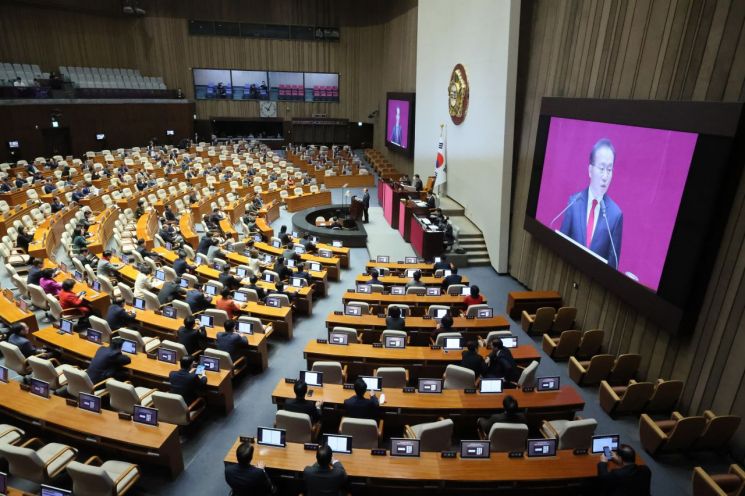
Regarding regulatory reform to boost economic growth, he said, "In the 22nd National Assembly, we will carry out more bold regulatory reforms than any previous assembly," adding, "Regulatory bills that significantly impact the economy and people's livelihoods will, in principle, include sunset clauses, and their extension will be decided through periodic reviews." Furthermore, for new industries, he stated, "We will introduce a 'Regulation Zero Box' system that preemptively exempts regulatory laws except for the minimum necessary regulations for public safety."
On territorial reform, he said, "It is time to promote administrative district reorganization in Seoul and Gyeonggi Province," adding, "We will push for the incorporation of Seoul-adjacent cities such as Gimpo and Guri into Seoul, and it is desirable for northern Gyeonggi to grow independently by escaping metropolitan area regulations through subdivision." He also reaffirmed the intention to relocate the Korea Development Bank to Busan and exempt inheritance tax for succession of family businesses in small and medium-sized enterprises relocating to local areas.
Additionally, regarding financial reform, he promised a prompt investigation and fair compensation by financial authorities concerning the Hong Kong ELS incident, strengthening responsibility for incomplete sales, raising the deposit insurance limit to 100 million KRW, and introducing tax-saving savings accounts.
© The Asia Business Daily(www.asiae.co.kr). All rights reserved.


















