Andrew Bailey, Governor of the Bank of England (BOE), which is leading the monetary policy of the UK entering a technical recession, stated that interest rates could be cut before achieving the 2% inflation target. Investment bank Goldman Sachs predicted that the first rate cut in the UK will take place in June.
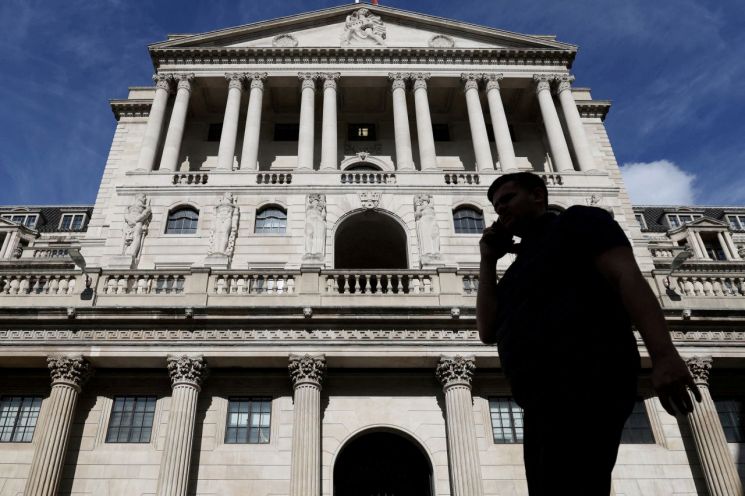
Governor Bailey appeared before the UK Parliament on the 20th (local time) and said, "It is not necessary for inflation to return to the target (2%) before cutting interest rates," adding, "I want to make that clear. It is not necessary." The BOE held the interest rate steady at 5.25% for the fourth consecutive time at the Monetary Policy Committee meeting earlier this month. This is the highest level in about 16 years.
Regarding the growing market expectations for rate cuts within the year, Governor Bailey also described them as "not unreasonable." He said, "We do not support the market's (rate cut) curve. We do not predict when or how much rates will be cut," but added, "Looking at the outline of the forecasts, it is clear that the market's thinking is not unreasonable." Earlier, the BOE's Chief Economist also hinted that the first rate cut could occur in a few months.
In particular, Governor Bailey emphasized that the key factor in rate decisions at this point is the confidence that inflation is continuously falling toward the 2% price stability target. He explained that even if the 2% target is temporarily achieved, it is meaningless if inflation rebounds immediately afterward. This aligns with recent remarks by Jerome Powell, Chair of the U.S. Federal Reserve (Fed), who stated that a sustained easing trend is more important than individual inflation indicators as a prerequisite for rate cuts. Last month, the UK's Consumer Price Index (CPI) rose by 4.0%, below market expectations.
The UK economy recorded negative growth in the fourth quarter of last year, entering a 'technical recession,' which means two consecutive quarters of negative growth. Accordingly, voices in the market are pouring out that it will be difficult to expect economic improvement unless monetary policy shifts to rate cuts. While not ruling out market expectations for rate cuts, Governor Bailey diagnosed that "the economy is already showing signs of recovery." He emphasized that although the fourth-quarter growth rate (-0.3%) was worse than the BOE's forecast, it was a "shallow recession," and recent indicators confirm a robust labor market and household income.
On the same day, Goldman Sachs predicted that the BOE will make its first rate cut in June. In a report released that day, Goldman Sachs said that although UK inflation is showing signs of slowing, the BOE will continue a cautious approach, delaying the expected timing of the first rate cut from May to June. However, once rate cuts begin, they expect the BOE to cut faster and more aggressively than the market anticipates. Goldman Sachs forecasted that the BOE could cut rates five consecutive times by 0.25 percentage points each, bringing the year-end rate down to 4%. This is more hawkish than the market's strong expectation of three cuts within the year.
© The Asia Business Daily(www.asiae.co.kr). All rights reserved.
![Clutching a Stolen Dior Bag, Saying "I Hate Being Poor but Real"... The Grotesque Con of a "Human Knockoff" [Slate]](https://cwcontent.asiae.co.kr/asiaresize/183/2026021902243444107_1771435474.jpg)















