Utilizing LiDAR and AI Technologies... Vehicle Passage and Opposite Side Situation Verification Possible
All Systems to be Completed by August, Acquired Data to be Used for Data-Driven Leading Administration
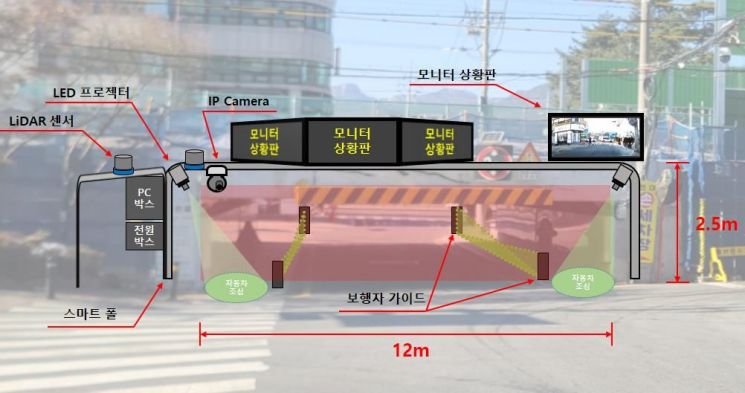
Everyone has probably stopped at least once while passing through a tunnel or underpass, wondering if their vehicle can pass through. Although there are height signs, many have gotten out of their cars to estimate the height since they do not know their vehicle's exact height.
Dobong-gu (District Mayor Oh Eon-seok) announced that it will promote a "LiDAR-Based Demonstration Project for Tunnel Safe Passage" to reduce such inconveniences and protect vehicles and facilities.
The budget required for the project was secured through selection in the Ministry of Land, Infrastructure and Transport's "Smart City Innovation Technology Discovery Project" competition.
Dobong-gu has one underpass with a height of 1.8m and two underpasses with a height of 2m due to the passage of Subway Line 1. Although this area accounts for only 0.3% of the total residential area in Dobong-gu, the traffic accident rate is seven times higher.
The district plans to secure the safety of pedestrians and drivers by utilizing LiDAR and AI technology in underpass passageways for the first time in Korea.
The technology applied to the underpass passageways measures the height of incoming vehicles and informs drivers whether passage is possible, assisting vehicle passage. It also informs drivers and pedestrians about the situation on the opposite side, reducing the occurrence of traffic accidents.
Additionally, laser emitting devices installed under the underpasses will ensure pedestrians can pass safely.
All systems are scheduled to be completed by August, and the information acquired through system operation will be digitized and stored on the urban data platform to be used for data-driven leading administration such as the e-Gujung Status Board.
Oh Eon-seok, Mayor of Dobong-gu, said, “The district aims to solve urban problems by introducing advanced technologies. This demonstration project is one of them,” adding, “We will continue to resolve urban issues and residents’ inconveniences through smart city projects utilizing new technologies, such as building an AI-based urban growth simulator platform.”
Meanwhile, in addition to this competition project, the district has been selected annually for projects related to data and smart cities by central government ministries, including the establishment of a CCTV integrated platform in 2020, an urban data aggregation platform in 2021, and a cloud-based air quality monitoring network in 2023.
© The Asia Business Daily(www.asiae.co.kr). All rights reserved.
![Clutching a Stolen Dior Bag, Saying "I Hate Being Poor but Real"... The Grotesque Con of a "Human Knockoff" [Slate]](https://cwcontent.asiae.co.kr/asiaresize/183/2026021902243444107_1771435474.jpg)















