Shinhan, 0.05~0.20%P Increase
Kookmin, Mortgage Loan Additional Interest Rate Up 0.23%P
Following KB Kookmin Bank, Shinhan Bank has also slightly raised interest rates on some household loan products, including mortgage loans and jeonse deposit loans. This comes as authorities emphasize stable management of household debt from this year, while mortgage loans have increased by about 5 trillion won in the past month due to factors such as a decline in market interest rates.
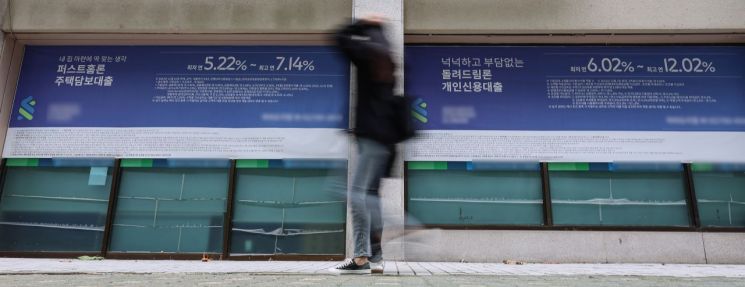
According to the financial sector on the 19th, Shinhan Bank raised interest rates on mortgage loans and jeonse deposit loans by 0.05 to 0.20 percentage points depending on the product, effective from that day. Accordingly, for Shinhan Bank’s representative mortgage loan product, Shinhan Housing Loan, the new Cost of Funds Index (COFIX) product rose by 0.20 percentage points to 4.21?5.82%, and the 5-year corporate bond product increased by 0.15 percentage points to 3.52?5.53%.
The representative jeonse deposit loan product, Shinhan Jeonse Loan, also increased by 0.10 percentage points to 3.96?5.46% based on the Korea Housing Finance Corporation (HF) guaranteed product. Other household loan refinancing products saw mortgage loan rates rise by 0.07?0.10 percentage points and jeonse deposit loan rates by 0.05?0.10 percentage points.
Prior to Shinhan Bank, KB Kookmin Bank also raised the additional interest rate on some mortgage loan products by 0.23 percentage points on the 7th. The banking sector’s slight increase in mortgage and other loan interest rates is aimed at managing household debt. A Shinhan Bank official explained, "We raised interest rates on some loan products to ensure stable management of household debt," adding, "Even slight interest rate hikes or cuts can have the effect of curbing loan demand."
The government has set a policy to manage the growth rate of household debt within the nominal growth rate starting this year to stabilize household debt, which has exceeded 100% of gross domestic product (GDP). The government’s nominal growth rate target for this year is 4.9%. In line with this, major financial holding companies have also informed authorities that they will manage this year’s household debt growth rate within the range of 1.5?2.0%.
However, household debt has again shown a high growth rate since the new year. According to the Bank of Korea, mortgage loans in the banking sector increased by 4.9 trillion won in January, marking the second-highest increase since January 2021 (5 trillion won increase).
The recent decline in market interest rates is cited as the background for this increase. In November last year, the U.S. Federal Reserve (Fed) hinted at the end of tightening, raising expectations for an early rate cut, which has driven interest rates down. According to the Korea Financial Investment Association, the 5-year bank bond yield, which was 4.733% in early November, has continuously declined since the Fed’s indication of ending tightening, falling to around 3.772% as of the 2nd of this month. Consequently, the COFIX rate, which had risen to the 4% range at the end of last year, dropped to 3.66% last month. The decline in market interest rates has led to a delayed reduction in loan interest rates, boosting loan demand. Recently, following the release of the U.S. January Consumer Price Index (CPI) and Producer Price Index (PPI), expectations that the Fed’s rate cut timing will be delayed to the second half of the year have strengthened, pushing rates back up to the 3.9% range, leaving room for interest rates to rise.
Additionally, the Stress Debt Service Ratio (DSR) system, scheduled to be implemented from the 26th of this month, is also evaluated to have influenced loan demand. The Stress DSR applies a certain level of additional interest rate when calculating the DSR, reflecting possible future rate hikes. Since the additional interest rate is applied, loan limits inevitably decrease. A banking sector official said, "Loan demand increased due to the decline in market interest rates and the resulting loan interest rate cuts, and the announcement of the Stress DSR introduction likely led to loans being made to secure higher loan limits."
© The Asia Business Daily(www.asiae.co.kr). All rights reserved.
![Clutching a Stolen Dior Bag, Saying "I Hate Being Poor but Real"... The Grotesque Con of a "Human Knockoff" [Slate]](https://cwcontent.asiae.co.kr/asiaresize/183/2026021902243444107_1771435474.jpg)
















