Government Sets Target of 20 Million Foreign Tourists This Year
Professor Seoyonggu of Sookmyung Women's University Calls for Regional Diversification
Industry Advocates for Transportation Improvements Including Rail and Bus
Need to Expand Use of K-Content Also Raised
The government, aiming to attract 20 million foreign tourists this year, needs to expand and diversify tourism products and spending targets beyond the past focus on limited areas such as Myeongdong and Gwanghwamun in Seoul, to include the entire Republic of Korea in order to achieve results in revitalizing foreign tourism and consumption.
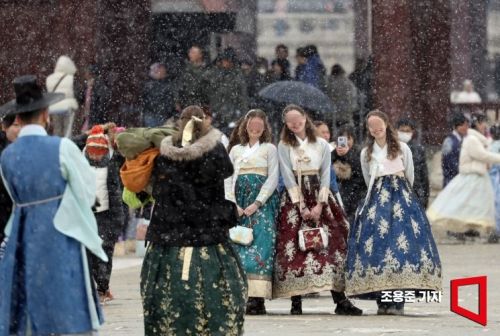 Last month on the 17th, foreign tourists visiting Gyeongbokgung Palace in Jongno-gu, Seoul, are enjoying the snowy scenery. Photo by Jo Yongjun jun21@
On the 20th, Professor Seo Yong-gu of the Department of Business Administration at Sookmyung Women's University advised in an interview with Asia Economy, “Currently, 80% of foreign tourists only visit Seoul and the metropolitan area, so I recommend creating various linked local tourism products to prevent this from stopping there.” He added, “Through continuous customer satisfaction, we need to provide long-term satisfaction and build bonds with tourists from each country.” Professor Seo suggested developing linked tourism products that allow foreign tourists visiting Korea to also visit other regions outside Seoul and the metropolitan area, such as Bu-Ul-Gyeong (Busan, Ulsan, Gyeongbuk), Gyeongju, Yeosu-Mokpo, and Gangwon-do.
He continued, “Like in Europe, Korea should also establish a transportation convenience system that integrates various types of transportation such as trains, ferries, express buses, city buses, and taxis, similar to a ‘Korea Pass’.” He recommended, “If foreign tourists are helped to freely travel anywhere nationwide, the amount they spend during their visit to Korea will increase accordingly, so the government and related companies need to actively consider this.”
 A foreign family visiting the 2024 Sancheoneo Festival held last month in Hwacheon-gun, Gangwon-do, is taking photos. [Photo by Hwacheon-gun]
There were also calls for improvements in public transportation and reservation/payment convenience to revitalize local tourism for inbound tourists. At the ‘2024 Inbound Trend’ event held last month by the Ministry of Culture, Sports and Tourism and the Korea Tourism Organization, Moon Yong-su, head of business development at Klook, pointed out, “Providing transportation convenience to foreign tourists is one of the most important issues in revitalizing local tourism.”
Mr. Moon analyzed, “Recently, sales of transportation products such as the Korail Pass and shuttle buses sold on Klook, which targets foreigners, have exploded. As transportation convenience has increased, sales of Klook users’ ski resort day tours and Nami Island travel products have also surged.” He argued that cooperation from the Ministry of Land, Infrastructure and Transport, Korail, and bus companies is necessary for this.
There was also an analysis that foreign tourists’ interest in various tourism destinations is increasing. Jin Jong-hwa, head of the China Regional Center at the Korea Tourism Organization, stated, “Previous surveys showed that 69% of Chinese tourists visiting Korea concentrated on Seoul, but recently, 30% of the younger generation prefer Jeju, and 15% chose Busan.” Jeong Ji-man, head of the Dubai branch of the Korea Tourism Organization, said, “Middle Eastern tourists visit Korea to enjoy scenery where the sea and mountains coexist and because of K-content such as dramas and movies,” advising, “There is a need to expand the use of K-content along with promoting nature tourism.”
© The Asia Business Daily(www.asiae.co.kr). All rights reserved.
![Clutching a Stolen Dior Bag, Saying "I Hate Being Poor but Real"... The Grotesque Con of a "Human Knockoff" [Slate]](https://cwcontent.asiae.co.kr/asiaresize/183/2026021902243444107_1771435474.jpg)

















