Discovered in the Italian Alps in 1931
"The part known as soft tissue is paint...
It does not mean the fossil is fake," emphasized
Some of the oldest early reptile fossils discovered in the Italian Alps have been revealed to be forged.
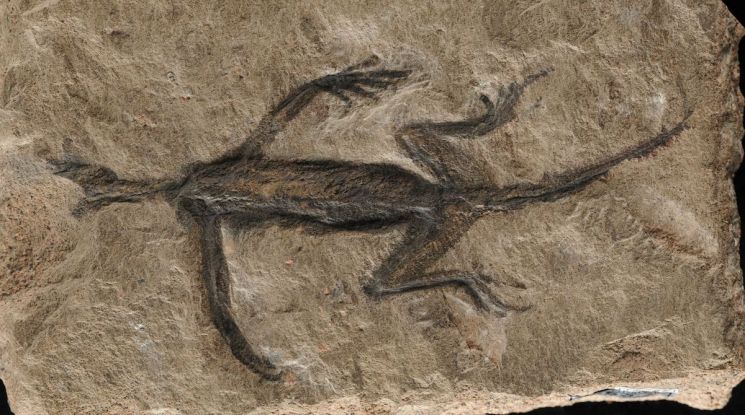 The oldest reptile fossil of Tridentinosaurus anticus.
 [Image source provided by Dr. Valentina Rossi]
On the 19th, Dr. Valentina Rossi and her research team at University College Cork in Ireland announced in the scientific journal Palaeontology that the part previously known as soft tissue in the 280-million-year-old reptile fossil 'Tridentinosaurus antiquus,' discovered in the Italian Alps in 1931, was actually paint. The team’s detailed analysis showed that the body outline, which appeared darker than the surrounding rock, was not soft tissue but paint, and they emphasized the need for caution when studying this fossil in the future.
This fossil has been a topic of interest since its discovery. It became especially famous because the body outline appeared darker than the rock, leading to the assumption that skin had been preserved. However, the researchers explained that detailed studies on this fossilized skin had not been conducted. Through microscopic analysis and ultraviolet photography of the fossil surface, the team revealed that the dark lizard-shaped outline was not skin tissue but black paint applied on the surface. Microscopic analysis showed that the texture and composition of the material forming the body outline did not match those of actual fossilized soft tissue. Ultraviolet photography analysis revealed that the entire specimen had been treated with a kind of 'coating material.'
The researchers stated, "In the past, it was common to coat fossils with varnish or lacquer, and sometimes this was necessary for specimen preservation," adding, "We hope that original soft tissue containing paleontological information remains beneath the coating layer." They further noted that the body outline was likely painted to enhance the fossil’s appearance and urged caution when using this specimen in future studies.
However, the team emphasized, "This finding does not mean the fossil is fake." They explained, "Although the preservation is not good, the hind limb bones, especially the femur, appear to be genuine reptile bones," and added, "Our analysis also revealed that small bone scales, known as osteoderms similar to crocodile scales, are present in the area presumed to be the back." They concluded by saying, "This study is an example of how modern analytical paleontology and rigorous scientific methods can solve paleontological mysteries that are nearly 100 years old."
© The Asia Business Daily(www.asiae.co.kr). All rights reserved.
![Clutching a Stolen Dior Bag, Saying "I Hate Being Poor but Real"... The Grotesque Con of a "Human Knockoff" [Slate]](https://cwcontent.asiae.co.kr/asiaresize/183/2026021902243444107_1771435474.jpg)















