Ukraine Aid Bill Faces House Passage Challenges Due to Republican Opposition
"64% of Ukraine Aid Returns to US Defense Industry"
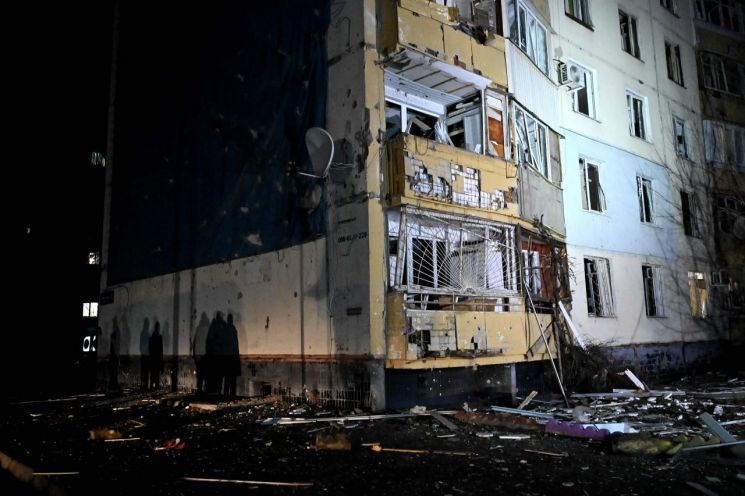
An analysis has emerged that the war between Russia and Ukraine is boosting the U.S. defense industry and generating significant economic effects. Amid Republican opposition preventing the Ukraine aid bill from passing the House, voices within the Biden administration mentioning the economic benefits of the war have drawn attention.
On the 18th (local time), the Wall Street Journal (WSJ) reported, citing data from the U.S. Federal Reserve (Fed), that the U.S. defense and aerospace equipment industrial production index rose from 109.6 in January 2022, just before Russia's invasion of Ukraine, to 128.8 as of January this year. This represents a 17.5% increase in U.S. defense and aerospace industry production immediately following the Ukraine war.
Not only the U.S., but the European Union (EU) also supported Ukraine with weapons, leading to a massive inflow of funds into the U.S. defense industry. According to the U.S. State Department, U.S. defense and aerospace companies signed weapon trade contracts worth over $80 billion (approximately 107 trillion KRW) from October last year to September this year, with $50 billion (approximately 67 trillion KRW) of that being transactions with European allies. Poland spent $30 billion (approximately 40 trillion KRW) on purchases including Apache helicopters, Germany spent $8.5 billion (approximately 11.35 trillion KRW) on Chinook helicopters, and the Czech Republic spent $5.6 billion (approximately 7.5 trillion KRW) on F-35 fighter jets. This scale of transactions is more than five times the usual level.
As opposition to support for Ukraine grew, the Biden administration began to mention not only the justification for war funding but also its economic effects. Lael Brainard, Chair of the National Economic Council (NEC), recently told WSJ, "One of the misunderstandings people have is about the importance of (funding for Ukraine) on national employment and production."
According to the Biden administration, of the $95 billion (approximately 127 trillion KRW) Ukraine-Israel aid package passed by the U.S. Senate on the 13th, 64% of the $60.7 billion (approximately 81 trillion KRW) allocated to Ukraine is estimated to return to the U.S. defense industry. Employment growth effects are also expected. U.S. defense company General Dynamics plans to establish a factory in Texas, creating 120 new jobs. British defense company BAE Systems is also expanding production facilities in Minnesota, with an expected employment increase of over 500 people.
The increase in U.S. energy exports to Europe is also cited as a secondary benefit of the war. As Russia reduced gas supplies to Europe, which supports Ukraine, European countries have increased their dependence on U.S. liquefied natural gas (LNG) imports. As a result, the U.S. became the largest LNG exporter in 2023, and exports are expected to nearly double by 2030. Two-thirds of this is projected to go to Europe.
Some argue that there is a time lag before European weapon order payments return to U.S. defense companies, so the economic effects do not appear immediately. There are also criticisms that the U.S., facing serious fiscal deficit issues, is reducing other expenditures instead of increasing military spending, resulting in limited overall economic stimulus effects.
© The Asia Business Daily(www.asiae.co.kr). All rights reserved.
![Clutching a Stolen Dior Bag, Saying "I Hate Being Poor but Real"... The Grotesque Con of a "Human Knockoff" [Slate]](https://cwcontent.asiae.co.kr/asiaresize/183/2026021902243444107_1771435474.jpg)
















