ETF Valuation Reaches 620 Trillion Won
Equivalent to Japan's 1-Year National Tax Revenue
The Bank of Japan (BOJ) has emerged as the biggest beneficiary of the Japanese stock market, which is rapidly rising and on the verge of hitting an all-time high.
Bloomberg reported on the 16th (local time), citing analysts' analysis, that due to the rally in the Japanese stock market, the value of the exchange-traded funds (ETFs) held by the BOJ has reached a level comparable to Japan's one-year national tax revenue.
According to Shingo Ide, chief equity strategist at NLI Research Institute, the BOJ's ETF holdings amounted to approximately 70 trillion yen (about 620 trillion won) as of the close on the 15th. Following the Nikkei 225 index hitting a 34-year high the previous day, unrealized gains of about 32 trillion yen (about 280 trillion won) were generated in addition to the BOJ's ETF book value of approximately 37 trillion yen (about 320 trillion won).
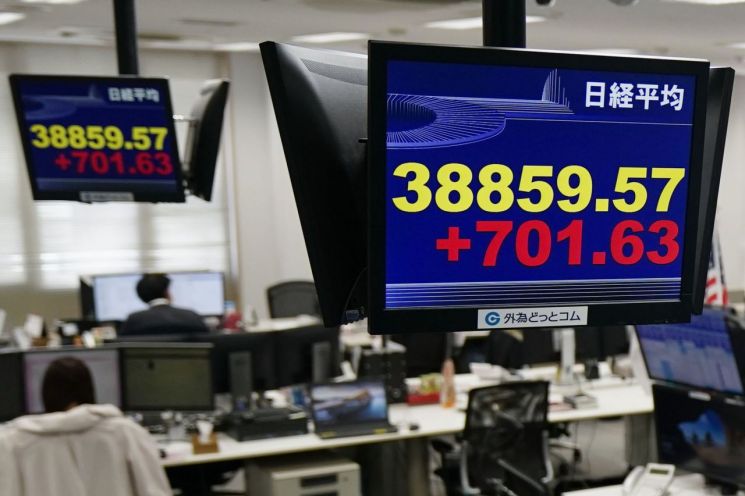
As experts begin to predict new highs for the Nikkei index within the year, it is speculated that the BOJ's dilemma over normalizing its currently ultra-loose monetary policy through interest rate hikes will deepen. If the BOJ, regarded as the largest player in the Japanese stock market, starts realizing profits, it could absorb market liquidity, effectively acting like a tightening policy.
Shingo Ide, chief equity strategist at NLI Research Institute, said, "The scale of ETF assets held by the BOJ is too large to sell off in the market," adding, "Many experts, including the Financial Services Agency, the Prime Minister's Office, and the Ministry of Finance, need to work together to find ways to maximize benefits for the Japanese people."
Last year, the BOJ incorporated ETFs into its holdings three times, but this year it has refrained from additional purchases, hinting that the end of the accommodative monetary policy is near.
Governor Kazuo Ueda stated at a parliamentary session on the 6th, "When the continuous and stable achievement of the current price target becomes visible, we will consider whether to end other measures, including the ETF purchase program."
Deputy Governor Shinichi Uchida also said on the 8th, "If the BOJ's monetary policy stance changes, it is natural to stop ETF purchases," and forecasted, "Even if purchases end and price formation is left entirely to the market, the impact on the market will not be significant." He also mentioned that the disposal of already purchased assets "needs to be carefully reviewed over time."
The market expects the BOJ to end its negative interest rate system by April.
Meanwhile, the Nikkei 225 index closed at 38,487.24 on the 16th, up 329.30 points (0.86%) from the previous session, breaking its highest level in 34 years since the 'bubble economy.' It is now close to the all-time high of 38,915 recorded at the end of 1989.
© The Asia Business Daily(www.asiae.co.kr). All rights reserved.
![Clutching a Stolen Dior Bag, Saying "I Hate Being Poor but Real"... The Grotesque Con of a "Human Knockoff" [Slate]](https://cwcontent.asiae.co.kr/asiaresize/183/2026021902243444107_1771435474.jpg)
















