Separate Punishment Provisions Exist Without Applying the Urban Maintenance Act
The Supreme Court has ruled that even if an executive of a small-scale reconstruction association, established and approved under the Special Act on the Maintenance of Vacant Houses and Small-scale Housing (Small-scale Housing Maintenance Act), borrows funds without the resolution of the general meeting, they cannot be punished by applying the penalty provisions of the Act on the Maintenance and Improvement of Urban Areas and Dwelling Conditions (Urban Maintenance Act).
The reason is that although the Small-scale Housing Maintenance Act adopts the Urban Maintenance Act’s provision that requires borrowing funds to be approved by the general meeting, it does not adopt the Urban Maintenance Act’s penalty provisions that punish executives who borrow funds without such approval, but instead has separate penalty provisions. Therefore, the penalty provisions of the Urban Maintenance Act cannot be applied.
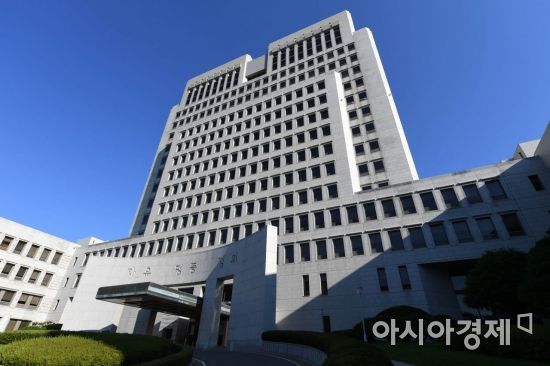
According to the legal community on the 16th, the Supreme Court’s Third Division (Presiding Justice Lee Heung-gu) overturned the lower court’s ruling that had suspended the imposition of a 1 million won fine on Kim, who was indicted for violating the Urban Maintenance Act, and remanded the case to the Gwangju District Court.
Kim, the head of a small-scale reconstruction project association in Buk-gu, Gwangju, was prosecuted for borrowing 39.35 million won from June 2019 to November 2020 without the resolution of the association members’ general meeting.
The first trial acquitted him, but the second trial reversed the decision to guilty and suspended the imposition of a fine.
However, the Supreme Court overturned the second trial court’s ruling, stating that the law was misapplied.
The second trial court applied Article 45(1) of the Urban Maintenance Act, which stipulates that borrowing funds is a matter requiring the general meeting’s resolution, and Article 137 of the same Act, which punishes violations, and found Kim guilty.
Article 45(1)(2) of the Urban Maintenance Act (Resolution of the General Meeting) stipulates that “borrowing funds and the methods, interest rates, and repayment methods thereof” must be approved by the general meeting. Also, Article 137(6) (Penalties) of the same Act punishes “association executives who arbitrarily proceed with projects under each item of paragraph 1 of Article 45 without the resolution of the general meeting” with imprisonment of up to two years or a fine of up to 20 million won.
However, the Small-scale Housing Maintenance Act adopts Article 45(1) of the Urban Maintenance Act but does not include the penalty provision Article 137 of the Urban Maintenance Act in its scope of adoption. Instead, the Small-scale Housing Maintenance Act separately stipulates in Article 61 that executives who arbitrarily proceed with projects without the resolution of the general meeting shall be punished.
In the case of small-scale housing reconstruction projects, the Small-scale Housing Maintenance Act takes precedence over other laws.
The court stated, “The Small-scale Housing Maintenance Act was enacted to contribute to improving the quality of residential life by stipulating necessary matters and special cases to efficiently maintain abandoned vacant houses and activate small-scale housing maintenance, and the Small-scale Housing Maintenance Act takes precedence over other laws regarding small-scale housing reconstruction projects.”
Furthermore, the court said, “In light of this regulatory framework, executives of small-scale reconstruction associations established and approved under the Small-scale Housing Maintenance Act cannot be punished by applying Article 137 of the Urban Maintenance Act,” and added, “The lower court’s ruling that applied Article 137 of the Urban Maintenance Act to the defendant, an executive of the small-scale reconstruction association, and found him guilty, contains errors that affected the judgment by misunderstanding the relationship between the Small-scale Housing Maintenance Act and the Urban Maintenance Act, as well as the legal principles concerning the establishment of the violation of Article 137(6) and Article 45(1)(2) of the Urban Maintenance Act.” This was the reason for overturning and remanding the case.
© The Asia Business Daily(www.asiae.co.kr). All rights reserved.

















