33% Increase Compared to Last Year in the Capital Area
7,383 Cases in Gyeonggi, 7,130 Cases in Seoul, etc.
Actual Deposit Recovery Is Difficult
Reluctance to Bid Due to Deposit Burden
Seoul Villa Auction Success Rate Only 15%
Last month, the number of forced real estate auctions in the Seoul metropolitan area reached an all-time high. As many landlords were unable to return the jeonse deposits due to ‘reverse jeonse’ (a phenomenon where the jeonse market price is lower than the contract price) caused by falling house prices, frustrated tenants handed over their jeonse homes to court auctions. However, experts analyzed that since successful bids are difficult to achieve, the recovery of deposits may become uncertain.
According to the Court Registry Information Plaza on the 16th, the number of valid forced auction initiation registrations in the Seoul metropolitan area (based on collective buildings) in January this year was recorded at 17,954 cases. This is a 33% increase compared to the same period last year (13,467 cases) and 621 cases more than the previous month (17,333 cases). This figure has shown an upward trend for nine consecutive months since April last year (13,765 cases). It surpassed 15,000 cases in August and 16,000 cases in November.
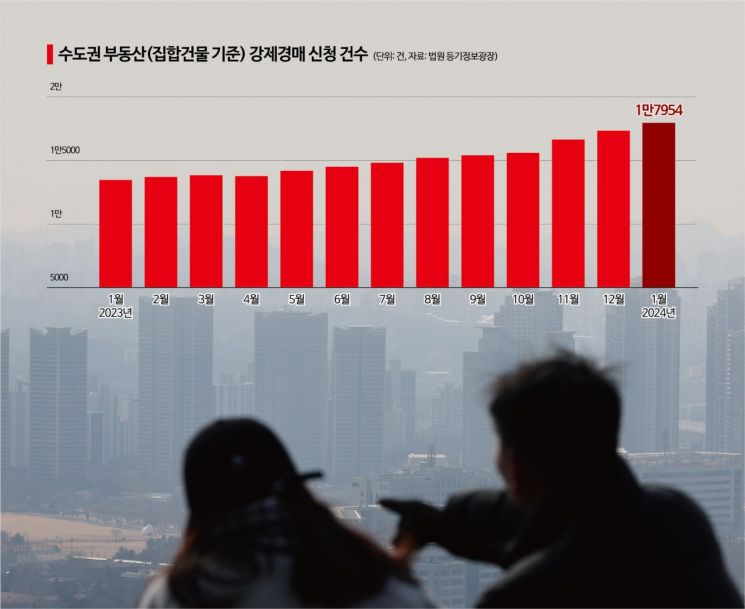
Forced auction refers to the court seizing and forcibly selling real estate when a creditor (tenant) fails to receive the promised amount (jeonse deposit) by the agreed date. Around 2021, when house prices were rising, tenants who secured jeonse at prices higher than the market price at the time of purchase have been unable to recover their deposits due to subsequent price drops and a transaction freeze, leading them to apply for auctions at the court to recover their deposits. Especially after the ‘jeonse fraud’ incident became prominent at the end of 2022, row houses and multi-family houses (villas) have increasingly entered the bidding process since last year. It takes at least six months from the court auction application to the first sale date.
As a result, the Seoul metropolitan area, where the housing price decline was significant, showed the highest number of forced auction applications. Looking at the forced auction application numbers by region last month, Gyeonggi Province had the highest with 7,383 cases, followed by Seoul with 7,130 cases, and Incheon with 3,441 cases. In Seoul, Hwagok-dong, Gangseo-gu had the most with 1,288 cases (17%), followed by Sinwol-dong, Yangcheon-gu (294 cases), Doksan-dong, Geumcheon-gu (270 cases), and Sinjeong-dong, Yangcheon-gu (248 cases). These areas are all densely populated with low-priced villas where large-scale jeonse frauds occurred. In Gyeonggi Province, Bucheon City (1,320 cases), Pyeongtaek City (599 cases), Gwangju City (390 cases), Hwaseong City (378 cases), and Suwon City (336 cases) had many cases.
The problem is that it is not easy for victims of jeonse fraud to recover their deposits. Typically, victims who contracted at jeonse prices higher than the market price tend to choose houses with low loans, making them senior creditors with what is called ‘priority rights.’ In such cases, the appraised value during the auction is often not higher than the market price at the time of the jeonse contract. From the bidder’s perspective, if the winning bid price is lower than the deposit, they must pay additional funds to the tenant to cover the deposit. Because of the deposit burden at the time of bidding, these properties become less attractive to bidders. The sharp decline in villa demand due to the jeonse fraud aftermath is also cited as a factor making successful bids difficult.
According to Gigi Auction, a real estate auction and public sale data specialist company, the auction success rate for row houses and multi-family houses in Seoul last month was 14.9%, sharply down from the 22-41% range before the reverse jeonse phenomenon in 2021. This means only about 1.5 out of 10 villas were successfully auctioned. The winning bid rate also dropped to 78%, nearly 20 percentage points lower than the 83-98% range in 2021. The auction success rates for row houses and multi-family houses in Gyeonggi and Incheon last month were 18.5% and 17.3%, respectively.
Senior researcher Lee Joo-hyun of Gigi Auction explained, "Compared to 2021, when jeonse prices peaked, both jeonse and sale prices have dropped significantly, so ‘empty jeonse’ or jeonse fraud properties continue to increase. Since market recovery is uncertain, the number of auction cases is bound to keep rising for a while."
© The Asia Business Daily(www.asiae.co.kr). All rights reserved.
![Clutching a Stolen Dior Bag, Saying "I Hate Being Poor but Real"... The Grotesque Con of a "Human Knockoff" [Slate]](https://cwcontent.asiae.co.kr/asiaresize/183/2026021902243444107_1771435474.jpg)
















