Democratic Party Origin Lawmaker Yang Jeong-suk Joins
All 5 Incumbent Lawmakers Are from Democratic Party
Most Lee Jun-seok Faction Members Are Non-incumbents
'Anti-Yoon Seok-yeol' Reform Conservative Banner Weakens
As the Reform New Party grows in size, analysis suggests that the share of the Lee Jun-seok faction within the party is rapidly decreasing. It is explained that the existing Lee Jun-seok New Party, which united under the banner of anti-Yoon (anti-Yoon Seok-yeol) and reform conservatism, is shifting its center of gravity toward a centrist-progressive tendency dominated by the Democratic Party faction after the merger.
According to the opposition on the 15th, independent lawmaker Yang Jeong-suk, formerly of the Democratic Party, joined the Reform New Party the day before. With Yang’s joining, the number of incumbent lawmakers in the Reform New Party increased to five. All of these incumbents began their legislative careers in the Democratic Party. Not only lawmakers Kim Jong-min, Jo Eung-cheon, and Lee Won-wook, but also Yang Hyang-ja and Yang Jeong-suk left the Democratic Party to either found a new party or act as independents. Among non-incumbents, former leader Lee Nak-yeon serves as co-chair of the Reform New Party, and former lawmaker Geum Tae-seop holds the position of supreme council member.
From the People Power Party, the core includes co-chair Lee Jun-seok, former lawmaker Heo Eun-ah, supreme council member Lee Gi-in, and Secretary-General Kim Cheol-geun. Although Lee Jun-seok leads the party’s core, most are non-incumbents. Lawmaker Heo, who was elected via proportional representation from the People Power Party, lost her seat after leaving the party and joining the Reform New Party. Currently, there are no incumbent lawmakers from the Lee Jun-seok faction within the party.
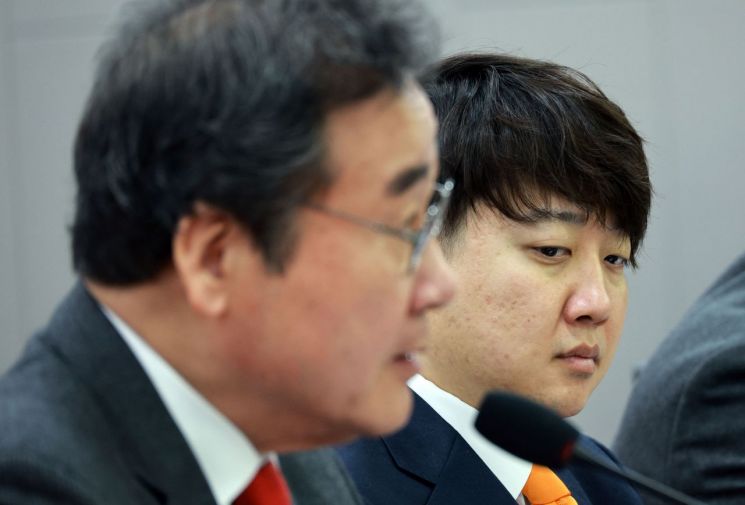
In political circles, it is expected that as the number of Democratic Party-affiliated members increases, the Reform New Party’s centrist-progressive voices will grow stronger. This relatively implies a weakening of the Lee Jun-seok faction. Changes were immediately noticeable in the content of the Reform New Party’s supreme council meeting. The day before, Lee Jun-seok mentioned the idiom yangduguyuk (羊頭狗肉, literally “sheep’s head, dog meat,” meaning “to hang a sheep’s head and sell dog meat”) during the meeting, directing criticism at Han Dong-hoon, the emergency committee chairman of the People Power Party. The dominant analysis is that Lee brought up this four-character idiom again, which he had used during his tenure as People Power Party leader amid conflicts with the presidential office, to rally anti-Yoon unity.
In contrast, lawmaker Jo Eung-cheon and supreme council member Geum Tae-seop focused on criticizing the founding of Cho Kuk’s new party, while lawmaker Kim Jong-min criticized the creation of satellite parties as a trick by the two major parties. With most supreme council members adopting a stance critical of satellite parties, the voice of the Lee Jun-seok faction centered on anti-Yoon has diminished. Co-chair Lee Nak-yeon described the party leadership as “like a rainbow party.” While this meant that diverse voices are emerging within the party, some interpret it as a critique of the lack of a unified voice.
The aftereffects of the merger are also evident in disputes over the party’s symbolic color. New Future Party officials, mainly from the Democratic Party, proposed that the navy blue color, which was the symbolic color before the merger, should be incorporated into the Reform New Party. Heo Eun-ah, chief spokesperson of the Reform New Party, repeatedly affirmed, “The party name remains Reform New Party, and the party color is orange,” but this can be seen as a case where internal leadership conflicts surfaced. A Reform New Party official from the Democratic Party side said, “Orange is the principle party color, but it was mentioned that a modified color could be used flexibly depending on the situation,” cautioning against interpreting this as a leadership competition.
© The Asia Business Daily(www.asiae.co.kr). All rights reserved.
![Clutching a Stolen Dior Bag, Saying "I Hate Being Poor but Real"... The Grotesque Con of a "Human Knockoff" [Slate]](https://cwcontent.asiae.co.kr/asiaresize/183/2026021902243444107_1771435474.jpg)
















