Impact of the Longest Holiday Ever from 10th to 17th
First Holiday After Overcoming COVID-19 Effects, etc.
As the Spring Festival (Chunje, Chinese New Year) holiday continues, tourist attractions across China are struggling with an influx of visitors.
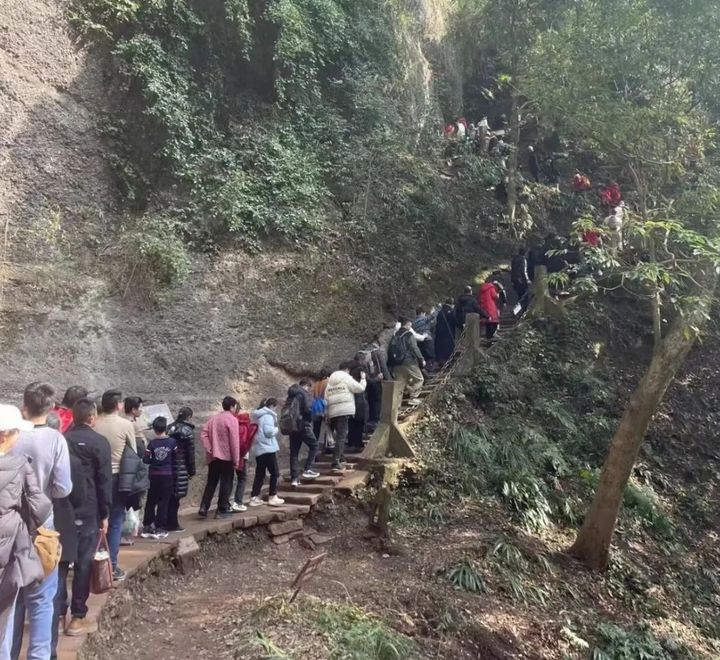 During the Chinese New Year holiday (February 10-17), the largest festival in China, major tourist attractions across the country are crowded with people. The photo shows the Qingcheng Mountain hiking trail in Zhujiangyan, Sichuan Province, filled with tourists on the 11th. [Image source=Weibo capture]
On the 14th, Chinese state media including Xinhua News Agency reported that the Wutaishan Tourist Service Center in Shanxi Province announced via its WeChat (Chinese version of KakaoTalk) account that ticket sales would be suspended from 7 a.m. that day. The reason given for halting ticket sales was that the number of tourists and visiting vehicles had reached saturation. For safety reasons, no more tourists will be admitted.
Wutaishan was designated a UNESCO World Cultural Heritage site in 2009 and is a sacred place of Manjusri Bodhisattva as well as one of the four major Buddhist sacred sites in China. The mountain, composed of five main peaks, hosts a total of 86 tourist attractions including religious facilities such as Xiantong Temple, Tayuan Temple, and Bosaljeong.
Earlier, at 8 a.m. on the 13th, the Putuoshan Tourist Area in Zhejiang Province also suspended ticket reservations. On the same day, Dujiangyan in Sichuan Province, famous for its ancient irrigation system, stopped online ticket sales after reaching 95% reservation capacity, and Huanghelou, a historic pavilion in Wuhan, Hubei Province, also halted ticket sales. The Palace Museum and National Museum in Beijing were nearly fully booked during the Spring Festival period, with only occasional refund tickets becoming available.
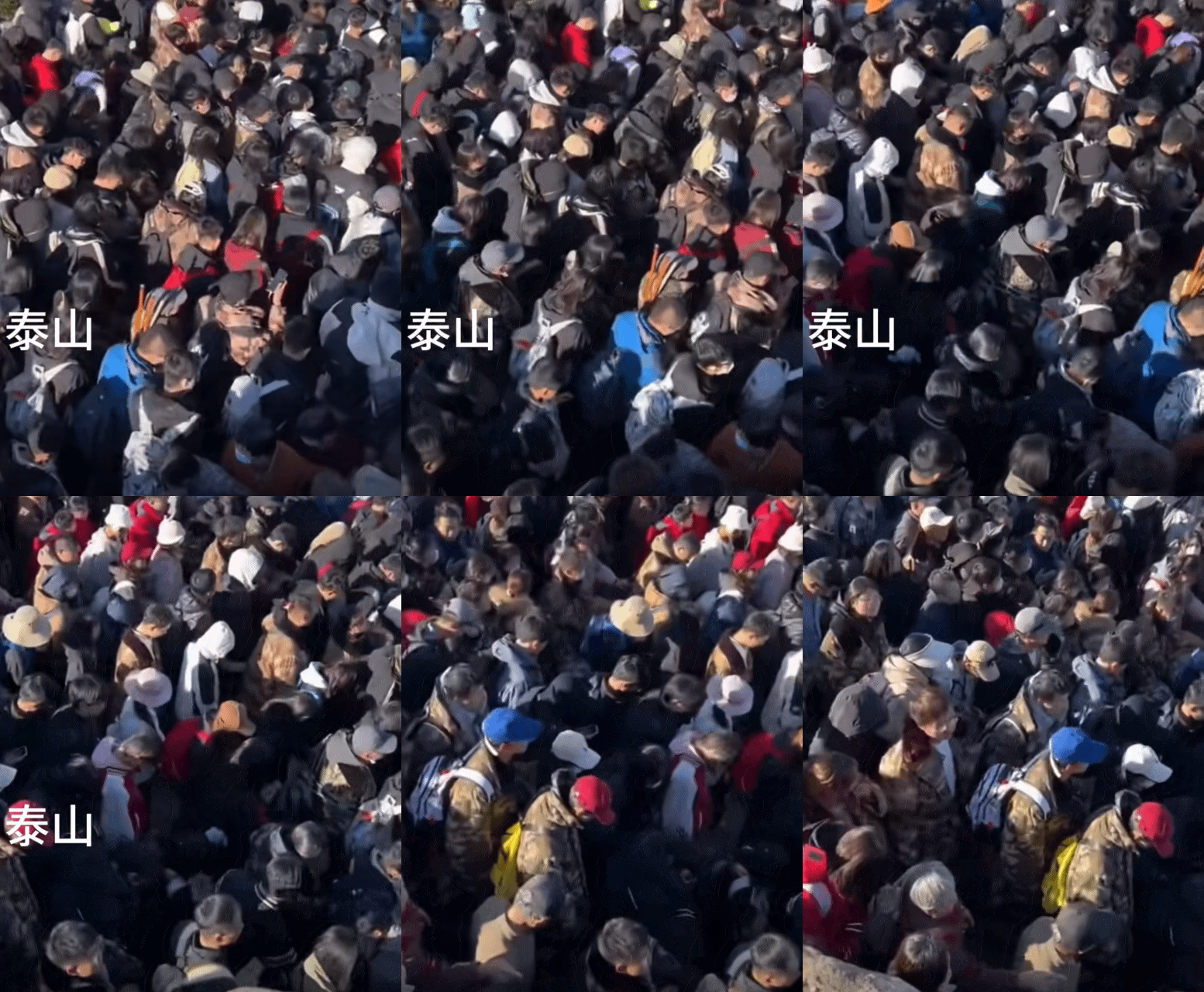 During the Chinese New Year holiday (February 10-17), the largest holiday in China, major tourist attractions across the country are crowded with people. The photo shows tourists visiting Mount Taishan in Shandong Province during the Chinese New Year holiday. [Image source=Weibo capture]
China’s transportation authorities initially estimated that during the 40-day special Spring Festival transportation period called Chunyun (January 26 to March 5), a total of 9 billion trips would be made for returning home and traveling. Since the start of Chunyun until the 13th of this month, the number of visitors to major tourist sites in China reached 123 million, a 22.8% increase compared to the same period last year. The average length of stay also increased from 3.4 hours to 4.2 hours. One notable trend during this holiday is the sharp rise in “1+1” type trips, where people visit their hometowns during the long holiday and then tour domestic tourist destinations.
Chinese people also visited movie theaters during the long holiday. Since the start of the Spring Festival, movie ticket sales surpassed 5 billion tickets as of 11:42 a.m. that day. Chinese films such as "YOLO" (Chinese title: Le La Gun Tang), "Pegasus 2," and the animation "Bear Infestation: Time Reversal" ranked first to third at the box office.
The increase in domestic tourists is attributed to this year’s Spring Festival being the first major Chinese holiday completely free from the impact of COVID-19, and the holiday period lasting eight days (from the 10th to the 17th), the longest in history. Additionally, the Chinese government, struggling with economic slowdown, is encouraging tourism to boost domestic consumption. At the Central Economic Work Conference in December last year, where economic policy directions for this year were decided, President Xi Jinping promised to revitalize the domestic travel sector. The China Tourism Academy (CTA) forecasts that the number of domestic travelers this year will surge from about 4.9 billion last year to over 6 billion, a level similar to that before the pandemic in 2019. Chinese authorities are also working to attract overseas tourists by announcing visa-free policies for about 10 countries in Europe and Asia.
© The Asia Business Daily(www.asiae.co.kr). All rights reserved.
![Clutching a Stolen Dior Bag, Saying "I Hate Being Poor but Real"... The Grotesque Con of a "Human Knockoff" [Slate]](https://cwcontent.asiae.co.kr/asiaresize/183/2026021902243444107_1771435474.jpg)
















