Uiryeong Climate and Clean Environment
Favorable for Insect Diversity Conservation
The Gyeongnam Uiryeong Insect Ecology Learning Center is gaining great popularity among visitors as a place where they can observe disappearing insects through engaging experiences in an era of insect extinction and reflect on the coexistence and symbiosis between humans and non-human life forms.
According to the county on the 14th, since the opening of the Insect Ecology Learning Center in 2016, the cumulative number of visitors surpassed 500,000 as of the 24th of last month. The 500,000th visitor was Kang Mijeong (39, Jinju), who received Uiryeong’s representative local delicacy, Manggae-tteok, and a stag beetle larva raising kit as gifts.
.
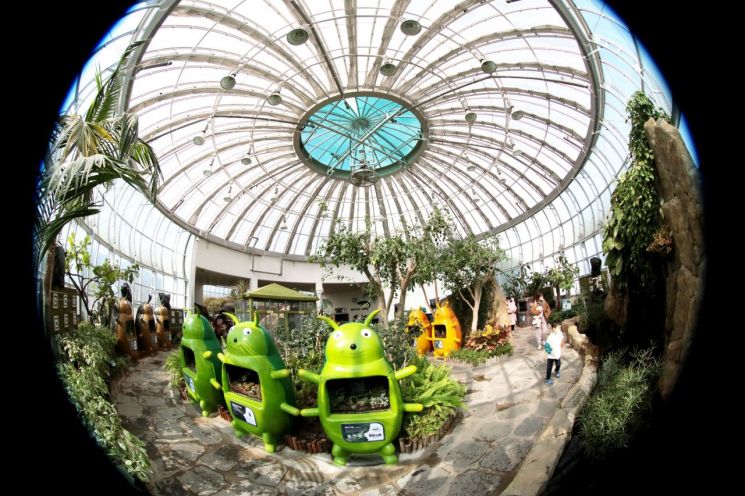
Last year, the Insect Ecology Learning Center was completely transformed into a ‘participatory and play-oriented’ exhibition facility, allowing for a wider variety of experiences, and it is expected to become a representative tourist destination of Uiryeong.
In May 2022, Uiryeong County was selected for the Regional Public Science Museum Capacity Building Project, securing 500 million KRW in project funds to carry out a full remodeling.
County Governor Oh Taewan stated, “We must transform this place into a truly special experience that satisfies both fun and meaning, focusing especially on children as the future generation.”
The county enhanced interest by providing exhibitions with three-dimensional and diverse stories rather than simple flat appreciation, and placed various dynamic experiential facilities at the forefront. Through fascinating facilities such as insect live sketching, hidden insect finding games, insect raising touch screens, and insect climbing, visitors can learn about the ‘life cycle of insects’ while playing.
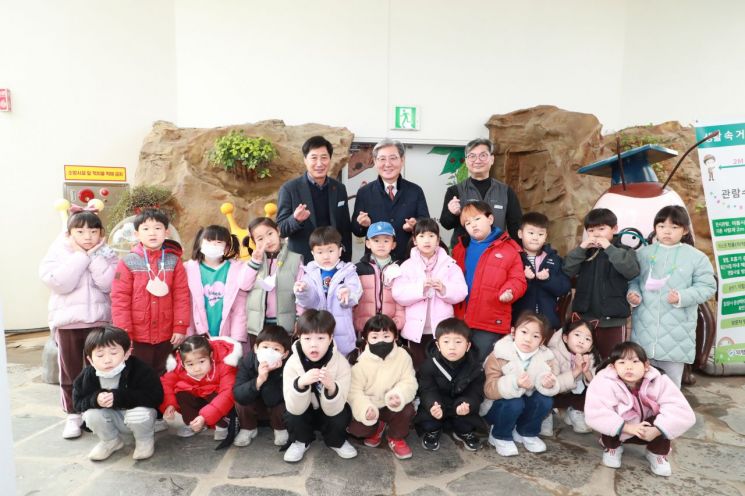 O Tae-wan, Uiryeong County Governor, and children who came for learning. [Image provided by Uiryeong County]
Additionally, experiential events have been diversified to satisfy everyone from young children to middle school students. Insect collecting and specimen making captivate young children’s interest, while insect ecology exploration teams and experiences as ecologists and taxonomists are especially popular among upper elementary and middle school students.
The ecological glass greenhouse where insects inhabit has been perfected with filtration, drainage, and life-support systems considering the ecological environment of the organisms. It has been reorganized into an exhibition space where visitors can directly observe and learn about the habitats of insects through live insect ecological displays in water, grasslands, and underground.
In the ecological glass greenhouse, visitors can see all insects and small animals such as aquatic insects, reptiles, arthropods, meerkats, and birds that inhabit the Earth in one place. Particularly popular among children are the cute and fascinating long-tailed chinchilla, uparupa, antlion, and clown stink bug.
The county is currently planning to expand the ecological greenhouse by doubling its size (864㎡) with completion expected by the end of this year. Furthermore, it plans to expand integrated tourism infrastructure by linking facilities such as the subtropical botanical garden, agricultural culture theme park, and future education center near the Insect Ecology Learning Center, while simultaneously operating educational experience programs.
The newly expanded ecological greenhouse will increase the number of insect specimens to allow observation of insects from different climate zones such as temperate and tropical. This place is expected to provide education that raises awareness of climate change and promotes ecological education to preserve biodiversity.
Meanwhile, the Insect Ecology Learning Center raises awareness of the importance of ‘symbiosis’ by examining insects endangered due to rapid climate change and urbanization. At the entrance, a dinosaur symbol is erected with the phrase “Insects can become extinct like dinosaurs,” giving visitors a moment to reflect. Visitors can learn about endangered insects in South Korea and directly observe endangered species such as water scavenger beetles, two-spotted stag beetles, and longhorn beetles.
On the 7th, ahead of the Lunar New Year holiday, Kim Eunjae (11), who visited with his father from Sacheon City, said, “The insects I saw in the books are very fascinating, but it’s also sad to hear that they might disappear someday,” adding, “It’s pitiful. I hope adults protect them.”
Director Park Jangwoo said, “Thanks to Uiryeong’s clean natural environment, there is a variety of insect food plant gardens. Also, because the temperature difference across the four seasons is not extreme, southern and northern insects come down and coexist with insects found in the central region, showing a unique feature,” and added, “In the long term, education will be conducted not only inside the learning center but also outside. Our goal is to protect insects, ‘humanity’s smallest friends,’ here in Uiryeong.”
© The Asia Business Daily(www.asiae.co.kr). All rights reserved.
![Clutching a Stolen Dior Bag, Saying "I Hate Being Poor but Real"... The Grotesque Con of a "Human Knockoff" [Slate]](https://cwcontent.asiae.co.kr/asiaresize/183/2026021902243444107_1771435474.jpg)
















