Unusual Interest in Political Documentaries at Lunar New Year Theaters
'Geon-guk Jeonjaeng', 'Gilwie Kim Dae-jung' Gain Successive Popularity
Ruling and Opposition Parties Rally Supporters Through Films
As the April 10 parliamentary elections approach, the 'general election war' has spread to popular culture, including films and online video streaming services (OTT). With politically charged films being released one after another, the political sphere is using movies, which easily influence the public, as a foothold to rally their support base. The phenomenon of 'film politics' is so rampant that even content unrelated to politics is being infused with political colors.
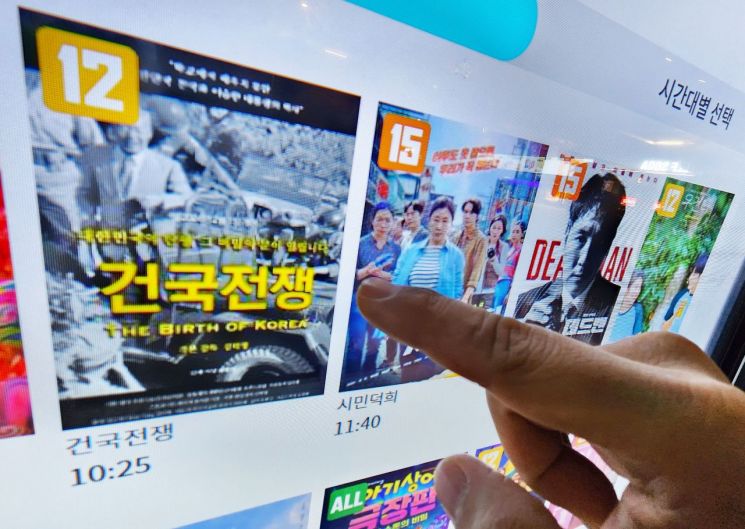
'The Founding War' Quiet Success Amid Ruling Party Support
The documentary film 'The Founding War' (director Kim Deok-young), which sheds light on the life and politics of former President Rhee Syngman, highlights his youthful independence movement, belief in liberal democracy, and achievements such as land reform during his tenure. It is composed of photos and video materials of the former president, interviews with people around him including his daughter-in-law Jo Hye-ja, and experts.
According to the Korea Film Council's integrated box office data as of the 13th, 'The Founding War' attracted 52,217 viewers, ranking second at the box office. This is an achievement that surpassed several commercial films released ahead of the Lunar New Year holiday. Since its release on the 1st, a total of 382,158 people have watched the film. The production cost was between 200 to 300 million KRW. It surpassed the break-even point (BEP) of 200,000 viewers early on the 10th. According to CGV data, the reservation ratio by age group for 'The Founding War' is 50s (45.4%), 40s (26.1%), 30s (19.6%), 20s (8%), and teens (0.9%). The gender ratio shows that women (51.2%) outnumber men (48.8%).
Among recent politically related documentary films, those that made an impact include 'You Are Cho Kuk' (2022, cumulative 330,000 viewers) and 'This Is Moon Jae-in' (2023, cumulative 110,000 viewers). Although the production cost of 'You Are Cho Kuk' was only 400 million KRW, over 1.3 billion KRW was raised through crowdfunding, and the cumulative revenue reached 3.11045 billion KRW. 'This Is Moon Jae-in' was completed with 100 million KRW support from the Jeonju Film Festival's film production support project. Its cumulative revenue was 1.13366 billion KRW.
The political documentary film that attracted the most viewers in history is 'This Is Roh Moo-hyun' (2017), which portrayed the human side of former President Roh Moo-hyun, with a cumulative audience of 1,854,867. Following are 'The Founding War,' 'You Are Cho Kuk,' 'The Collaborators' (2017, 260,000 viewers), and 'Moo-hyun, Two Cities Story' (2016, 190,000 viewers).
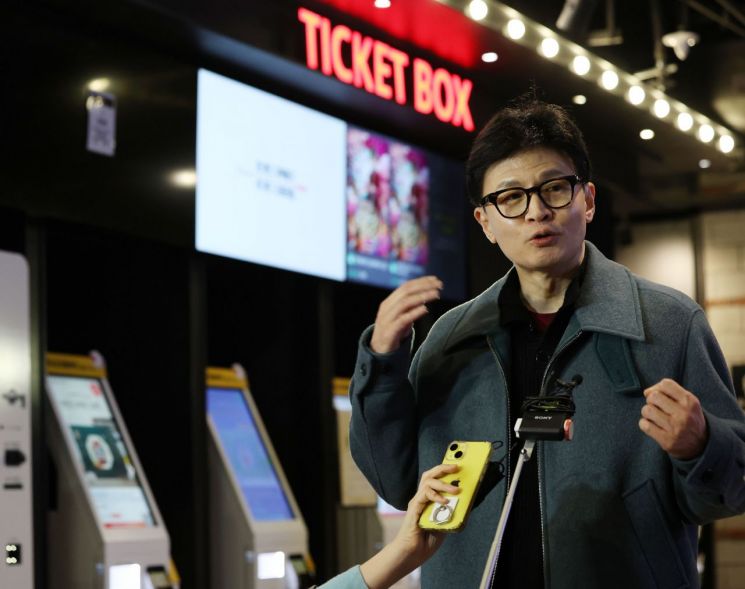 People Power Party Emergency Response Committee Chairman Han Dong-hoon answers reporters' questions after watching the movie 'Geon-guk Jeonjaeng' at a movie theater in Yeouido, Seoul, on the afternoon of the 12th.
 [Photo by Yonhap News]
The success of 'The Founding War' was influenced by ruling party political figures such as Han Dong-hoon, the emergency committee chairman of the People Power Party, who all shared their viewing reviews, drawing attention. The film includes a scene where Chairman Han, as Minister of Justice last July, participated as a speaker at the Korea Chamber of Commerce and Industry Jeju Forum, praising former President Rhee's land reform by saying, "The land reform of the Rhee Syngman government in 1950 was the most decisive moment that brought South Korea to where it is today. It played a crucial role in defending liberal democracy against North Korea's invasion." Recently, after watching the film with emergency committee office staff at a cinema in Yeouido, Seoul, Chairman Han said, "If it weren't for the signing of the Korea-US Mutual Defense Treaty and the land reform, today's South Korea would be very different."
Director Kim Deok-young actively promoted Chairman Han's review on his social media, fueling the film's success. In a lengthy post titled 'Chairman Han Dong-hoon watched the film The Founding War,' he wrote, "Chairman Han's words clearly show where the prosperity and development of today's South Korea began. Including his speech scene was for that reason. I am grateful."
Seoul Mayor Oh Se-hoon, Minister of Culture, Sports and Tourism Yoo In-chon, and other ruling party lawmakers also shared their reviews of 'The Founding War,' encouraging interest. Eventually, even President Yoon Suk-yeol stepped forward. Recently, President Yoon mentioned 'The Founding War' to his aides as "an opportunity to correctly understand history."
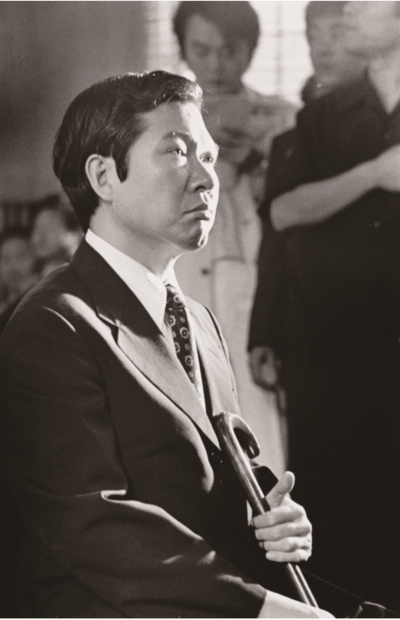
'On the Road with Kim Dae-jung' Gathers Opposition Figures... Long-term Screenings in Provinces and Overseas
The documentary film 'On the Road with Kim Dae-jung' (director Min Hwan-gi), produced to commemorate the 100th anniversary of former President Kim Dae-jung's birth, is also experiencing unusual success. The film depicts the process of Kim Dae-jung, a young entrepreneur, enduring hardships and growing into a politician, culminating in his candidacy for the 1987 presidential election. 'On the Road with Kim Dae-jung' was released on the 10th of last month and attracted 55,000 viewers in its first week. It is rare for a documentary film to gather over 50,000 viewers in its opening week. While 'You Are Cho Kuk' recorded 157,533 viewers and 'This Is Moon Jae-in' 74,721 in their first weeks, considering the fewer events and less buzz, this is a meaningful achievement.
The film has steadily drawn audiences through long-term screenings for over a month, surpassing 122,998 cumulative viewers as of the previous day. The production cost was 500 million KRW, exceeding the break-even point (120,000 viewers). Although the known production cost was 430 million KRW, 7,100 people participated in the first round of crowdfunding conducted by the production company Myung Films before release, raising 426 million KRW. Including the second round of funding, about 500 million KRW was raised, and the break-even point was set accordingly. Special screenings outside theaters, centered on civic groups in places like Iksan, Jeonbuk, and Cheorwon, Gangwon, contributed to this rare success.
The overseas response is also remarkable. An overseas screening committee was formed to continue the momentum through screenings for overseas Koreans. The film was screened overseas starting January 6 in Johannesburg, South Africa, followed by Seattle, Philadelphia, Houston, New York, Orange County in the U.S., Toronto in Canada, and Dalian, Shanghai, Qingdao in China. Originally planned for simultaneous screenings in 30 cities across 15 countries, the number expanded to 37 cities. 'On the Road with Kim Dae-jung' is the first documentary film to hold screenings in three South American countries simultaneously with its domestic release.
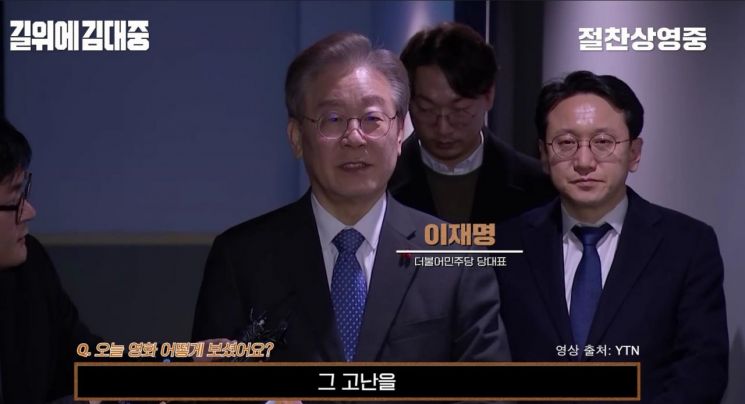 Appearance of Lee Jae-myung, leader of the Democratic Party of Korea, after watching 'Kim Dae-jung on the Road'
 [Photo by IOK Company, Myung Films]
Opposition politicians have rallied. Lee Jae-myung, leader of the Democratic Party of Korea, who watched the film, commented, "It well illuminated the life of a truly great figure in South Korean political history who transformed democracy with his passionate desire." Former President Moon Jae-in watched the film with his wife Kim Jung-sook and about 200 party members from Yangsan Gap and Eul districts of the Democratic Party. Moon said, "The image of former President Kim weeping in front of Kwon Yang-sook on the day of former President Roh Moo-hyun's funeral remains most deeply in my heart." He added, "If former President Kim were alive, he would have lamented the current three major crises of democracy, the livelihood economy, and inter-Korean relations, and earnestly urged us to be a conscience in action." Former Prime Minister Kim Boo-kyum, Gwangju Mayor Kang Ki-jung, and Jeonbuk Governor Kim Kwan-young also watched the film.
Sushi and Sister-in-law... Blatant Satire of Lee Jae-myung?
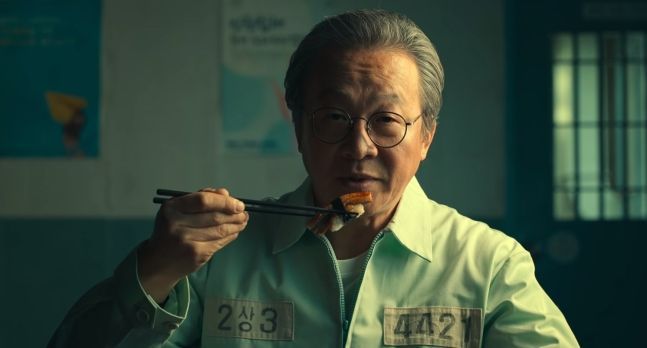
The Netflix series 'The Killer's Shopping List' was released on the first day of the Lunar New Year holiday, the 9th. It is a crime thriller about Lee Tang (Choi Woo-shik), who commits murder impulsively, and detective Jang Nankam (Son Seok-gu) who pursues him. The content is adapted from the webtoon of the same name serialized in 2010-2011. It was directed by Lee Chang-hee, who also directed the film 'Vanishing Night' (2018) and the drama 'Strangers from Hell' (2019).
Immediately after the release of 'The Killer's Shopping List,' online communities were embroiled in controversy over political coloring, with claims that a character resembling Lee Jae-myung, leader of the Democratic Party, appears in episode 7. The character pointed out as a lookalike is Chairman Hyeong Seong-guk, who uses money as a shield to commit various corrupt acts. His appearance, including his hair swept back with white hair and black-rimmed glasses, was said to resemble Lee. Also, his prisoner number 4421 is said to evoke the Daejang-dong scandal linked to Lee. The total sales revenue of Jeil Construction, which reportedly received six apartment blocks in Daejang-dong from Seongnam City, matches 442.1 billion KRW, corresponding to the number 4421. Additionally, some reactions noted that the character 'Hyeong Ji-soo' reminds viewers of the word 'hyung-su' (sister-in-law), related to a series of incidents involving Lee.
There were also claims that the scene where Chairman Hyeong Seong-guk eats sushi in the detention center recalls allegations that Lee's wife paid for sushi with a corporate card. Both the sushi scene and the prisoner number scene are settings not present in the original work. This sparked fierce debates online between supporters of both ruling and opposition parties. Opinions ranged from "Satirizing the opposition leader ahead of the general election is inappropriate" to "Seeing it as intentional direction because of a similar actor is just fitting the pieces." Regarding this, a Netflix representative dismissed the claims as "not true" to Asia Economy.
Director Lee Chang-hee told Asia Economy on the afternoon of the 14th, "I feel wronged and absurd," adding, "I think it is unfair to slyly embed the director's personal views into the drama." Regarding the sushi setting, he explained, "It is just a clich? (a stereotyped dramatic setting). When thinking of a high-end lunchbox a company chairman might eat in detention, sushi was the only option." He also said, "The white hair is the original appearance of the actor (Seung Eui-yeol), not dyed. The black-rimmed glasses are the same. It was just neatly combed back, with no intention."
© The Asia Business Daily(www.asiae.co.kr). All rights reserved.
![Clutching a Stolen Dior Bag, Saying "I Hate Being Poor but Real"... The Grotesque Con of a "Human Knockoff" [Slate]](https://cwcontent.asiae.co.kr/asiaresize/183/2026021902243444107_1771435474.jpg)

















