Government Prepares Customized Support Plans for Advanced Industry Clusters
Supports Saemangeum Secondary Battery, Yongin and Pyeongtaek Semiconductor Complexes
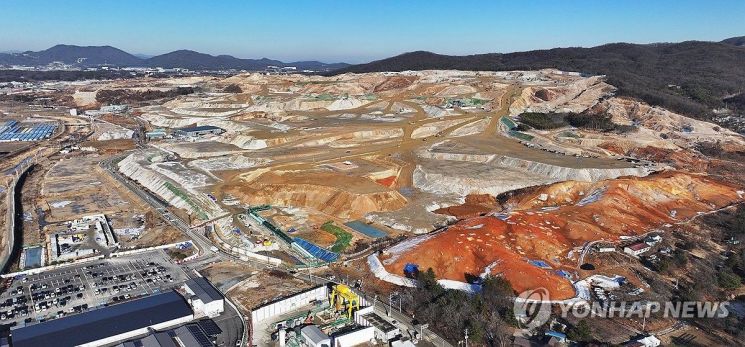 The site of the Yongin Semiconductor Cluster in Wonsam-myeon, Cheoin-gu, Yongin-si, Gyeonggi-do, where construction is underway [Yonhap News archive photo]
Preliminary feasibility studies for the Goheung and Uljin National Advanced Industrial Complexes will be exempted, and the processing speed of feasibility studies for other national advanced industrial complexes will be accelerated by more than three months. Existing regulations that prohibited buildings taller than seven stories in the Daejeon Research and Development Special Zone's 'K-Kendall Square (Advanced Convergence Special Zone)' will also be improved. The ecological area ratio obligation for companies moving into the Saemangeum secondary battery advanced specialized complex will be relaxed, and the transportation network for the Yongin-Pyeongtaek semiconductor advanced specialized complex will be improved.
On the 14th, Choi Sang-mok, Deputy Prime Minister for Economy and Minister of Strategy and Finance, chaired an emergency economic ministers' meeting at the Government Seoul Office to discuss the agenda titled 'Customized Support Measures for Advanced Industry Clusters,' which includes these details.
This agenda is a follow-up measure to the '2024 Economic Policy Direction' announced last month. It aims to provide tailored support according to the progress of each of the 58 advanced industry clusters nationwide, including 15 national advanced industrial complexes, as well as future clusters. For complexes under development, the focus is on early establishment by supporting expedited administrative procedures, while for those already occupied and operating, the goal is to assist in creating an innovative ecosystem.
Among the 15 candidate sites for national advanced industrial complexes, except for the Yongin Advanced System Semiconductor National Complex, which has already been exempted from feasibility studies, the remaining 14 will have their feasibility studies expedited or exemptions pursued. The Goheung Space Launch Vehicle National Complex and Uljin Nuclear Hydrogen National Complex, where corporate demand is deemed sufficient, will be pushed for feasibility study exemptions, and the other complexes will have their current seven-month feasibility study process expedited to within four months. Feasibility studies, usually selected in February, June, and October, will also be selected on an ad hoc basis to further reduce the duration.
In the Research and Development Special Zone, the building coverage ratio and floor area ratio in education, research, and commercialization facility zones within natural green areas will be increased without height restrictions within seven stories. Since the Korea Land and Housing Corporation (LH) participates in 14 of the 15 national advanced industrial complex candidate sites, financial performance related to costs and losses in national complex development will be considered during public institution management evaluations. Kim Seung-tae, Director of the Industrial Economy Division at the Ministry of Strategy and Finance, explained, "This is to support LH so that it does not operate passively in consultations with local governments due to concerns about financial structure deterioration when developing multiple national complexes," adding, "We plan to review comprehensively considering the institution's overall financial situation and fairness with other institutions."
Advanced industry cluster difficulties will also be resolved by region nationwide. For the Yongin-Pyeongtaek semiconductor advanced specialized complex, where site construction is scheduled for 2027, delays in expansion projects are occurring due to increased traffic volume and road congestion. Considering this, a transportation network improvement plan, including adjustments to the highway bus-only lane operation sections, will be prepared within the first half of this year.
In the Chungcheong region, the Cheonan-Asan display specialized complex faces difficulties as display equipment is becoming larger, requiring larger transport vehicles (length 20m, width 5-6m), but these vehicles are restricted under road laws. The government, led by the Ministry of Land, Infrastructure and Transport, will operate a 'one-stop consultation system' for the operation of large equipment transport vehicles and establish simplified submission documents and extended permit period standards by June. To support the creation of K-Kendall Square in the Daejeon Research Special Zone, the development zone land will be changed from green areas to commercial and industrial zones, relaxing the regulation that limited buildings to a maximum of seven stories. This was a promise made by President Yoon Suk-yeol at last year's 'Advanced Industry Global Cluster Strategy Meeting.'
In the Honam region, the Saemangeum secondary battery advanced specialized complex will relax the ecological area ratio standard for industrial land within the secondary battery specialized complex from 10% to 5% within the scope of meeting Ministry of Environment standards to reduce corporate cost burdens. Even with the relaxation to 5%, the overall ecological area ratio of the complex will be 21.8%, meeting the Ministry of Environment's standard of 20%. A 'salinity certification' guideline will be prepared to allow secondary battery companies within the complex to discharge saline wastewater directly into the ocean, presenting concentrations by salinity components and quantifying the toxicity and hazard levels of salinity components.
In the Yeongnam region, the underground pipeline for secondary battery treated water in the Pohang secondary battery advanced specialized complex will be included in the advanced specialized complex infrastructure support targets. For sites with elevation differences, the project implementer LH will first carry out site leveling work to shorten the construction period of secondary battery production facilities by more than six months. The government plans to continuously monitor progress by cluster and promptly receive and address difficulties to support rapid cluster establishment. Director Kim stated, "We will continuously receive and address difficulties of advanced industry clusters going forward."
© The Asia Business Daily(www.asiae.co.kr). All rights reserved.

















