460 Billion NPL Fund Returns 13% with Early Liquidation
New Head Appointed for Infrastructure Division, ESG Theme Fund Promotion
Industry's First Entry into Senior Housing Sector This Month
Alternative investment specialist Aegis Asset Management has recently been gaining attention by delivering consecutive achievements in niche markets. Amid a global downturn in the commercial real estate market that shows no easy signs of recovery, the company is pursuing a strategy to overcome the crisis by pioneering new areas.

460 Billion KRW Non-Performing Loan (NPL) Fund Early Liquidated with Annual Average Return of 13%
Aegis NPL Fund No. 2, which executed investments worth approximately 460 billion KRW after its 2019 subscription, recently confirmed early liquidation ahead of the fund's maturity in May this year. The initial target annual average return was 8%, but the actual internal rate of return exceeded 13%, attracting industry attention.
This is a differentiated achievement, especially as real estate physical and development funds in the industry are struggling. The investor recruitment for the planned Aegis NPL Fund No. 4 is also expected to gain momentum. Led by Team Leader Oh Yoon-seok, Aegis Asset Management’s AI (Alternative Investment) division has been recognized for its expertise, having conducted approximately 1.3 trillion KRW worth of NPL-related investments.
NPL funds primarily invest in non-performing loans that have been overdue for more than three months among financial institutions' loan receivables. The structure involves purchasing distressed loans sold by financial institutions for asset quality management at a discount and then resolving them to generate profits. During economic downturns with abundant supply, these can be acquired at low prices, and during recoveries, they can be disposed of at normalized prices, making this model suitable for the current market conditions.
The fund’s capital strength and ability to select undervalued quality assets are critical to the business model. The domestic NPL market has rapidly grown, with cumulative transaction volume reaching 4 trillion KRW by the end of Q3 last year, nearly doubling the previous year’s total transaction volume.
Newly Appointed Head of Infrastructure Division Accelerates ESG-Themed Blind Fund Initiative
Aegis Asset Management appointed a new head of its infrastructure division earlier this year and is accelerating the formation of blind funds. CEO Oh Tae-seok, who joined Aegis in 2022 after serving in Macquarie Infrastructure and Shinhan Asset Management’s Infrastructure Strategic Investment Office, is leading the division.
Infrastructure investment supports the supply and operation of social overhead capital (SOC), which is essential national infrastructure. It is regarded as more stable in terms of business sustainability compared to general commercial real estate. It has lower investment volatility than traditional real estate assets and benefits from strong institutional support.
Considering institutional investors’ preference for infrastructure investments, the company is preparing to launch an ESG (Environmental, Social, and Governance) themed infrastructure fund.
Last year, Aegis Asset Management secured development rights for fuel cells and energy storage systems (ESS). The company participated in two bids and was designated as the project operator for both, a rare achievement in the domestic asset management industry, although overseas specialized managers have won such rights before.
With uncertainties removed by securing project rights, fundraising for the fund is expected to gain momentum. Aegis plans to start with ESG-themed infrastructure funds and proceed with forming blind funds focused on diverse infrastructure investments.
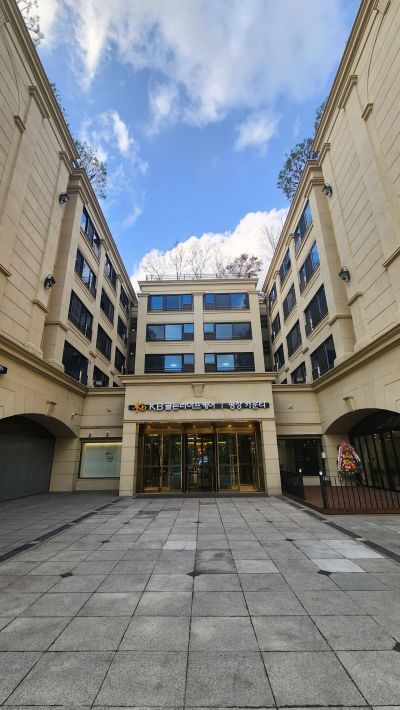 Silver Town 'KB Golden Life Care Pyeongchang County' jointly supplied by KB Golden Life Care and Aegis Asset Management
[Photo by Aegis Asset Management]
First Entry into Senior Housing Industry by Asset Management Sector, ‘3rd Generation Office’ to Debut in Seongsu-dong Next Month
The traditionally strong real estate sector is finding new vitality through fresh themes. A representative example is the silver town supplied last month in Pyeongchang-dong in collaboration with KB Golden Life Care, a subsidiary of KB Life Insurance. It is also the first silver town developed by an asset management company. Besides the Pyeongchang-dong silver town, Aegis Asset Management is pushing forward with plans to develop additional silver towns in two other areas within Seoul.
With South Korea expected to enter a super-aged society by 2026, the need to expand silver town supply is increasing, leading to a positive outlook. An Aegis Asset Management official stated, "Carefully examining demographic and industrial environment changes to find spatial investment ideas where financial capital can be utilized is Aegis’s core competitiveness," adding, "We were also the first asset management company to promote data center establishment in response to the expansion of cloud services across all industries."
'Factorial Seongsu,' scheduled for completion in Q1 this year, is also attracting attention as a new concept in the premium office market. It is an asset developed through collaboration between Hyundai Motor Group, Samsung Electronics, and an asset management company from the outset.
Factorial Seongsu will house Hyundai Motor Group’s 'Robotics Lab,' which gained attention after acquiring Boston Dynamics, providing parking and delivery services for tenant convenience. Samsung Electronics will supply advanced building control management solutions for smart building creation.
Factorial Seongsu is Aegis Asset Management’s first 3rd generation office. The office market has evolved from 1st generation offices (1980s?1990s) with system furniture and personal computers, to 2nd generation offices (2000s?2020s) featuring various workspace types like shared offices and amenity facilities. Recently, IT giants’ smart offices have been classified as 2.5 generation. The 3rd generation office mainly refers to 'Tech Ready Buildings' evolved to suit the working styles of large tech companies.
An Aegis Asset Management official said, "Given the persistent market uncertainties this year, the company plans to focus its capabilities on selecting promising assets and forming funds with greater stability from an investor’s perspective rather than rapid growth, aiming for medium- to long-term success."
© The Asia Business Daily(www.asiae.co.kr). All rights reserved.
![Clutching a Stolen Dior Bag, Saying "I Hate Being Poor but Real"... The Grotesque Con of a "Human Knockoff" [Slate]](https://cwcontent.asiae.co.kr/asiaresize/183/2026021902243444107_1771435474.jpg)
















