Oversupply of Elementary and Secondary Students Until 2035... Teacher Supply Also Restricted
Some Say "Expand Student Interaction, Improve Education Quality"
The trend of low birth rates in China is threatening the job security of 'iron rice bowl' teachers. It is projected that by 2035, there will be 1.9 million 'surplus teachers' if no unexpected changes occur. However, some argue that this should be seen as an opportunity to expand exchanges between teachers and students and improve the quality of education.
On the 13th, Hong Kong's South China Morning Post (SCMP) cited research by Professor Chao Jinzhong's education team at Beijing Normal University, reporting that if current class and lesson sizes are maintained, by 2035 there will be an oversupply of about 1.5 million primary school teachers and 370,000 secondary school teachers compared to demand. The class sizes used as a standard are up to 50 students in urban areas and about 30 in rural areas.
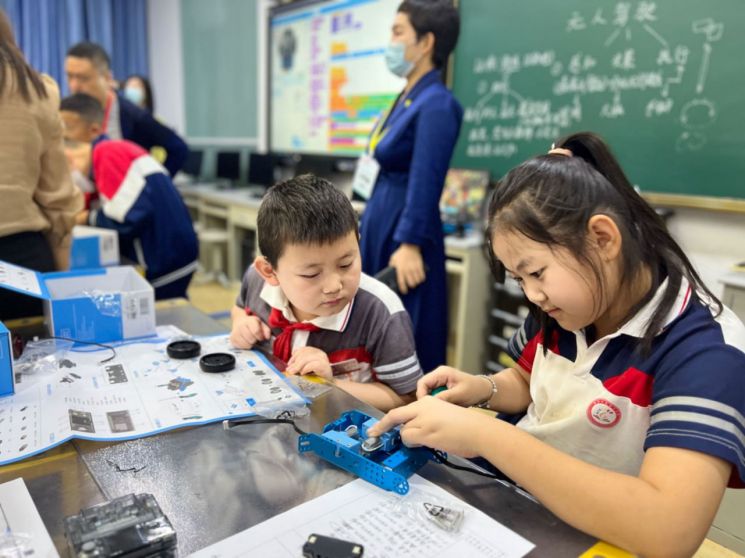 Students are attending a science class at an elementary school in Neimenggu, China. (Photo by Kim Hyunjung)
SCMP explained, "The education sector, considered one of China's 'iron rice bowls,' remains a preferred choice for job seekers in an era of economic uncertainty. However, as the birth rate declines accelerate, teacher oversupply will occur, and millions are expected to lose their jobs within the next decade."
In fact, the number of births in China, which approached 16 million by 2012, has been declining continuously from 2017 through last year. Last year, the number plummeted to around 9 million, marking the lowest level since the founding of the People's Republic of China in 1949.
Chuao Zhahui, a senior researcher at the Chinese National Institute of Education Sciences, stated, "When the number of students decreases, layoffs in certain periods or regions will be inevitable. According to field surveys, due to financial burdens, local governments plan to drastically reduce teacher recruitment this year." SCMP added, "Local authorities are facing increasing financial pressure due to the crisis in the real estate industry, a major source of revenue, and weak demand."
In fact, last year, several local governments, including Shandong and Sichuan provinces, announced plans to stop offering education-related degree programs to suppress the supply of teachers.
Some hold a positive outlook, suggesting that the reduced demand for educational resources will lead to qualitative improvements. Professor Huang Bin of Nanjing University's Education Research Institute said, "Many teachers have relatively low skill levels, especially rural teachers. It is important to promote the improvement of rural teachers' quality through quantitative reduction as soon as possible." He added, "The integration of vocational colleges and comprehensive universities, along with narrowing gaps between them, could help alleviate anxiety over entrance exams."
SCMP further noted, "This is an opportunity for China to improve the quality of education and is crucial for realizing the 'talent dividend' goal, which is expected to provide stronger momentum for economic growth."
© The Asia Business Daily(www.asiae.co.kr). All rights reserved.
![Clutching a Stolen Dior Bag, Saying "I Hate Being Poor but Real"... The Grotesque Con of a "Human Knockoff" [Slate]](https://cwcontent.asiae.co.kr/asiaresize/183/2026021902243444107_1771435474.jpg)















