Capital Region Incumbents, Yeongnam Lee Jun-seok, Honam Lee Nak-yeon
'Base Election Campaign' Strategy Centered on Regional Figures
Acceleration of 'Incumbent Joining' Expected After Lunar New Year Holiday
The third-party new party forces have completed a big tent called the 'Reform New Party.' The new party, which has entered the full-fledged 'grand unification' process, is discussing a 'triangle' strategy as a successful scenario to check the two major parties. The plan is to conduct election campaigns based on strongholds: the metropolitan area centered on incumbents, Daegu and Yeongnam led by co-representative Lee Jun-seok, and Gwangju and Honam centered on co-representative Lee Nak-yeon.
On the first day of the Lunar New Year holiday, the 9th, four new party forces?Reform New Party, Saeroun Mirae (New Future), Saeroun Seontaek (New Choice), and Wonchikgwa Sang-sik (Principles and Common Sense)?announced a 'surprise unification.' Earlier, when lawmakers Lee Won-wook and Cho Eung-cheon defected during the Saeroun Mirae integration process, it seemed to face a split phase, but the atmosphere reversed with the proposal of a 'Unified Nomination Management Committee.' Although there were continued struggles over the party name and leadership system, with only two months left until the general election, it was decided that it could no longer be delayed, and a 'unification merger convention' under the name Reform New Party would be held immediately after the Lunar New Year holiday.
'Leading with the "signboard" for joint election campaigns... "Triangle" strategy
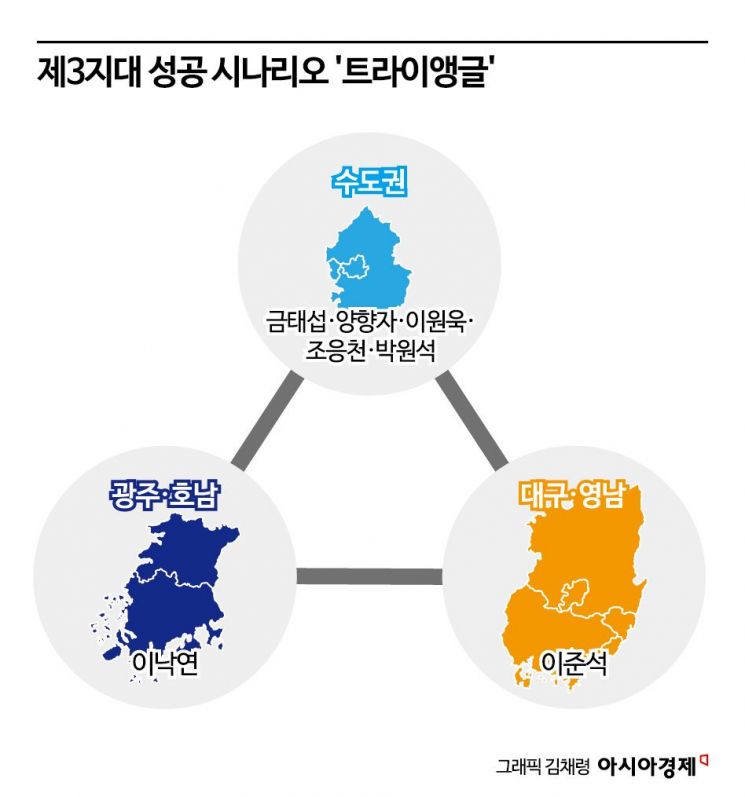
Since forces with different identities have boarded the same ship, there are still hurdles to overcome, including a 'chemical bond,' but the 'unified party' Reform New Party has begun serious consideration of nominations and election campaigns. Even though they have combined forces beyond factions, it is practically difficult to field candidates in all 253 constituencies. Accordingly, the opinion that conducting 'stronghold election campaigns' is the most effective is gaining traction.
The scenario of dividing strongholds for election campaigns is the 'triangle' structure. In the Seoul and Gyeonggi regions, the plan is to form a 'metropolitan belt' centered on Geum Tae-seop, co-representative of Saeroun Seontaek, who declared candidacy in Jongno-gu, Seoul; Yang Hyang-ja, floor leader of the Reform New Party, challenging Yongin-gap, Gyeonggi; and incumbent lawmaker Lee Won-wook in Hwaseong, Gyeonggi. Lawmaker Cho Eung-cheon (Namyangju-gap, Gyeonggi) is also considering moving to Seoul or southern Gyeonggi.
The representative candidate for Yeongnam is Lee Jun-seok, leader of the Reform New Party. Although he has not ruled out running in Nowon-byeong, Seoul, it is known internally that he has settled on running in Daegu. He aspires to bring a new breeze of 'reform conservatism' to the conservative stronghold. The first destination visited by the Reform New Party leadership was Daegu. If Lee runs in Daegu, Dalseo-gu, known as a 'conservative fortress,' or Suseong-gu, called 'Gangnam of Daegu,' are considered likely. His background as a 'Park Geun-hye kid' who entered politics and his image as a highly educated Harvard graduate are seen as favorable factors.
The center of Honam is Lee Nak-yeon, co-representative of Saeroun Mirae. From the preparation process of Saeroun Mirae to the joint founding with the Future Coalition, Lee's schedule has been focused on the Honam region. Although he initially declared he would not run, on the 7th, at the on-site responsibility committee meeting held at the Kim Dae-jung Convention Center in Gwangju, he stated, "If I run, I will prioritize Gwangju." A Saeroun Mirae official said, "With a mindset of giving up everything, he is trying to respond to demands from inside and outside the party," adding, "Running in Gwangju is a matter of staking his political life, but after much deliberation, he made the decision."
The core of the 'triangle' scenario is 'realism.' The judgment is that joint election campaigns focusing on 'possible constituencies' centered on key figures in each stronghold are effective. A key official of a new party emphasized, "The key to the new party's success is to attract the non-affiliated voters rather than the supporters of the two major parties." This is interpreted as meaning they will 'give up' constituencies where the two major parties have solid support. The official added, "Considering nomination screening, proportional representation candidate selection, the joining of incumbents from the two major parties, and the actual election campaign period, we agreed to unify on a grand scale."
New party formed by former ruling and opposition leaders... 'Chemical bond' challenge
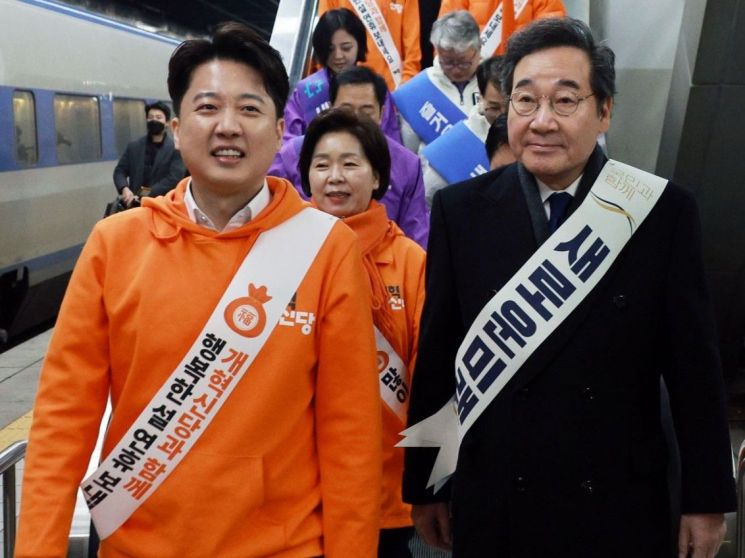 New Future co-representative Lee Nak-yeon and Reform New Party representative Lee Jun-seok are moving to give Lunar New Year greetings at Yongsan Station in Seoul on the morning of the 9th.
 [Image source=Yonhap News]
The 'unified' Reform New Party showcased an unprecedented 'breaking of factions' with former ruling and opposition leaders serving as co-representatives. As voter expectations rise, there are also views that achieving a 'chemical bond' equivalent to a complete merger will not be easy.
The first hurdle is that the ideological orientations and identities of each force differ: the existing Reform New Party (Lee Jun-seok, Yang Hyang-ja) launched from the conservative camp, and Saeroun Mirae (Lee Nak-yeon, Kim Jong-min), Saeroun Seontaek (Geum Tae-seop, Ryu Ho-jeong), and Wonchikgwa Sang-sik (Lee Won-wook, Cho Eung-cheon), which emerged from the opposition camp. Even if the leadership agrees, harmonizing the support bases is a different matter. Continuous friction may occur on the way to the general election.
Whether other forces will agree on the general election pledges announced by Lee Jun-seok is also a point of interest. Since they attracted much attention, some have criticized them as 'divisive,' indicating several sensitive points. However, lawmaker Lee Won-wook emphasized, "There is a difference in the support bases of leaders Lee Jun-seok and Lee Nak-yeon," but added, "We will maximize support through a harmonious leadership of elderly, middle-aged, and youth."
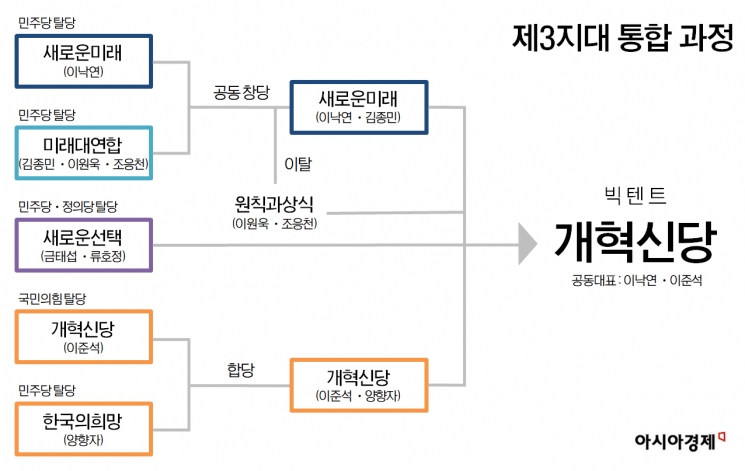
There is also concern about the impact of the last-minute defection of lawmakers Lee Won-wook and Cho Eung-cheon during the formation of the opposition camp's 'middle tent.' If disputes over shares among forces and tensions among the opposition camp intensify, it will inevitably have a negative impact on the general election journey. When the two lawmakers defected from Saeroun Mirae, it is reported that the Future Coalition, their base, felt disappointed. The two lawmakers had played a major role in talent recruitment. From this point, relations with lawmaker Kim Jong-min also deteriorated, and Park Won-seok, Saeroun Mirae's responsible committee member, harshly criticized it as a "second Yoon Young-chan incident."
The most sensitive issue, the 'party name,' is quickly stabilizing thanks to the leadership's decision. After announcing that the unified party's name would be 'Reform New Party,' co-representative Lee Nak-yeon took the forefront to soothe supporters. He said, "Many party members and supporters showed deep attachment to the name 'Saeroun Mirae,' and I also liked that name," but persuaded, "If we spend the Lunar New Year holiday tugging over the party name, the entire new party could sink." He pledged, "Under the banner of 'Reform New Party,' we will unite as one and open a 'new future.'"
Post-Lunar New Year, speed up 'incumbent joining'... 'Number 3' likely to be smooth
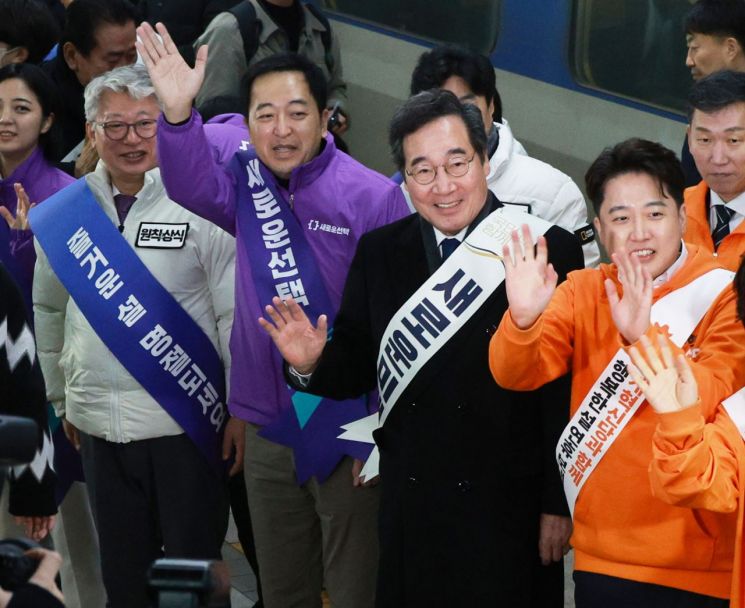 New Future Co-Leader Lee Nak-yeon, Reform New Party Leader Lee Jun-seok, Principle and Common Sense Assemblyman Cho Eung-cheon, and New Choice Co-Leader Geum Tae-seop are greeting Lunar New Year travelers on the morning of the 9th at Yongsan Station in Seoul.
 [Image source=Yonhap News]
Before the merger announcement, on the morning of the 9th, the 'unified' Reform New Party also exchanged Lunar New Year greetings at Yongsan Station in Seoul. It is reported that they have already reached prior agreements on broad policy directions and party charters. Most of the pledges previously proposed by each force are likely to be adopted as 'common pledges.' The judgment is that it is more important to avoid being trapped in conservative-progressive camp logic.
In the Reform New Party-Saeroun Mirae two-party structure, the joining of incumbents, which could have been a trigger for 'division,' is expected to add great momentum to the 'unified' Reform New Party. The 'number 3,' determined by the number of seats in the National Assembly, can symbolize the third-party representative and can be politically utilized due to its order. Currently, it belongs to the 'Green Justice Party,' which holds six incumbents, but with the rapid joining of incumbents, the Reform New Party is expected to take it.
Leader Lee Jun-seok said, "The Reform New Party now has four seats (Yang Hyang-ja, Lee Won-wook, Kim Jong-min, Cho Eung-cheon)," and added, "I am confident it will increase to six or seven seats next week." He continued, "This time, the ruling and opposition parties will not have the capacity to transfer such seats to proportional parties as in the last general election," emphasizing, "There will be no major problem with the Reform New Party appearing as number 3 in both constituency and proportional representation ballots."
© The Asia Business Daily(www.asiae.co.kr). All rights reserved.



















