Recent High-Level Communications Between China and Russia
China and Russia Also Show Willingness to Communicate... Meaningful
Fundamental Change Difficult but Situation Management Needed
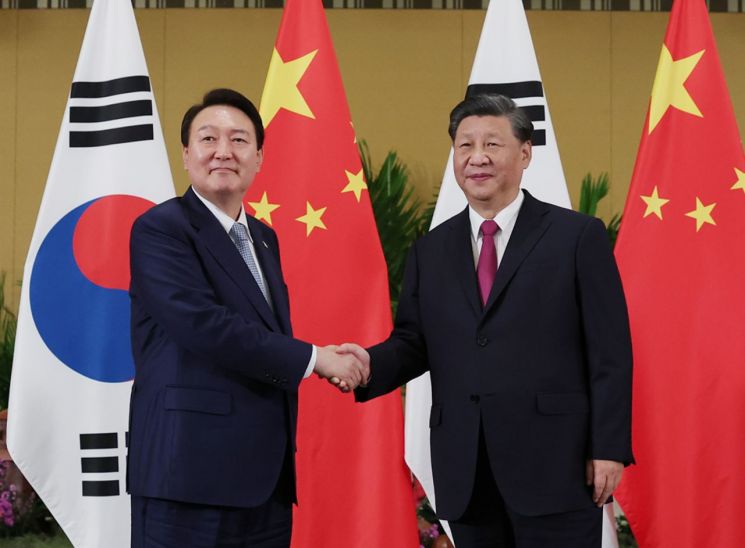 President Yoon Suk-yeol and Chinese President Xi Jinping are shaking hands at the Korea-China summit held at a hotel in Bali, Indonesia, on November 15, 2022 (local time). [Image source=Yonhap News]
Recently, as our government has been communicating consecutively with high-ranking officials from China and Russia, there is growing expectation that the frozen relations between South Korea and China, and South Korea and Russia, may begin to thaw. Although the immediate possibility of breaking the 'South Korea-China-Japan versus North Korea-China-Russia' framework is low, it is analyzed that since China and Russia also need to maintain political and economic relations with South Korea, our government can strategically utilize this situation.
According to diplomatic authorities and experts on the 10th, the recent visit of Andrey Rudenko, Russia’s Deputy Foreign Minister for Asia-Pacific Affairs, and the first phone call between the foreign ministers of South Korea and China are seen as significant. Deputy Minister Rudenko’s visit is the first high-level Russian visit under the Yoon Suk-yeol administration, and he met privately with Jang Ho-jin, the Director of the National Security Office. Meanwhile, Wang Yi, China’s Foreign Minister, showed warmth by inviting Cho Tae-yeol, South Korea’s Foreign Minister, to visit China during their first phone call on the 6th.
Kang Jun-young, a professor at the Graduate School of International Area Studies at Hankuk University of Foreign Studies, explained, "It may be difficult for the tense situation to suddenly improve through this event, but it is not unreasonable to see it as reflecting the will of both governments to maintain communication." A Ministry of Foreign Affairs official also emphasized, "This high-level South Korea-Russia consultation is meaningful in that it allows communication and review of major issues between the two countries," adding, "Russia also visited South Korea for this purpose."
Until now, China and Russia have maintained somewhat hostile or awkward relations with South Korea. In particular, Russia has repeatedly shown a critical stance toward South Korea by openly supporting North Korea in the international community. On the 26th of last month (local time), Russia responded strongly to remarks made by Defense Minister Shin Won-sik, and on the 1st of this month, to statements by President Yoon Suk-yeol, both unusually forcefully. This led to a deterioration in relations to the extent that our government summoned the Russian ambassador.
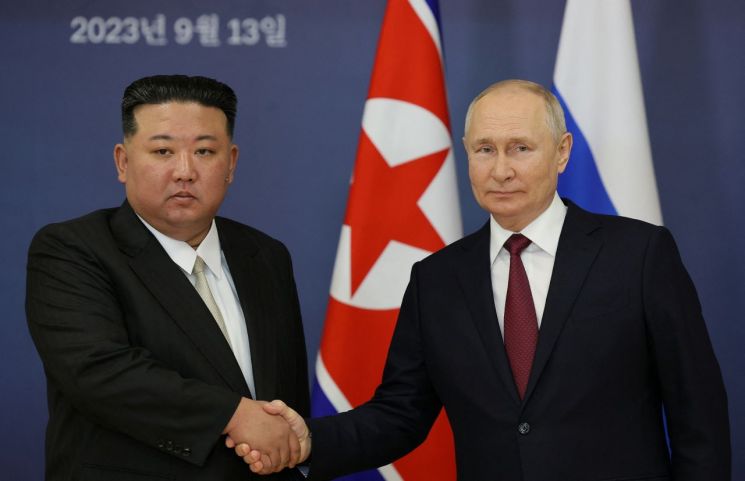 North Korean State Affairs Commission Chairman Kim Jong-un (left) and Russian President Vladimir Putin held a meeting and shook hands at the Vostochny Cosmodrome in Amur Oblast, Russia, on September 13 last year (local time).
 [Image source=Yonhap News]
In this context, Deputy Minister Rudenko’s visit to meet with the Deputy Foreign Minister and the Director of the National Security Office is interpreted as a demonstration of the will to maintain South Korea-Russia relations. Park Won-gon, a professor in the Department of North Korean Studies at Ewha Womans University, explained, "From Russia’s perspective, North Korea is necessary because of the Ukraine war, but in many other respects, South Korea is more important than North Korea," adding, "There may also be a fear that if South Korea truly provides lethal weapons to Ukraine, it could become a game changer on the battlefield."
Although there was a discordant moment during Deputy Minister Rudenko’s visit when a Russian Foreign Ministry spokesperson criticized President Yoon Suk-yeol, this is analyzed as an unexpected incident caused by limitations in Russia’s diplomatic capabilities.
At the New Year’s gathering on the 1st, Wang Yi referred to Japan, with which China has had friction, as a "strategic reciprocal relationship," but did not mention South Korea at all, reflecting the awkward state of South Korea-China relations. However, during the phone call with Minister Cho Tae-yeol, they agreed on achieving qualitative growth in South Korea-China relations and reaffirmed their intention to promote the South Korea-China-Japan summit. Given China’s still weak economy, it is interpreted that China expressed a willingness to communicate as it needs to manage stable relations not only with the United States but also with South Korea.
Of course, the possibility that China or Russia will immediately exert influence to resolve the North Korean issue is low. Unless there is a change in the broader context of U.S.-China and U.S.-Russia conflicts, the South Korea-U.S.-Japan versus North Korea-China-Russia framework will inevitably continue. Professor Kang said, "Fundamental changes will not occur, but if we do not even communicate with China and Russia, speculation will arise and the situation could develop in unexpected directions," adding, "We also need to manage the situation through communication." Professor Park said, "China is very uncomfortable with Russia and North Korea cooperating over Ukraine," and "There may be aspects of that relationship that we can utilize."
© The Asia Business Daily(www.asiae.co.kr). All rights reserved.
![Clutching a Stolen Dior Bag, Saying "I Hate Being Poor but Real"... The Grotesque Con of a "Human Knockoff" [Slate]](https://cwcontent.asiae.co.kr/asiaresize/183/2026021902243444107_1771435474.jpg)
















