Travel Deficit of 16.69 Trillion Won Last Year
Largest Since 2018
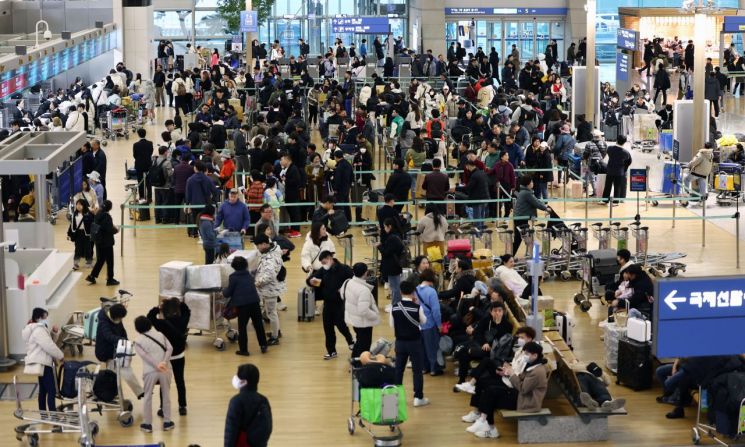 On the morning of the 8th, one day before the Lunar New Year holiday, the departure hall of Terminal 1 at Incheon International Airport is bustling with travelers.
 [Image source=Yonhap News]
Last year, South Korea's travel balance deficit reached its largest scale since 2018.
According to the Bank of Korea on the 9th, South Korea's travel balance deficit last year was $12.527 billion (16.69 trillion KRW), an increase of about 50% compared to $8.369 billion in 2022.
The travel balance refers to the difference between the money spent by domestic residents abroad and the money spent by foreigners domestically. As overseas travel by Koreans has become more active, the travel balance has never recorded a surplus since 1999.
In particular, last year's travel balance deficit was the largest since the pre-COVID year of 2018, when it was $16.565 billion. This is interpreted as Koreans traveling abroad extensively last year.
The number of Koreans who traveled overseas last year was about 22.71 million, the highest since 2019. The country most visited by Koreans was Japan. Last year, 6.96 million Koreans visited Japan, meaning about one in three overseas travelers went to Japan.
Koreans also accounted for the largest proportion of foreign visitors to Japan. Last year, the total number of foreign visitors to Japan was 25.07 million, of which Koreans made up 28%. Following Koreans were visitors from Taiwan (4.2 million), China (2.43 million), Hong Kong (2.11 million), and the United States (2.05 million).
The weaker yen and increased flight routes are cited as reasons for the rise in Korean visits to Japan. In particular, the KRW-JPY exchange rate is at its lowest level since the 2008 global financial crisis. The cheaper yen and close proximity have led to a significant increase in visits by younger generations in their 20s and 30s.
Although about 7 million Koreans visited Japan last year, only about 2.31 million Japanese visited Korea, showing a large gap. This gap is believed to be a major cause of the travel balance deficit.
A growing travel balance deficit also burdens the current account balance. Last year, South Korea's current account surplus was $35.49 billion (47.3 trillion KRW), about $10 billion more than the previous year, but still far below the $85.2 billion recorded in 2021. The larger travel balance deficit amid sluggish exports compared to 2021 also had an impact.
In Japan's case, the current account surplus last year was 20.6295 trillion yen (about 185 trillion KRW), a 92.5% increase from the previous year. This was influenced by increased exports and a significant expansion of the travel balance surplus due to more foreign tourists.
Meanwhile, besides Japan, popular travel destinations for Koreans included Southeast Asian countries such as Vietnam, Thailand, and the Philippines, followed by the United States, Europe, and China.
© The Asia Business Daily(www.asiae.co.kr). All rights reserved.
![Clutching a Stolen Dior Bag, Saying "I Hate Being Poor but Real"... The Grotesque Con of a "Human Knockoff" [Slate]](https://cwcontent.asiae.co.kr/asiaresize/183/2026021902243444107_1771435474.jpg)















