Stores for Ancestral Rite Foods and Ritual Items 'Only Paris'
Long Waiting Lines at Rice Cake Shops, Side Dish Stores, and Jeon Shops
On the 7th, just before the Lunar New Year holiday, Kyungdong Market in Dongdaemun-gu, Seoul was so crowded that one had to walk carefully to avoid bumping shoulders with others at every step. Visitors to the market appeared excited about the upcoming holiday, but the expressions of the market vendors varied. Some shops were frantically busy with long lines of customers, while others showed no sign of the festive atmosphere at all.
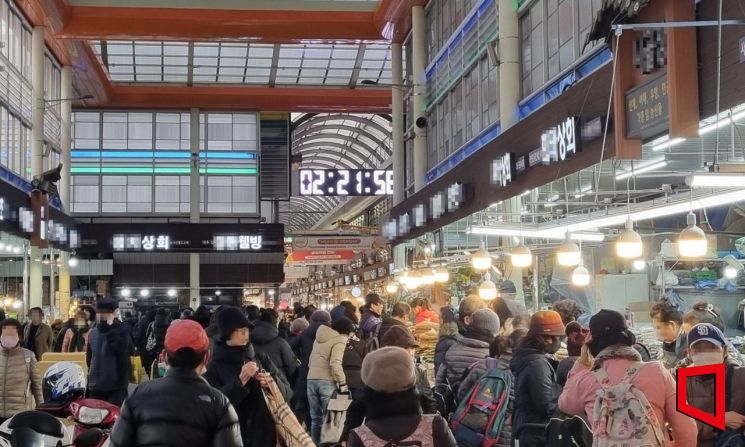 On the 7th, ahead of Seollal, the biggest traditional holiday, Gyeongdong Market in Dongdaemun-gu, Seoul, was bustling with citizens.
 [Photo by Shim Seong-ah]
Most of the quiet shops, described as "so deserted that flies could be seen," were those selling ritual items or traditional holiday foods. Shin (64), who sells Korean traditional sweets called hangwa, sighed, saying, "Although the economy is tough and consumption has shrunk, people like us who sell ritual items are facing an even more serious situation," adding, "It seems that many people no longer hold ancestral rites, perhaps because their mindset is different from ours."
Kim (78), who visited the market, said, "In the past, ancestors and ancestral rites were important, but nowadays many people don't observe them," and added, "People are busy just making a living, and since the rites are costly and complicated, not holding them brings peace to both body and mind." According to the Korea Agro-Fisheries & Food Trade Corporation (aT), the average cost of setting a Lunar New Year ancestral table was 309,641 won, a 0.7% increase from last year's 307,528 won.
The traditional ancestral rites culture associated with the holiday is gradually disappearing. A recent survey conducted by KB Kookmin Card among customer panels showed that only 38% of respondents said they would perform ancestral rites with family or relatives during the Lunar New Year holiday. This figure is lower than the 58% who said they planned to visit or have meals at family or relatives' homes.
Ann Young-joo (63), who has been selling deodeok (Codonopsis lanceolata) at Kyungdong Market for 20 years, said, "Our generation also prefers to dine out with family rather than hold separate ancestral rites during the holidays," adding, "I heard that younger people even go on trips."
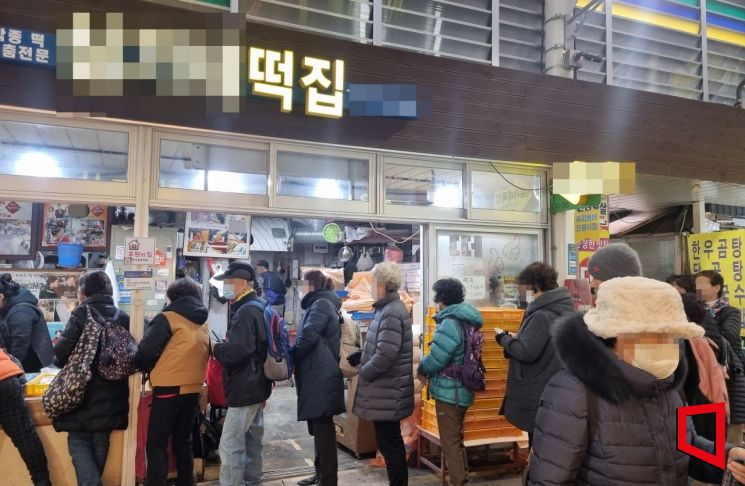 On the 7th, ahead of Seollal, the biggest traditional holiday, citizens lined up in front of a rice cake shop at Gyeongdong Market in Dongdaemun-gu, Seoul, waiting for their turn.
 [Photo by Shim Seong-ah]
Separate from performing ancestral rites, the desire to create a festive holiday atmosphere has not diminished. In front of a rice cake shop in the market that day, there was a line of customers extending around the corner of the alley, with people continuously coming to buy ingredients for tteokguk, the representative dish of Lunar New Year.
Shim (64), an employee at the rice cake shop, said, "We had two to three times more customers than usual," adding, "It seems that the perception that tteokguk must be eaten on Lunar New Year is still strong." According to a survey conducted by KB Kookmin Card's Data Strategy Center, 77% of respondents said they eat tteokguk on Lunar New Year.
Side dish shops selling kimchi, japchae, and namul, as well as shops making jeon (Korean pancakes), were equally busy. They were bustling with people wanting to conveniently prepare holiday foods to share with their families. Jeong, who runs a jeon shop, said, "Even people who don't usually eat jeon come a lot during the holiday season," adding, "Sales definitely increase compared to usual."
In rapidly changing modern society, perceptions of the holiday are also evolving. Kim Eun-joo, director of the Korean Women's Political Research Institute, analyzed, "The holiday is shifting from being centered on ancestral rites to a time for family communication and traveling together to share family love," adding, "While it may seem like past traditions are disappearing, it should be seen as a process of creating new forms of tradition."
© The Asia Business Daily(www.asiae.co.kr). All rights reserved.
![Clutching a Stolen Dior Bag, Saying "I Hate Being Poor but Real"... The Grotesque Con of a "Human Knockoff" [Slate]](https://cwcontent.asiae.co.kr/asiaresize/183/2026021902243444107_1771435474.jpg)
















