Shortage of 56,000 Nurses by 2035
5.25 Clinical Nurses per 1,000 People
Improvement in Nurses' Working Conditions
The government plans to increase the number of nursing college entrants by 1,000 following the 2,000 increase in medical school admissions for the 2025 academic year.
Based on the assessment that there is a shortage of clinical nurses working in medical institutions, the government has been increasing nursing college admissions by 700 students annually since the 2019 academic year. However, as the shortage of clinical nurses persists, discussions on expanding nursing college admissions began last year. Accordingly, the nursing college admission quota for next year is expected to increase from the current 23,883 to 24,883.
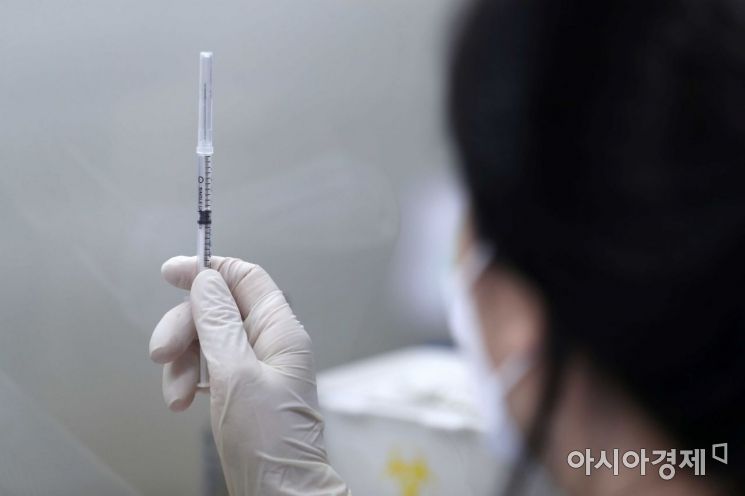 On the 15th, the 'Seoul City No. 1 COVID-19 Vaccination Center' was set up in the main auditorium of Seongdong-gu Office in Seoul. Nurses are demonstrating the vaccine aliquoting process. Photo by Mun Ho-nam munonam@
On the 7th, the Ministry of Health and Welfare announced the plan to expand nursing college admissions for the 2025 academic year.
According to the Ministry, the shortage of nurses is expected to reach 56,000 by 2035. This figure assumes a scenario where the workload intensity of nurses is reduced to 80% of the current level based on mid- to long-term supply and demand projections for nursing personnel.
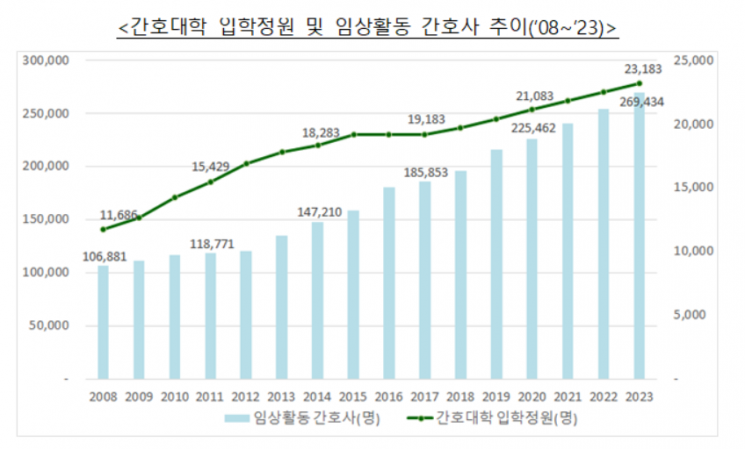
There are approximately 509,000 licensed nurses this year, but only 269,000 (52.9%) are active clinical nurses working in medical institutions. Including nurses employed by national and local government public health officials, 119 fire departments, long-term care facilities, and other health-related organizations, the overall nursing activity rate is 73% (as of 2020). Considering reemployment rates by age group, it is analyzed that only about 40,000 inactive nurses have the potential to return to the medical field.
The government has decided to simultaneously pursue policies to increase nursing college admissions and improve working conditions to prevent nurse attrition, taking into account the current nurse supply difficulties and future supply projections in medical settings.
Accordingly, the nursing college admission quota for the 2025 academic year will increase by 1,000 from 23,883 in 2024 to 24,883.
Until now, nursing college admissions have steadily increased from 11,686 in 2008 to 23,183 in 2023, nearly doubling (1.98 times). The number of clinical nurses working in medical institutions per 1,000 population also increased 2.43 times, from 2.16 to 5.25.
However, this still falls short of the OECD average of 8.4 in 2021.
The government has recognized that clinical nurses working in medical institutions are still insufficient compared to other countries, and that regional imbalances in nurse supply have worsened, necessitating an expansion of nursing personnel. Therefore, since the 2019 academic year, the national nursing college admission quota has been increased by 700 students annually compared to the previous year.

Despite these efforts, the shortage of clinical nurses has not been resolved. Since last year, the Ministry of Health and Welfare, Ministry of Education, Korean Nurses Association, Korean Hospital Association, Korea Patient Organization Federation, and consumer groups have held three 'Nursing Workforce Expert Committee' meetings to discuss the scale of nursing college admission increases. The admission quota for the 2026 academic year will also be discussed and decided at the Nursing Workforce Expert Committee by the end of this year.
In the future, the increased admission quotas will be allocated by the Ministry of Education based on applications from individual universities.
The Ministry of Health and Welfare will also work to improve nurses' working conditions alongside expanding nursing college admissions.
First, the 'Nurse Shift System Improvement Project,' which was scheduled for full expansion in 1 year and 9 months, will be accelerated and fully expanded. As of December last year, 88 medical institutions are participating in this project. Additionally, in the 'Nursing and Care Integrated Service System Improvement Plan' announced in January this year, it was stated that from January 2026, general hospitals with many critically ill patients will be allowed to have one nurse care for five patients per shift, similar to tertiary general hospitals.
Through the newly implemented 'Essential Medical Nurse Training Support Project,' the government plans to support the labor costs of 239 dedicated education nurses at 84 general hospitals to train approximately 8,100 skilled nurses in essential medical fields such as operating rooms and intensive care units.
Furthermore, the government plans to revise the current Medical Service Act Enforcement Rules to switch the national nursing examination to a practical case-based problem-solving format by 2028, enhancing nurses' adaptability to the field. The budget to support the establishment of simulation centers for nursing colleges will also be nearly doubled this year (from 3 billion KRW to 5.8 billion KRW) to improve practical skills training conditions.
Jeon Byeongwang, Director of the Health and Medical Policy Office at the Ministry of Health and Welfare, emphasized, "The government will faithfully implement the 'Comprehensive Nursing Workforce Support Plan' announced last year to improve nurses' working conditions and gradually expand the nursing workforce to alleviate the shortage of nursing personnel in the field."
© The Asia Business Daily(www.asiae.co.kr). All rights reserved.
![Clutching a Stolen Dior Bag, Saying "I Hate Being Poor but Real"... The Grotesque Con of a "Human Knockoff" [Slate]](https://cwcontent.asiae.co.kr/asiaresize/183/2026021902243444107_1771435474.jpg)

















